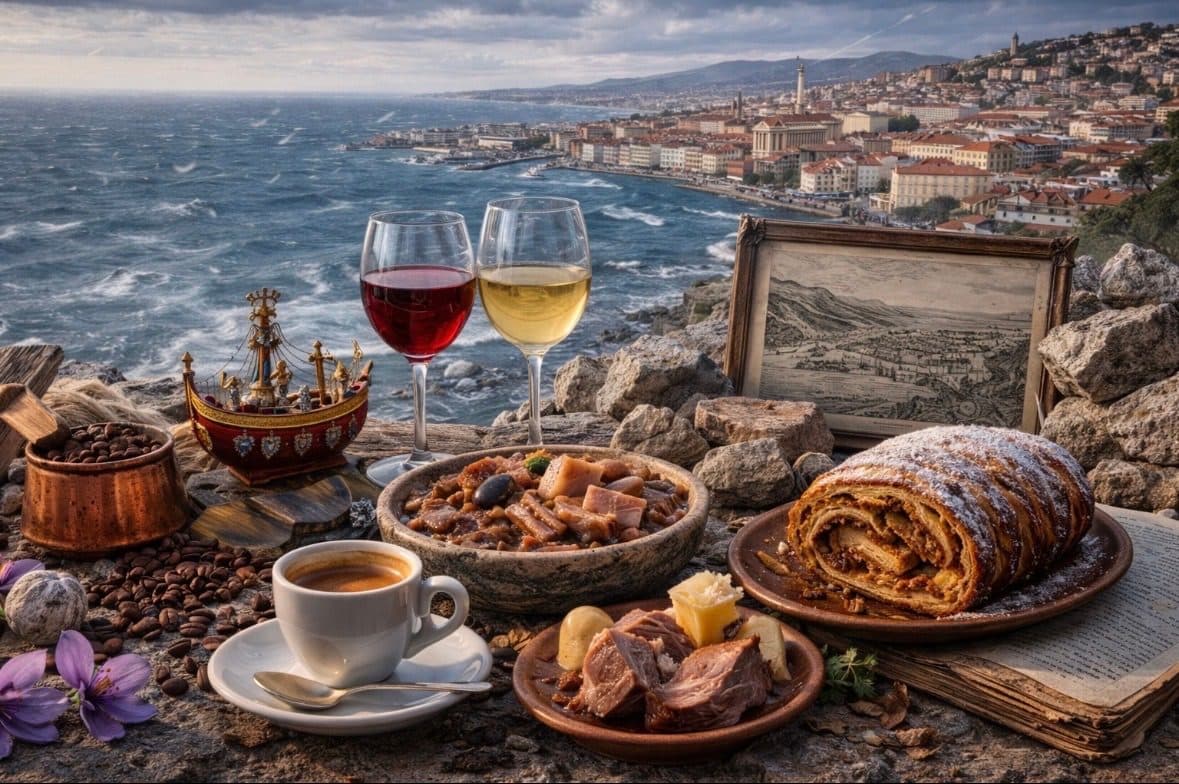
Introduction — The Perspective of the Cultural Gastronome
A cultural gastronome visits a city trying to understand what the local dishes reveal.
They do not look only at flavor, but try to understand: • which ingredients grow in the local territory • which trade routes brought new products • which peoples have influenced the cuisine.
Trieste is a particularly interesting city for this kind of perspective.
For centuries it was the main port of the Habsburg Empire, linking the Mediterranean with Central Europe. In the city you therefore encounter: • Italian cuisine • Slovene traditions • Austrian influences • products from the Karst.
Trieste’s dishes and desserts tell the story of this meeting of cultures.
Trieste and the coffee port
Souvenir: • Trieste coffee
The connection between Trieste and coffee began in 1719, when Emperor Charles VI declared the city a free port of the Habsburg Empire.
This status encouraged the arrival of goods from all over the world, including coffee coming from the ports of the Mediterranean and the Americas.
Over time Trieste became one of Europe’s main centers for the trade and roasting of coffee. Even today, major companies in the sector are headquartered here.
Coffee culture is also visible in everyday language. In Trieste’s bars you don’t simply order an espresso: there is a specific vocabulary, for example: • nero → espresso • capo → espresso with frothed milk • gocciato → espresso with a drop of milk.
These names reflect a long local tradition connected to historic cafés and the social life of the port.
The Karst and wine as an archive of stone
Souvenirs: • wine from the Trieste Karst • Karst prosciutto
Behind Trieste stretches the Karst, a limestone plateau characterized by rocky soil and a cold, dry wind called the bora.
This challenging environment has given rise to very distinctive products.
Wine
Karst winegrowers mainly cultivate two varieties: • Vitovska • Terrano
The vines grow in poor limestone soils, often reclaimed from among the stones. Terrano, in particular, is a very acidic and mineral red wine, closely tied to the agricultural traditions of the Karst.
Prosciutto del Carso DOP
Prosciutto del Carso DOP is cured by taking advantage of the local climate.
The bora wind slowly dries the meat during curing, contributing to the development of its characteristic flavor.
This production method is recognized by the European DOP certification.
Soups and meat: the cuisine of the borderlands
Souvenir: • Trieste-style jota • Trieste-style porzina
Trieste’s cuisine preserves many dishes that are also common in Austria, Slovenia, and Croatia. This comes from the city’s history, as it was part of the Austro-Hungarian Empire until 1918.
Jota
Jota is a hearty soup made with: • sauerkraut or fermented cabbage • beans • potatoes • often pork.
It is a typical dish of the Alpine and Karst regions, where sauerkraut was an effective way to preserve cabbage during the winter.
Porzina
Porzina is boiled pork served with: • kren (grated horseradish) • mustard.
This preparation is also widespread in Austro-Bohemian cuisine and reflects the gastronomic influence of Central Europe.
The sweets of the Empire
Souvenirs: • plum gnocchi • presnitz • putizza
Many Trieste desserts have their origins in the traditions of Central Europe.
Plum gnocchi
Plum gnocchi are potato gnocchi filled with plums, then dressed with butter and toasted breadcrumbs.
Similar dishes exist in Austria and Bohemia, and arrived in Trieste during the Habsburg period.
Presnitz
Presnitz is a rolled pastry filled with: • walnuts • almonds • raisins • spices • rum.
Tradition says the name comes from a prize awarded during a visit by Emperor Francesco Giuseppe in the 19th century.
Putizza
Putizza is another rolled cake common in the Slovenian communities of the Karst. The filling is based on walnuts, honey, raisins, and spices.
The presence of these desserts reflects the meeting of Italian, Slovenian, and Austrian cultures.
Conclusion — What These Dishes Reveal About Trieste
Through these gastronomic souvenirs, three fundamental elements of the city emerge. 1. The international port which brought goods and a culture of coffee. 2. The Karst plateau which influenced wines and cured meats thanks to its climate and the bora wind. 3. The Austro-Hungarian history which introduced soups, boiled meats, and Central European desserts.
These dishes do not exist in Trieste by chance. They were born from the meeting of a Mediterranean port, the Karst landscape, and Central European culture—three elements that have shaped the city’s history for centuries.
Contenu éditorial produit avec l'aide de l'intelligence artificielle et révisé par Trouvenir. Il peut contenir des inexactitudes.
Téléchargement gratuit
Emportez Trouvenir avec vous
iOS et Android. Gratuit.
Respect de la vie privéeSynchronisation multi-appareilsFonctionne hors ligne