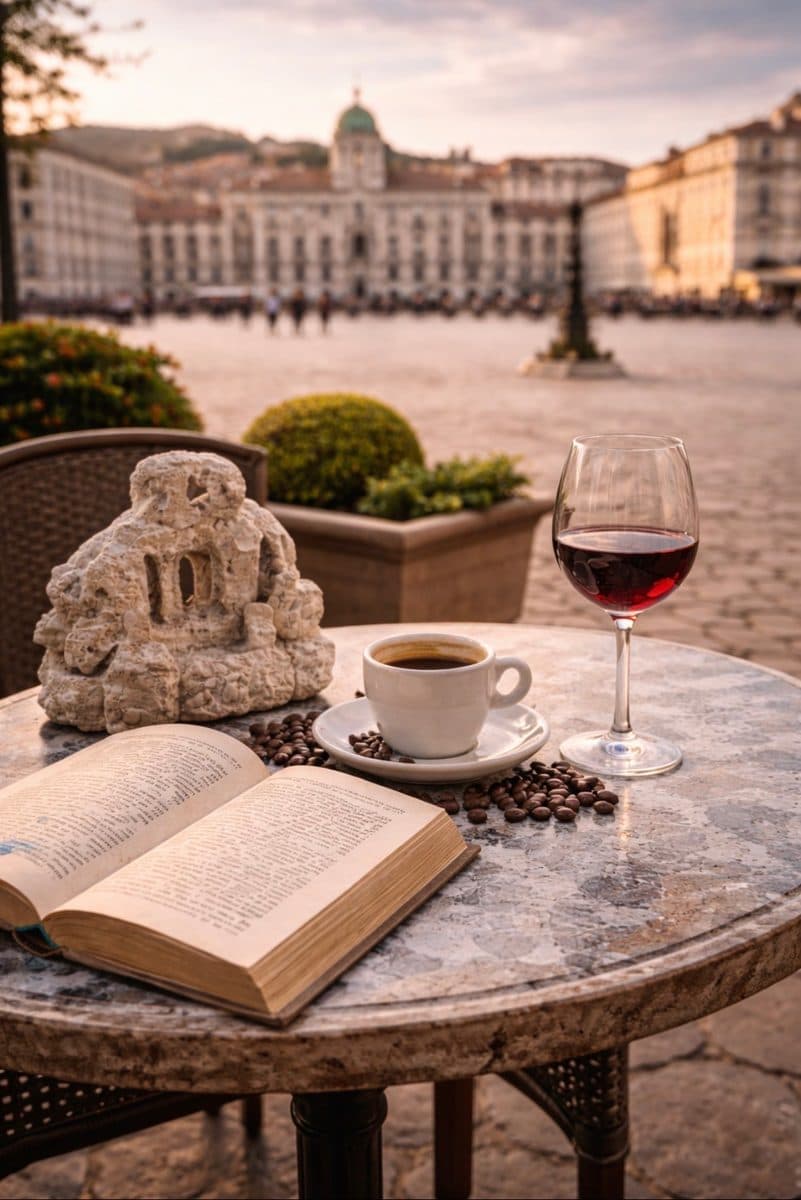
The Everyday Observer’s Gaze
The everyday observer does not look for spectacular monuments or great historical events. Instead, they notice the objects that accompany the daily lives of the people who live here.
In Trieste, these objects tell the story of a unique city: a commercial port of the Austro-Hungarian Empire, a meeting point between the Italian, Slavic, and Central European worlds, and a gateway for goods arriving from the Mediterranean and the rest of the world.
A cup of coffee, a bottle of wine from the Karst, the stone of the houses, or the books of local writers all help reveal how people live—and have lived—in this border city.
The City of Coffee
Souvenir: Trieste coffee in a traditional blend
Trieste is one of Europe’s coffee capitals. This connection began in 1719, when Emperor Charles VI declared Trieste a free port of the Habsburg Empire. The port became a central hub for importing coffee from Latin America and Africa.
In the 19th century, large quantities of green coffee arrived in the city and were then processed by local roasters. Even today, companies founded in Trieste such as Illycaffè continue this tradition.
In Trieste, coffee is not just a drink: it’s part of the daily routine. In the city’s bars, a local vocabulary is used: • nero → espresso • capo → espresso with frothed milk • capo in b → served in a glass
This terminology reflects the influence of Central European culture and the tradition of literary cafés.
Books and the Border City
Souvenir: a book from the Triestine literary tradition
Between the late nineteenth and early twentieth centuries, Trieste developed one of the most important literary traditions in Italy.
Three central figures are: • Italo Svevo, author of La coscienza di Zeno • Umberto Saba, poet and owner of the historic Libreria Antiquaria Saba • James Joyce, who lived in Trieste between 1904 and 1920 and wrote parts of Ulysses here
The city offered a multicultural environment: different languages, international trade, and a dynamic urban bourgeoisie. The city’s cafés became meeting places for writers, teachers, and merchants.
For this reason, many literary souvenirs in Trieste are dedicated precisely to the authors who told the story of the city’s life.
The wine of the Karst
Souvenir: Karst wine
A few kilometers from the center of Trieste lies the Karst, a rocky plateau that stretches between Italy and Slovenia. The soil is made up of highly draining limestone rock, with very little surface earth.
These conditions make agriculture difficult, but they favor certain grape varieties.
Two wines representative of the area are:
Terrano (Terrano del Carso DOC) • red wine made from the Refosco grape variety • known for its acidity and deep color
Vitovska • a white wine typical of the Karst • adapted to the windy climate and limestone soil
The Carso DOC designation protects these wines and their local production.
Karst wine is therefore a souvenir that directly tells the story of the agricultural landscape surrounding the city.
Karst stone in the homes of the city
Souvenir: objects made of Karst stone
The Karst landscape surrounding Trieste is formed by compact limestone rocks that for centuries have been used as a building material.
This stone was quarried in numerous sites across the Karst and can be seen in many historic buildings in the city and in the villages of the plateau.
Its main characteristics are: • resistance to weathering • light color tending toward gray • ease of workmanship
For this reason, today you can find souvenirs and handcrafted objects — such as small decorative pieces or utensils — made from the same material used in local architecture.
These objects allow you to take with you a raw material that defines the city’s landscape.
Conclusion
Looking at Trieste through everyday objects reveals four fundamental elements of the city.
Coffee tells the story of its past as an international commercial port. The books of writers from Trieste show the cultural life of a border city. Karst wine connects Trieste to the agricultural landscape that surrounds it. Karst stone reveals the natural material that built the houses and villages of the region.
Together, these objects explain why Trieste is different from many other Italian cities: a place where commerce, Central European culture, and the Karst landscape meet in everyday life.
Contenu éditorial produit avec l'aide de l'intelligence artificielle et révisé par Trouvenir. Il peut contenir des inexactitudes.
Téléchargement gratuit
Emportez Trouvenir avec vous
iOS et Android. Gratuit.
Respect de la vie privéeSynchronisation multi-appareilsFonctionne hors ligne