Traditions
Rome, a City of Signs
Reading the capital through material symbols, imperial memory, and images that have shaped the myth of Rome
A symbolic Explorer observes the city as a system of concrete signs: objects, materials, images, and rituals that over time have represented identity, power, and collective memory. Rome is one of the places in the world where this symbolic language is most layered. Imperial antiquity, the antiquarian Renaissance, and the global spread of the city’s image have produced objects that are not simple souvenirs: they are small fragments of a shared imagination. In this journey we read Rome through four highly recognizable material symbols — the archaeological cast, travertine, the engraved city view, and sour cherry liqueur — to understand how the city has transformed its history into tangible signs. Each object tells a way in which Rome has been studied, built, represented, or passed down. Following these signs, the city emerges as a place where the past continues to be translated into everyday objects.
Replicating the ancient: the cast as memory of the Empire
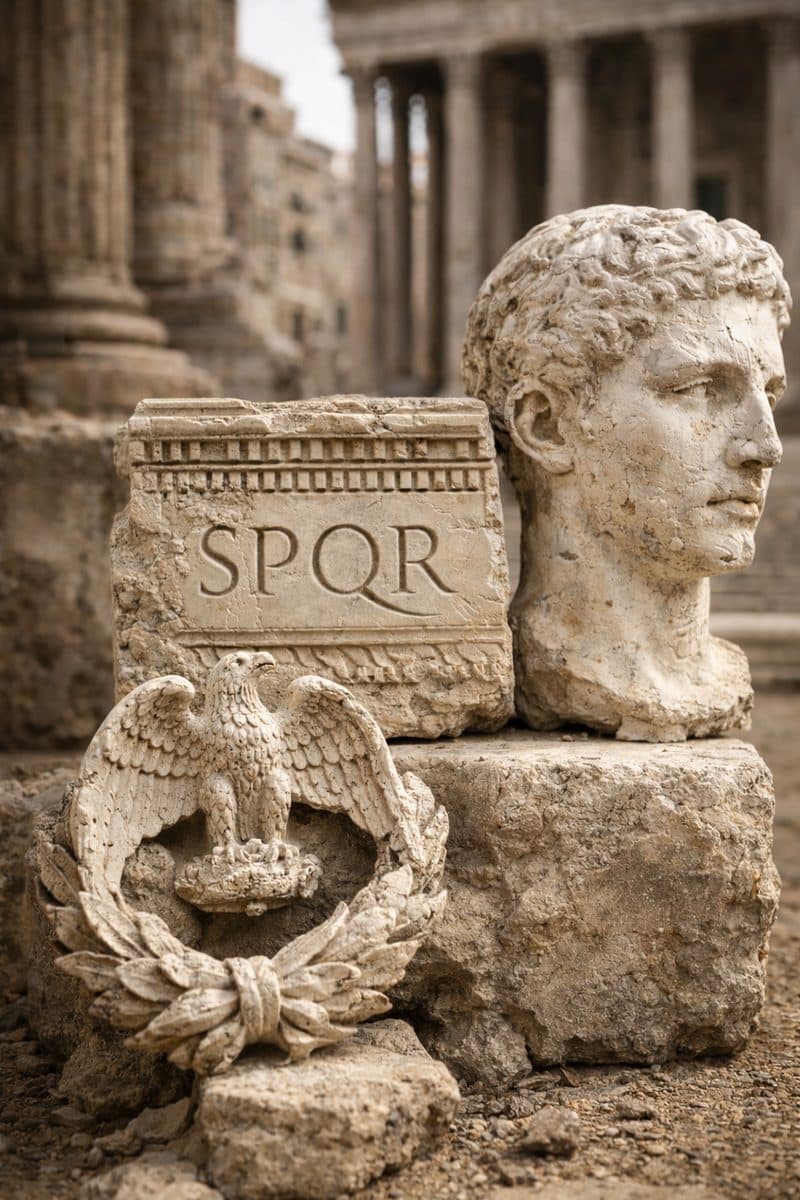
Entering many Roman museums, it is common to see students and artists carefully observing copies of ancient statues. They are not always originals: often they are casts. This practice, now almost invisible to visitors, was for centuries one of the main tools for studying classical art.
From the Renaissance onward, Rome became the European center for copying antiquity. Major sculptures discovered in the city — from the Apollo Belvedere to the Laocoön — attracted artists from across Europe. To study them without moving the originals, plaster casts were produced that faithfully replicated forms and proportions. Academies and ateliers used them to teach drawing, anatomy, and composition.
The small casts found today in the bookshops of Roman museums descend directly from this tradition. They reproduce imperial busts, fragments of statues, or archaeological reliefs and function as miniatures of an educational system that spread the language of classical art throughout Europe.
The symbol is not the copy itself. It is the idea that Rome was the great material source of antiquity: a place where the forms of classical culture were preserved, studied, and replicated for generations.
Chapter sources:
The stone of the Eternal City
Walking among the Colosseum, the Theatre of Marcellus, or many Renaissance façades in the historic center, one quickly notices a shared color: a pale, porous stone that appears almost golden in sunlight. This is travertine, the material that more than any other tells the story of Rome’s physical construction.
This limestone mainly comes from quarries in Tivoli, just a few kilometers from the city. Already in Roman times it was valued for its strength and for how easily it could be worked. Blocks of travertine were used for fundamental monuments of Roman architecture, from the Colosseum to numerous temples and public buildings.
Craft objects made from travertine — small decorative pieces, paperweights, or sculptures — carry with them the same material that built the monumental city. They do not imitate Rome: they literally contain a geological fragment of it.
For this reason travertine is more than a building material. It is a continuous urban sign, a stone that connects imperial antiquity, the Renaissance, and contemporary architecture within one long story.
Chapter sources:
Imagined Rome: the views that created the myth
In the 17th and 18th centuries, thousands of European travelers arrived in Rome for the Grand Tour. They wanted to see the ruins of antiquity, study classical art, and bring home a memory of the city that represented the origin of European civilization.
A true market of images emerged for these visitors. Engravers and artists produced detailed views of monuments: the Colosseum, the Forum, the Pantheon, and the great Baroque squares. Among them, Giovanni Battista Piranesi stands out, whose engravings transformed Roman ruins into monumental and almost theatrical scenes.
These prints were not simple souvenirs. For many Grand Tour travelers they were the main way to remember and recount Rome once they returned home. Through engravings, the image of the ancient city circulated throughout Europe and helped build Rome’s cultural myth.
The prints found today in Roman workshops continue this tradition. Each view is a small heir to that period when Rome was transformed, through printmaking, into a universal symbol of history and grandeur.
Chapter sources:
- Giovanni Battista Piranesi – Encyclopaedia Britannica
- Piranesi and the Roman View – The Metropolitan Museum of Art
The taste of Jewish-Roman memory
In the Roman Ghetto district, some recipes tell a story that stretches back more than two thousand years. One of the oldest Jewish communities in Europe lives here, present in the city since at least the Roman era and the bearer of a very distinctive culinary tradition.
Among the most characteristic ingredients are visciole, small sour cherries with an intense flavor. In Jewish-Roman cuisine they become the stars of desserts such as crostata di visciole, where the fruit retains a pleasantly tart note that contrasts with the pastry and sugar.
The fruit also gives rise to sour cherry liqueur, obtained by macerating the cherries with sugar and alcohol. It is a simple preparation but deeply tied to the territory and to the history of the community that passed it down.
In this case the symbol is not a monument but a cultural memory. Visciole tell how different traditions — Jewish and Roman — have coexisted for centuries within the same urban space, leaving traces even in the city’s flavors.
Chapter sources:
Ruins as identity
In many cities, ruins have disappeared or been absorbed by more recent buildings. In Rome, however, they remain visible and central within the urban space. The Roman Forum, triumphal arches, temples, and columns have for centuries been an everyday presence in the city’s landscape.
From the Middle Ages onward, these remains became objects of study for antiquarians, archaeologists, and artists. Drawing them, engraving them, or reproducing them in plaster became a way to catalogue and understand Roman civilization. Images and casts functioned as tools of observation before becoming collectible objects.
Archaeological prints and small reproductions of statues translate the ruins into portable forms. They allow details, proportions, and monuments to be observed even far from the archaeological sites.
In this way Rome is not only a place filled with ancient remains. It becomes a city that has learned to transform its ruins into shared symbols, capable of traveling the world in the form of images and objects.
Chapter sources:
Closing
Following these symbols means understanding that Rome lives not only in its monuments but in the forms through which its image has been transmitted. The cast spreads antiquity, travertine builds the city’s continuity, engravings transform Rome into a global image, and visciole tell the memory of the communities that have inhabited it. Small objects, yet capable of holding much larger stories. For a symbolic Explorer, Rome appears as a living archive of signs: every material, image, or flavor becomes a gateway into the long cultural construction of the Roman myth.
Sources for the journey:
- Plaster cast
- Musei Capitolini
- Travertine
- Colosseum Archaeological Park – The Colosseum
- Giovanni Battista Piranesi – Encyclopaedia Britannica
- Piranesi and the Roman View – The Metropolitan Museum of Art
- Visciola
- The Jewish community of Rome – Encyclopaedia Britannica
- Roman archaeology – Treccani
- Roman Forum – Encyclopaedia Britannica
Replicating the Ancient: the Cast as Memory of the Empire
Walking into many museums in Rome, it’s common to see students and artists carefully observing copies of ancient statues. They are not always originals: often they are casts. This practice, now almost invisible to visitors, was for centuries one of the main tools for studying classical art.
From the Renaissance onward, Rome became the European center for copying antiquity. The great sculptures discovered in the city — from the Apollo del Belvedere to the Laocoonte — attracted artists from across Europe. To study them without moving the originals, plaster casts were made that faithfully replicated their forms and proportions. Academies and workshops used them to teach drawing, anatomy, and composition.
The small casts found today in the bookshops of Roman museums descend directly from this tradition. They reproduce imperial busts, fragments of statues, or archaeological reliefs and function as miniatures of an educational system that spread the language of classical art throughout Europe.
The symbol is not the copy itself. It is the idea that Rome was the great material source of antiquity: a place where the forms of classicism were preserved, studied, and replicated for generations.
Sources:
The Stone of the Eternal City
Walking past the Colosseum, the Theatre of Marcellus, or many Renaissance façades in the historic center, one detail immediately stands out: a pale, porous stone that turns almost golden in the sunlight. It is travertine, the material that more than any other tells the story of Rome’s physical construction.
This limestone comes mainly from the quarries of Tivoli, just a few kilometers from the city. Already in Roman times it was prized for its durability and for how easily it could be worked. Blocks of travertine were used for some of the most important monuments of Roman architecture, from the Colosseum to numerous temples and public buildings.
Handcrafted objects made from travertine — small decorative pieces, paperweights, or sculptures — carry with them the very same material that built the monumental city. They do not imitate Rome: they literally contain a geological fragment of it.
For this reason, travertine is more than a building material. It is a continuous urban signature, a stone that links imperial antiquity, the Renaissance, and contemporary architecture in one long story.
Sources:
Imagined Rome: the views that created the myth
In the 17th and 18th centuries thousands of European travelers arrived in Rome for the Grand Tour. They wanted to see the ruins of antiquity, study classical art, and bring home a memento of the city that represented the origin of European civilization.
A true market for images emerged for these visitors. Engravers and artists produced detailed views of the monuments: the Colosseum, the Forum, the Pantheon, and the great Baroque squares. Among them, Giovanni Battista Piranesi stands out, whose engravings transform Roman ruins into monumental, almost theatrical scenes.
These prints are not simple souvenirs. For many Grand Tour travelers they are the main way to remember and recount Rome once they return home. Through engravings, the image of the ancient city circulates across Europe and helps build the cultural myth of Rome.
The prints found today in Roman shops continue this tradition. Each view is a small heir to that era when Rome was transformed, through printmaking, into a universal symbol of history and grandeur.
Sources:
The taste of Jewish-Roman memory
In the Ghetto district of Rome, some recipes tell a story more than two thousand years long. One of the oldest Jewish communities in Europe lives here, present in the city since at least Roman times and the protagonist of a highly recognizable culinary tradition.
Among the most characteristic ingredients are visciole, small sour cherries with an intense flavor. In Jewish-Roman cuisine they become the stars of desserts such as crostata di visciole, where the fruit retains a tangy note that contrasts with the pastry and sugar.
The fruit is also used to make visciole liqueur, produced by macerating sour cherries with sugar and alcohol. It is a simple preparation but deeply tied to the territory and to the history of the community that has passed it down.
In this case, the symbol is not a monument but a cultural memory. Visciole tell the story of how different traditions — Jewish and Roman — coexisted for centuries in the same urban space, leaving traces even in the city’s flavors.
Sources:
Ruins as Identity
In many cities, ruins have disappeared or have been absorbed into more recent buildings. In Rome, however, they remain visible and central within the urban landscape. The Roman Forum, the triumphal arches, temples, and columns have been a daily presence in the city’s scenery for centuries.
From the Middle Ages onward, these vestiges became objects of study for antiquarians, archaeologists, and artists. Drawing them, engraving them, or reproducing them in plaster became a way to catalogue and understand Roman civilization. Images and casts functioned as tools of observation even before becoming collectible objects.
Archaeological prints and small reproductions of statues translate ruins into portable forms. They make it possible to observe details, proportions, and monuments even far from the archaeological sites.
In this way, Rome is not only a place filled with ancient remains. It becomes a city that has learned to transform its own ruins into shared symbols, capable of traveling the world in the form of images and objects.
Sources:
Contenu éditorial produit avec l'aide de l'intelligence artificielle et révisé par Trouvenir. Il peut contenir des inexactitudes.
Téléchargement gratuit
Emportez Trouvenir avec vous
iOS et Android. Gratuit.
Respect de la vie privéeSynchronisation multi-appareilsFonctionne hors ligne