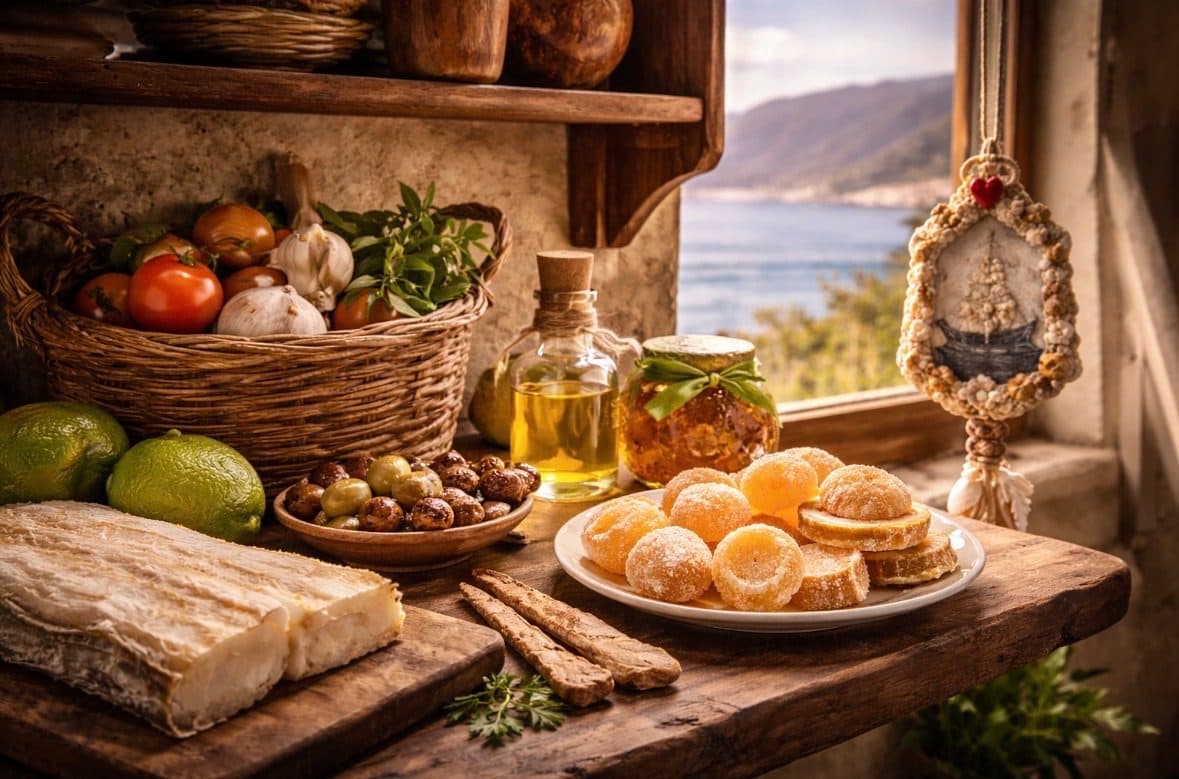
Introduction — The gaze of the Everyday Observer
The Everyday Observer does not look for monuments or major historical events. Instead, they prefer objects that are part of the everyday lives of residents: what people eat, what they use to work, what they keep in their homes or on their boats.
In Reggio Calabria, this kind of perspective helps reveal how the city is connected to three different environments: • the sea of the Strait of Messina • the citrus-growing hills of the Ionian coast • the mountain villages of Aspromonte
The selected souvenirs tell the story of these three dimensions of everyday life.
Stockfish from the North that becomes home cooking
Souvenir: Stocco di Mammola
The stockfish of Mammola is a preparation made with stockfish, that is, dried cod from Northern Europe.
Historically, the fish arrived in Calabrian ports through Mediterranean trade routes that were already widespread in the Middle Ages. The dried product was particularly suited to southern regions because it could be preserved for a long time without refrigeration.
The town of Mammola, in the inland area of Reggio Calabria, gradually developed its own tradition for preparing stockfish. The typical dish is stocco alla mammolese, cooked with: • potatoes • tomato • olives • capers • chili pepper • extra virgin olive oil
The recipe has become central to local home cooking, and every year the town hosts the Sagra dello Stocco.
This food therefore tells the story of an everyday domestic cooking tradition born from the meeting of maritime trade and rural culture.
The fragrance of citrus in the Strait
Souvenir: bergamot confectionery products
Bergamot from Reggio Calabria is a citrus fruit grown almost exclusively along the Ionian coast of Reggio Calabria.
This geographic concentration is due to very specific climatic conditions: • coastal soil • sun exposure • the microclimate of the Strait.
For this reason, the product has obtained the Bergamotto di Reggio Calabria DOP certification.
Traditionally, bergamot was cultivated mainly for its essential oil used in international perfumery, but in local cuisine it has also become popular in pastry making.
Pastry shops in Reggio Calabria produce: • candied peels • marmalades • flavored biscuits • creams and liqueurs.
These sweets are purchased by both residents and visitors and are part of the city’s everyday gastronomic life.
Weaving for Work
Souvenir: basket from the Aspromonte area
In the inland area of Reggio Calabria lies the Aspromonte National Park, a mountainous region where local communities have traditionally developed agricultural and pastoral activities.
To transport agricultural products, firewood, or harvests, people used hand‑woven baskets made with local plant materials such as: • wicker • chestnut branches • wild broom.
Basket weaving was a widespread craft in mountain villages and was often carried out within the family.
These objects tell a very concrete story of everyday life in Aspromonte: work in the fields and forests.
Today the baskets are sold as souvenirs, but the weaving technique comes from tools that were genuinely used in agricultural work.
The Faith of the Strait’s Fishermen
Souvenir: seafaring devotional object
Reggio Calabria is a city deeply connected to the waters of the Strait of Messina, one of the busiest stretches of sea in the Mediterranean since ancient times.
Fishing communities developed specific religious traditions to ask for protection during navigation.
Among the most common objects are: • marine ex-votos (model boats or objects offered to shrines) • images of the Madonna, protector of sailors • small religious items kept on boats.
These practices are documented in the shrines and coastal churches of the Strait and are part of the local maritime culture.
The devotional objects sold as souvenirs therefore derive from a real religious tradition connected to the lives of fishermen.
Conclusion — A city between sea, citrus, and mountains
Looking at these objects through the eyes of the everyday observer, Reggio Calabria appears as a city shaped by three different environments.
The sea of the Strait explains the presence of fishermen’s devotions and the trade that brought stockfish. The Ionian coast tells the story of bergamot cultivation, unique in the world for its geographic concentration. Aspromonte reveals the agricultural and artisanal life of mountain communities.
Food, work tools, and religious objects are not simple souvenirs: they are tangible traces of how the people of this area have cooked, worked, and lived with the sea for centuries.
Contenu éditorial produit avec l'aide de l'intelligence artificielle et révisé par Trouvenir. Il peut contenir des inexactitudes.
Téléchargement gratuit
Emportez Trouvenir avec vous
iOS et Android. Gratuit.
Respect de la vie privéeSynchronisation multi-appareilsFonctionne hors ligne