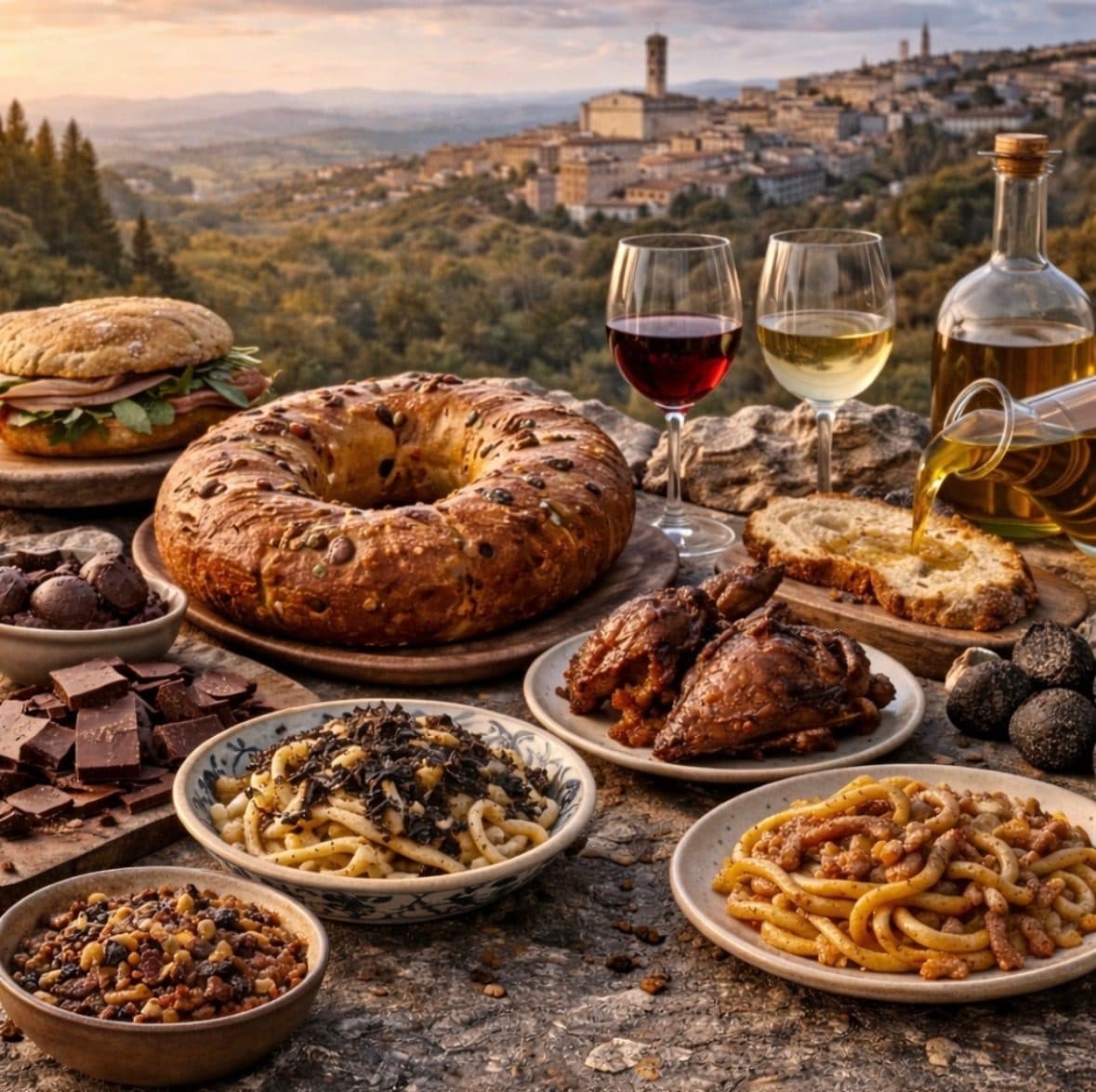
Introduction — The Perspective of the Cultural Gastronomist
A cultural gastronomist explores a city through its dishes, ingredients, and cooking techniques. They do not simply taste: they want to understand where the ingredients come from, who produces them, and why that particular dish was born in that specific place.
Perugia and Umbria offer a very clear example of this relationship between cuisine and landscape. Hills planted with olive trees and vineyards, forests rich in truffles, traditional livestock farming, and a long agricultural history have shaped a cuisine built on simple pasta, roasted meats, bread, and products from the woods.
This journey follows some of the products and dishes that help explain how Perugian cuisine developed between countryside, city life, and religious traditions.
The cocoa that transformed Perugia
Related souvenirs • Artisan chocolate • Perugian chocolate gelato
For centuries, Umbrian cuisine was dominated by local ingredients. Chocolate, however, came from afar: cocoa was introduced to Europe in the 16th century after the colonization of the Americas.
In Perugia its spread took place mainly between the 19th and 20th centuries, when an important local confectionery industry emerged. In 1907 the factory that would become Perugina was founded, helping transform the city into one of Italy’s main centers of chocolate production.
Even today the tradition continues with artisan workshops and with Eurochocolate, the international festival that every year draws visitors and producers from all over the world.
The chocolate gelato found in the city’s gelaterias comes directly from this confectionery tradition: cocoa has become one of the city’s most representative ingredients.
Bread and home cooking in the Umbrian tradition
Related souvenirs • Torta al testo • Torcolo di San Costanzo
Perugian cuisine was largely born in rural homes. Two very different examples tell the story of this world.
Torta al testo is a flatbread cooked on a stone griddle called a testo. This cooking method was common in the Umbrian countryside, where homes often lacked ovens. The bread was filled with cured meats, herbs, or cheeses and represented a simple but nourishing meal.
Very different is the torcolo di San Costanzo, a sweet prepared on January 29, the feast day of Perugia’s patron saint. It is a ring-shaped cake with raisins, pine nuts, and candied fruit that is traditionally eaten during the city’s celebrations. Its ring shape recalls the gesture of offering the cake during local religious festivities.
These two products show how food in Perugia is connected both to the everyday life of families and to the calendar of religious traditions.
Umbrian pasta: local flours and forest ingredients
Related souvenirs • Umbricelli with black truffle • Strangozzi with goose sauce • Farro soup
Umbrian pastas share a common trait: they are made with very few ingredients, often just flour and water.
Umbricelli are a thick handmade pasta, especially widespread in the area of Perugia and central Umbria. They are often dressed with black truffle, an ingredient widely found in the region’s forests.
Strangozzi are a long pasta similar to spaghetti but with a square cross-section. Traditionally they can be paired with robust sauces, such as goose ragù, typical of rural cooking where several kinds of farmyard animals were raised.
Alongside pasta, grains have played a fundamental role. Farro soup recalls a very ancient crop of the Apennines: farro was already widespread in central Italy in Roman times and continued to be used in peasant cooking.
These dishes tell the story of a cuisine based on local agriculture and the gathering of wild forest products.
Meat and products from the Perugian countryside
Related souvenirs • Perugian-style roast pigeon • Lamb coratella • Umbrian black truffle
The cuisine of Perugia also includes many meat dishes closely tied to the region’s agricultural traditions.
Perugian-style roast pigeon is one of the city’s historic dishes. Pigeons were raised in medieval urban centers and in the surrounding countryside, and their meat has remained a typical preparation in local restaurants.
Lamb coratella uses the animal’s offal (liver, heart, and lungs). It is often prepared during the Easter period and reflects a cuisine that uses every part of the animal, following a logic typical of rural farming communities.
Finally, the Umbrian black truffle grows in the wooded hills of the region. Umbria is one of Italy’s main areas for gathering Tuber melanosporum, widely used to season pasta, meat, and eggs.
Olive oil and wine: the agricultural landscape around Perugia
Related souvenirs • Trasimeno DOC wine • Extra virgin olive oil from the Perugian hills
The cuisine of Perugia cannot be separated from the agricultural landscape that surrounds it.
The hills around Lake Trasimeno produce Trasimeno DOC, a designation that highlights local grape varieties and the area’s winemaking traditions.
The olive oil, meanwhile, comes from the olive groves that cover much of the Umbrian hills. Perugia falls within the DOP Umbria area, a certification that guarantees the origin and quality of the extra virgin olive oil produced in the region.
These two products are not just ingredients: they tell the story of the agricultural work that has shaped the territory for centuries.
Conclusion
Through these products, you can read the gastronomic history of Perugia.
Chocolate tells the story of the city’s modern industrial development. Torta al testo flatbread and torcolo cake reflect home cooking and religious celebrations. Handmade pasta and cereal soups mirror the agricultural traditions of Umbria. Meat and truffle come from livestock farming and the resources of the surrounding forests. Finally, wine and olive oil connect the cuisine to the hilly landscape that surrounds the city.
By following these dishes, it becomes clear that Perugian cuisine does not arise from a single tradition, but from the meeting of agriculture, forests, livestock farming, and urban history.
Contenu éditorial produit avec l'aide de l'intelligence artificielle et révisé par Trouvenir. Il peut contenir des inexactitudes.
Téléchargement gratuit
Emportez Trouvenir avec vous
iOS et Android. Gratuit.
Respect de la vie privéeSynchronisation multi-appareilsFonctionne hors ligne