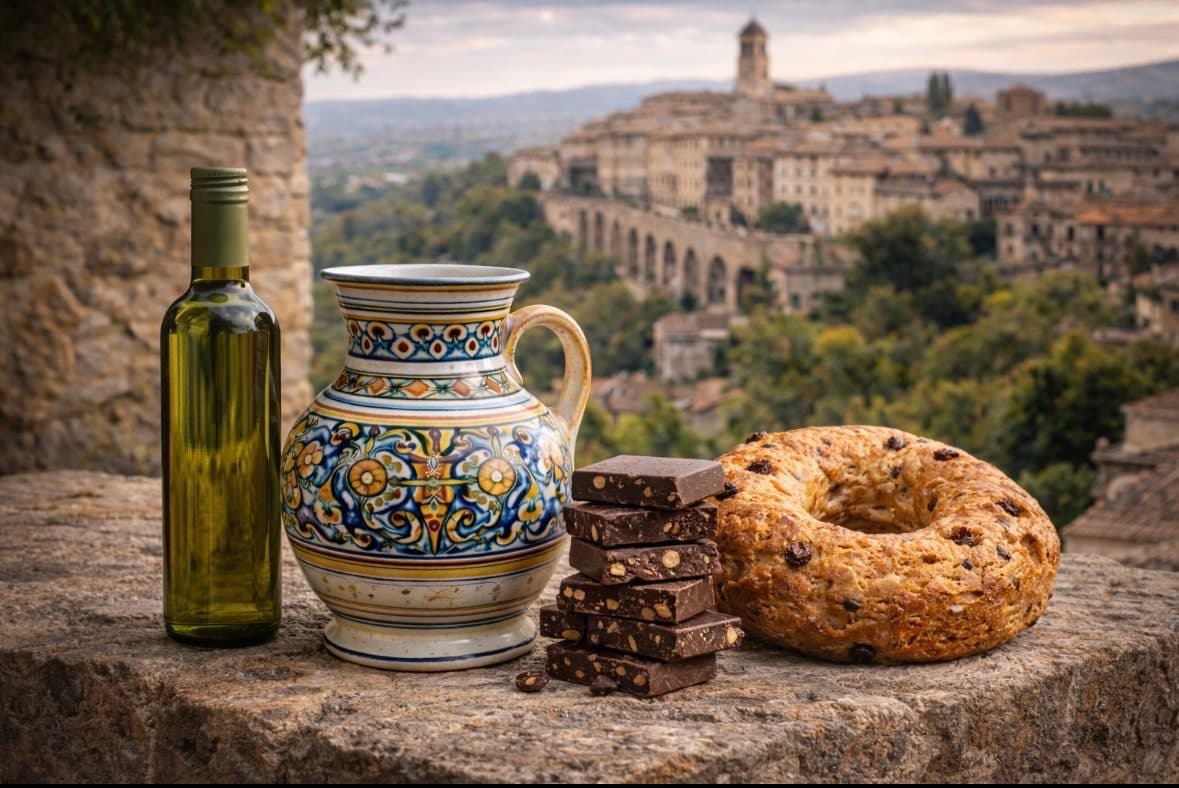
Introduction — Looking at the city through what is used every day
The Daily Observer does not look for spectacular monuments but for concrete objects that are part of the lives of the people who live in the city.
In Perugia, this perspective passes through: • the olive oil that comes from the hills around the city • the ceramic plates used in Umbrian homes • the chocolate that shaped the local industrial history • a cake prepared in families for the patron saint’s feast.
By following these objects, one discovers how agriculture, craftsmanship, the food industry, and domestic traditions still coexist today in everyday life in Perugia.
The Olive Oil of the Hills Around the City
Souvenir: extra virgin olive oil from the hills around Perugia
The hills surrounding Perugia are part of the production area of Umbria DOP olive oil, a designation recognized by the European Union in 1998.
The olive varieties most common in the area are: • Moraiolo • Frantoio • Leccino
The harvest generally takes place between October and November. The olives are quickly taken to local mills, where they are crushed and malaxed before pressing.
This oil is widely used in everyday Umbrian cooking: it is drizzled over legume soups, bruschetta, vegetables, and grilled meat.
Why here? The hilly climate of central Umbria — with strong temperature variations and limestone soils — encourages the production of olive oil particularly rich in polyphenols.
Maiolica plates in domestic life
Souvenir: everyday Umbrian maiolica (Deruta)
About 15 km from Perugia lies Deruta, one of the most important historic centers of Italian ceramics.
The production of maiolica is documented as early as the 14th century. Local artisans use shaped clay that is then coated with a tin-based glaze, which creates the white surface on which the decorations are painted.
Many of the objects produced were not intended for noble palaces but for domestic life: • plates • jugs for wine and water • albarelli jars for storing spices and medicines.
Even today, many workshops continue to produce table ceramics, linking Renaissance craftsmanship with contemporary everyday use.
Why here? Deruta lies in an area rich in clays suitable for ceramics and along ancient trade routes that connected Perugia with Rome and Florence, encouraging the spread of this production.
Chocolate and the city’s industrial history
Souvenir: artisanal chocolate from Perugia
In 1907 the Perugina chocolate factory was founded in Perugia by Luisa Spagnoli and Giovanni Buitoni.
The company introduced new cocoa‑processing techniques and developed products that became famous throughout Italy. The chocolate industry transformed Perugia into one of Italy’s main confectionery centers.
Today the city maintains this connection through: • the Museo Storico Perugina • numerous artisan shops • the international Eurochocolate festival.
Why in Perugia? At the beginning of the 20th century the city was home to innovative food companies and a commercial network linked to the Buitoni family, already active in the pasta sector.
The dessert of the patron saint’s feast
Souvenir: Torcolo di San Costanzo
Torcolo di San Costanzo is a cake prepared in Perugia on January 29, the day dedicated to the city’s patron saint.
The traditional recipe includes:
Main ingredients • flour • sugar • yeast • raisins • pine nuts • candied fruit • anise seeds.
The dough is shaped into a ring, which according to tradition resembles a crown.
The cake is prepared in homes and local pastry shops during the city’s celebration. It is a family tradition linked to the religious festivities dedicated to Bishop Costanzo, martyred in the 3rd century.
Why in Perugia? The cake is connected to the feast of the local patron saint and therefore to the city’s religious history.
Conclusion — The city seen through what people use every day
By following four simple objects, you can discover a tangible side of life in Perugia. • olive oil tells the story of the agricultural landscape of the Umbrian hills • Deruta maiolica reveals a craft tradition that is still alive today • chocolate recalls the city’s industrial history in the twentieth century • torcolo di San Costanzo preserves a domestic tradition linked to the religious calendar.
These objects are not just souvenirs: they are elements of everyday life in Perugia, still produced and used today in the very territory that gave rise to them.
Contenu éditorial produit avec l'aide de l'intelligence artificielle et révisé par Trouvenir. Il peut contenir des inexactitudes.
Téléchargement gratuit
Emportez Trouvenir avec vous
iOS et Android. Gratuit.
Respect de la vie privéeSynchronisation multi-appareilsFonctionne hors ligne