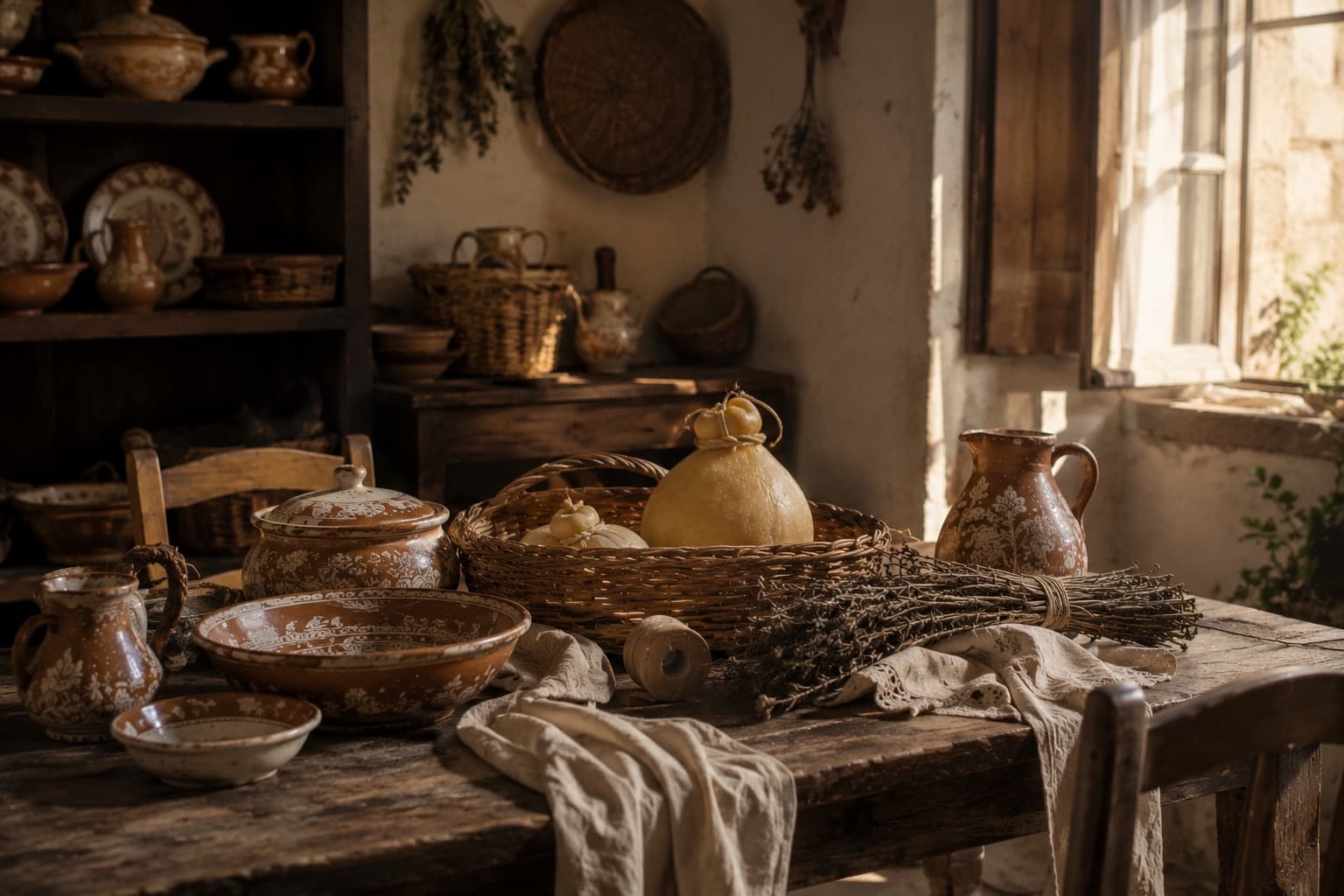
Traditions
The homes where time stays lit
Between slow kitchens, lively tables, and gestures repeated every day, Catanzaro tells its story through the habits that continue to hold everyday life together.
Introduction – The Gaze of the Everyday Observer
Some travelers look for hidden symbols. Others observe materials, the work of hands, and the time needed to transform raw matter. The Everyday Observer, instead, watches life as it happens. Open windows at lunchtime. Chairs left outside houses. Voices drifting out from kitchens. Bread placed on the table even before anyone sits down. They are drawn to what is repeated every day until it becomes identity. They do not look for exceptional moments. They look for habits. That is why they notice details that often go unseen: the rhythms of the markets, morning conversations in cafés, tables slowly prepared on Sundays, the automatic gestures of those who have always lived in a place. In Catanzaro many traditions continue to survive precisely within everyday life. In pots left on the stove for hours. In cafés where morzello is served early in the morning. In kitchens that fill with noise long before lunchtime. This route crosses the city by following what people continue to do almost without thinking: cooking, waiting, preserving, sharing, coming together again. Because sometimes the most authentic way to understand a place is to observe how it lives when it is not trying to show itself.
The City That Wakes Up Early
In Catanzaro, some days begin before dawn. The shutters of the bars slowly rise while the streets are still half empty. Behind the counters you hear the clink of stacked cups, the steam of the espresso machines, the first conversations spoken in low voices. The smell of warm bread reaches the street before the full morning light. A man walks into the same bar without even ordering. The barista has already started preparing his coffee. A little farther along, someone steps out of a bakery holding a still‑warm paper bag in their hands. The city moves through precise routines, repeated for years. Some stop for just a few minutes. Some stay chatting at the counter. Some bring something home to eat before the day truly begins. L’Osservatore Quotidiano notices this moment above all: when Catanzaro slowly stops being silent and begins to live again. Not through big events. Through small, familiar gestures that seem to belong more to people than to clocks.
Kitchens That Stay Lit
In many Calabrian homes, food takes time.
Pots stay on the stove for hours. Sauces slowly change consistency. Aromas travel through the rooms long before it’s time to eat.
From some open windows comes the smell of sautéed onion, basil, and warm tomato. In the distance you can hear the sound of plates being moved onto the table.
Dishes like pasta chjna, suffrittu, lagane e ceci, or bean and pork rind soup tell the story of a cuisine created to fill long tables and shared days.
These are not quick recipes.
They are habits built around waiting.
Someone tastes the sauce straight from the spoon. Chairs are slowly pulled closer to the table. A television stays on quietly in the background from another room.
Near the bread sits a wooden ladle darkened by time. A dishcloth folded over the back of a chair. A bottle of oil left open beside the stove.
Ordinary objects.
And yet it is precisely these details that tell the story of a lived‑in home.
L’Osservatore Quotidiano observes the way time enters the kitchen.
In Catanzaro many recipes continue to survive not because they are celebrated.
But because they are still part of everyday life.
The morning morzello
There are dishes that belong to a specific time of day. In Catanzaro, morzello is one of them. Spicy, intense, served inside warm pitta, it has accompanied quick breaks, savory breakfasts, and meetings in the city’s historic bars for years. Its spicy aroma drifts out to the street from the early hours of the morning. Inside the cafés people eat in different ways: some stand by the counter, some chat slowly over a glass of wine, some step in for just a few minutes before returning to work. It isn’t elegant cuisine. It’s a cuisine born from the need to turn simple ingredients into something strong, warm, and shared. L’Osservatore Quotidiano mainly notices the natural way this dish continues to be part of the city. The same hours. The same bars. The same gestures repeated almost automatically. Every city has flavors meant to be told to visitors. Others belong mostly to those who continue to live it every day. Morzello is one of them.
The Things Left on the Table
In many homes in Catanzaro, certain objects always seem to stay close to the kitchen. Fennel taralli inside still-open bags. Bottles of olive oil next to the bread. Wine poured without waiting for special occasions. They are simple details. And yet they immediately tell the story of a lived-in home. During the holidays, sweets prepared days in advance appear: turdilli, mustaccioli, cuzzupa. The scent of honey, sugar, and the oven lingers in the rooms even after the table has been cleared. A grandmother slowly arranges the sweets into tin containers while someone in the kitchen is still talking. L’Osservatore Quotidiano is drawn precisely to these small domestic traces that remain. Objects left in plain sight. Habits that no one feels the need to explain. Things that continue to stay in their place year after year. Because often a city tells its story better inside a kitchen than inside a monument.
The Habits That Remain
Many things in Catanzaro change slowly. The streets change. The shops. The signs. And yet some habits remain recognizable: long conversations in front of cafés, Sunday lunch, morning markets, noisy kitchens during holidays. L’Osservatore Quotidiano does not look for perfect places. It looks for real moments. For this reason it often remembers a city through tiny details: an open window, the sound of dishes, the smell of sauce rising from the houses, chairs still outside when the evening has already begun. Walking through Catanzaro, one often has the feeling that everyday life is not hidden. It simply continues to live in front of the eyes of those who know how to stop and look. From one house comes the sound of water in the sink. Someone calls a family member from the balcony. Further on, a television stays on while outside the streets slowly begin to empty. The city slows down without ever really stopping. And perhaps this is exactly what remains at the end of the walk: the feeling that some habits can still hold together time, people, and the everyday memory of a place.
Contenu éditorial produit avec l'aide de l'intelligence artificielle et révisé par Trouvenir. Il peut contenir des inexactitudes.
Téléchargement gratuit
Emportez Trouvenir avec vous
iOS et Android. Gratuit.
Respect de la vie privéeSynchronisation multi-appareilsFonctionne hors ligne