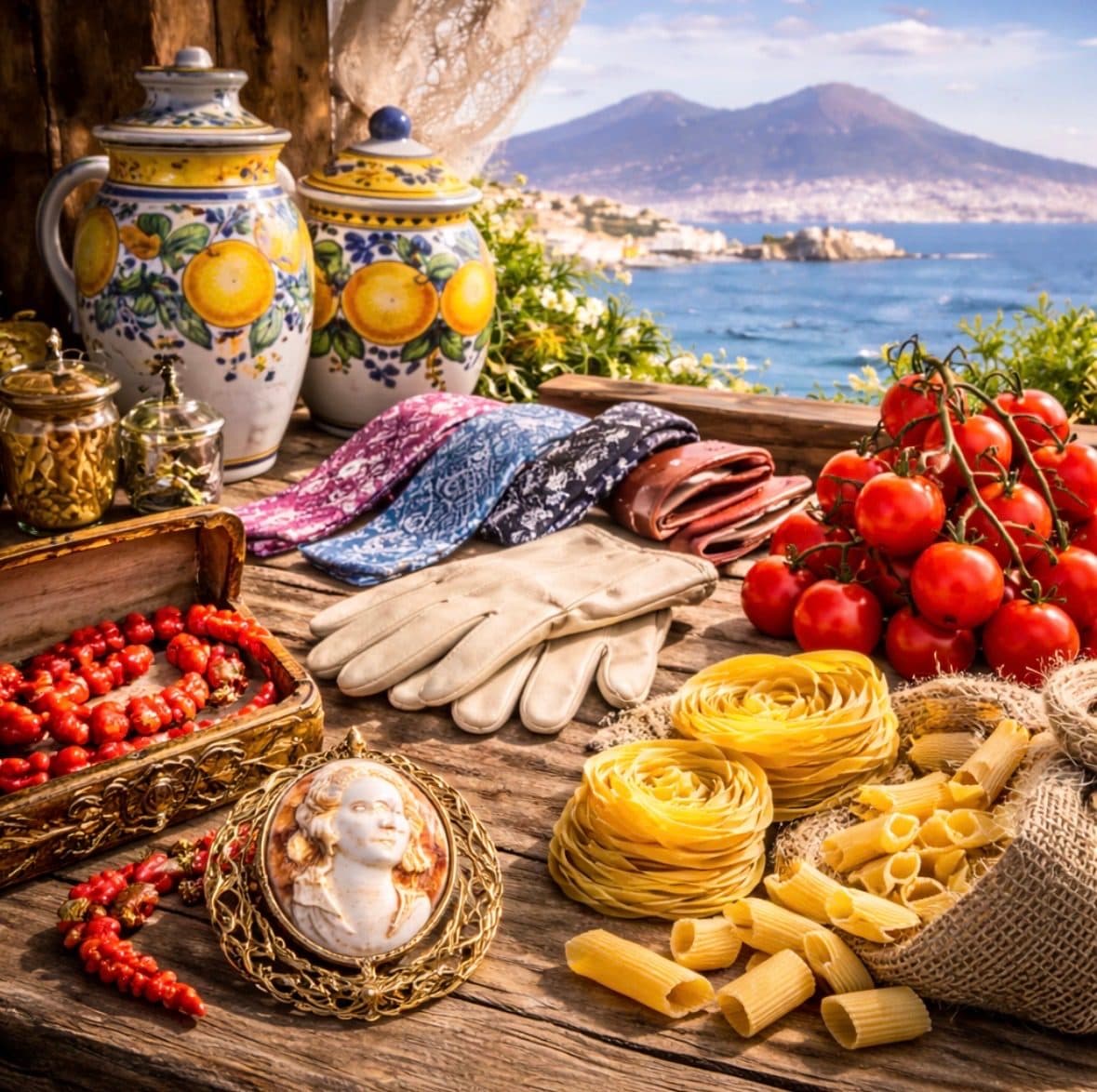
Naples through materials: from coral to wheat
A materials researcher observes a city through the objects produced in its territory.
When looking at a souvenir, they do not focus only on its aesthetic appearance. They mainly ask: • which raw materials are used • which production techniques are required • why these crafts originated precisely in that city.
In the Neapolitan area, many artisanal activities developed thanks to three main factors: • the sea and the commercial routes of the Mediterranean • the natural resources of the Vesuvian area • a long tradition of artisan workshops and manufactories.
By following certain objects — coral, cameos, ceramics, tailoring fabrics, and pasta — it becomes possible to understand how these materials became part of the city’s economic and cultural history.
Mediterranean coral and the artisans of Torre del Greco
Souvenir • Mediterranean coral • coral jewelry.
Mediterranean red coral (Corallium rubrum) has been harvested in the Mediterranean for centuries.
In the 19th century, Torre del Greco, at the foot of Mount Vesuvius, became one of the main centers for working this material.
Artisans cut and polish coral branches to transform them into: • jewelry • cameos • small decorative objects.
The presence of the port and the commercial routes encouraged the development of a district specialized in coral craftsmanship.
Engraved Shells: the Tradition of the Cameo
Souvenir • Neapolitan cameo.
Since the 19th century, artisans in Torre del Greco began carving tropical shells to produce cameos.
The shells used have layers of different colors. The artisan engraves the surface with tools called burins, creating raised images.
This craft requires: • hand precision • knowledge of the shell’s structure • specific engraving tools.
The cameo became one of the objects most sought after by European travelers during the Grand Tour.
Volcanic Clay and Ceramics
Souvenirs • Neapolitan ceramics • Capodimonte porcelain.
The area around Vesuvius is rich in volcanic clays, ideal for ceramic production.
In 1743 Charles of Bourbon founded the Royal Capodimonte Factory, dedicated to porcelain production.
Ceramic production involves several stages: 1. shaping the clay 2. drying 3. firing in the kiln 4. glazing and a second firing.
These techniques helped spread ceramic workshops throughout Campania.
Fabrics and leather: Neapolitan tailoring
Souvenirs • handcrafted gloves • tailored ties.
Between the 19th and 20th centuries Naples became an important center for men's tailoring and leather glove production.
The process requires: • selection of hides • hand cutting • very precise stitching.
The same tailoring tradition also fostered the artisanal production of ties, still widespread in the city's workshops today.
Durum Wheat and Wind: Gragnano Pasta
Souvenir • Pasta di Gragnano IGP.
The town of Gragnano, near Naples, is one of Italy’s main centers for the production of dried pasta.
The pasta is made with: • durum wheat semolina • local water.
The process uses bronze dies and a slow drying process.
In the past, the pasta was dried outdoors in the streets of the town, taking advantage of the winds coming from the Monti Lattari and the Gulf of Naples.
In 2013 the pasta obtained IGP certification.
Conclusion — The materials that tell Naples’ story
Looking at these objects, a common element emerges: each production begins with a specific raw material and an artisanal technique developed in the local area.
In the case of Naples: • Mediterranean coral and shells crafted in Torre del Greco • volcanic clays transformed into ceramics • leathers and fabrics crafted in tailoring workshops • durum wheat semolina used by the pasta makers of Gragnano.
These objects show how the city and its surrounding territory have, over time, developed production chains linked to natural resources, maritime trade, and local artisanal expertise.
Contenu éditorial produit avec l'aide de l'intelligence artificielle et révisé par Trouvenir. Il peut contenir des inexactitudes.
Téléchargement gratuit
Emportez Trouvenir avec vous
iOS et Android. Gratuit.
Respect de la vie privéeSynchronisation multi-appareilsFonctionne hors ligne