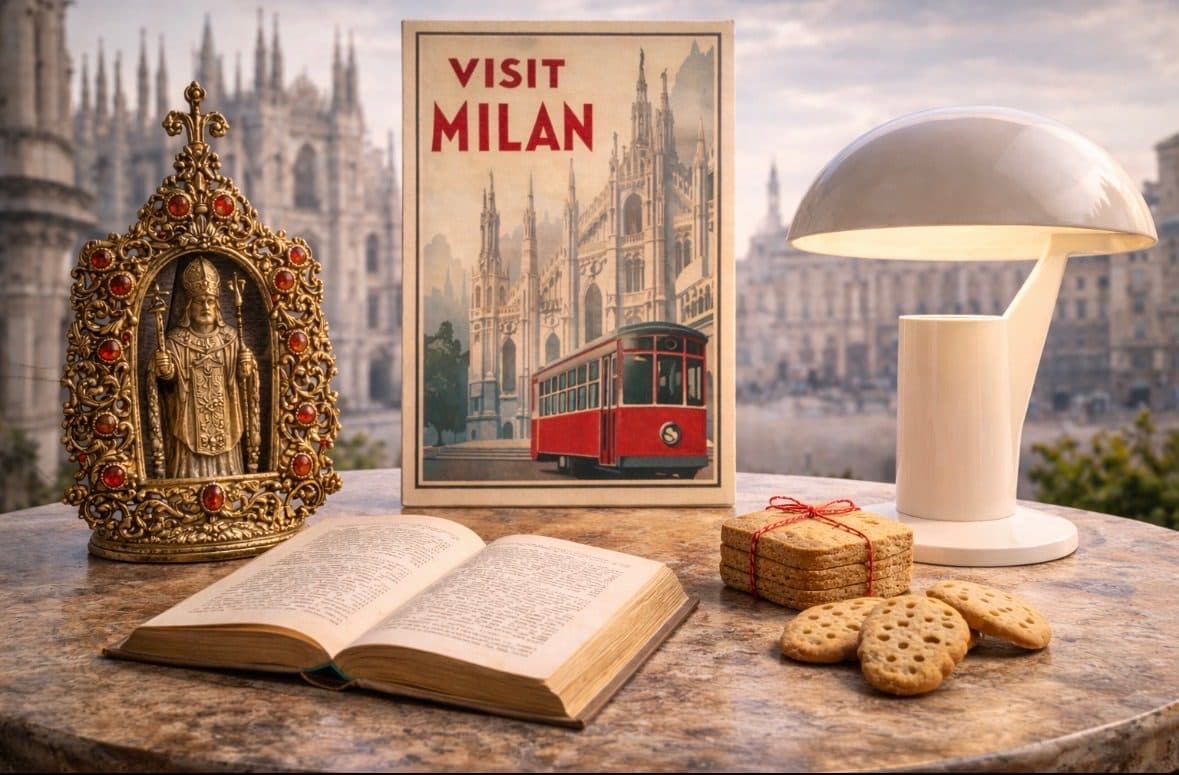
The Symbolic Explorer’s Gaze
Those who travel as a Symbolic Explorer look for objects that tell the cultural identity of a city.
They are not simple souvenirs: they are material traces of institutions, artistic movements, religious traditions, and economic activities that have shaped the history of the place.
In Milan, these objects speak of four central elements of the city: • industrial design • the publishing tradition • graphic design and visual communication • Ambrosian religious history
By following these objects, one moves through some of the cultural structures that have shaped modern Milan.
Design as urban culture
Souvenir: Milanese design object
After the Second World War, Milan became one of the main centers of European industrial design.
In the city, a particular system developed: designers, industries, and schools collaborate to design objects intended for industrial production.
Among the historic companies involved in the development of Italian design are, for example: • Kartell • Artemide • Cassina
Many objects designed by designers such as Achille Castiglioni or Vico Magistretti are now considered design classics.
A small design object purchased in Milan tells precisely this cultural story: the city as a laboratory where art, technology, and industry collaborate to produce everyday objects.
An important part of this history is preserved at the Triennale di Milano, an institution dedicated to design and architecture.
Milan, capital of Italian publishing
Souvenir: a book from Milan’s publishing tradition
From the late nineteenth century, Milan became the main center of Italian publishing.
Some of the country’s most important publishing houses were founded here, including: • Mondadori (1907) • Rizzoli (1927) • Feltrinelli (1954)
The concentration of publishers, printing houses, and bookstores transformed the city into a reference point for Italian cultural production.
According to Treccani, throughout the twentieth century Milan was the place where the main structures of the Italian publishing industry were concentrated.
Buying a book in Milan therefore means taking with you a part of this cultural tradition: the city where many of the most widely circulated texts in Italy were conceived, printed, and distributed.
Posters and Graphic Design in the City of Advertising
Souvenir: historic Milanese poster or graphic print
Between the late nineteenth and early twentieth centuries, Milan became one of Italy’s main centers of advertising graphics.
The growth of industry and consumer culture led companies to use illustrated posters to promote products and shows.
Illustrators and graphic designers worked for companies, theaters, and newspapers, producing posters that were displayed on the city’s streets.
Many of these works are now preserved in Milan’s museums dedicated to modern and contemporary art.
The graphic poster thus became a testament to the industrial and commercial Milan that expanded between the 19th and 20th centuries.
A graphic print inspired by these posters preserves the memory of that season of visual innovation.
The Ambrosian tradition
Souvenir: devotional objects linked to the Ambrosian tradition
Milan has its own liturgical tradition called the Ambrosian rite, connected to the figure of Sant’Ambrogio, bishop of the city in the 4th century.
This rite is different from the Roman rite and is still used today in the Archdiocese of Milan.
The differences concern several elements of the liturgy: • the calendar of celebrations • the structure of the Mass • Ambrosian liturgical chant
Many churches in the city preserve objects and images connected to this religious tradition.
Small devotional objects sold near Milanese churches reflect this specific religious history of the city.
They are not simple religious souvenirs: they tell the story of a local liturgical tradition that has existed for more than 1,500 years.
Conclusion - Milan Told Through Objects
Through these four objects, a concrete portrait of the city emerges. • design tells the story of Milan as a center of industry and planning • the book shows the city as a hub of Italian publishing culture • the graphic poster recalls the development of visual communication in industrial Milan • Ambrosian objects bear witness to a local religious tradition that is still alive.
Seen together, these souvenirs show how Milan has been shaped by the meeting of industry, culture, and religious institutions.
Objects that may appear simple thus become clues to the city’s cultural history.
Contenu éditorial produit avec l'aide de l'intelligence artificielle et révisé par Trouvenir. Il peut contenir des inexactitudes.
Téléchargement gratuit
Emportez Trouvenir avec vous
iOS et Android. Gratuit.
Respect de la vie privéeSynchronisation multi-appareilsFonctionne hors ligne