The Everyday Observer’s Gaze
An Everyday Observer does not look at a city only through monuments and major events. Instead, they seek out the objects that reveal how people lived day to day: what they cooked, how they heated their homes, what religious gestures they practiced, and which products they cultivated in the fields.
In L’Aquila, this kind of observation reveals a city built on the balance between agricultural land, artisanal traditions, and local religious practices.
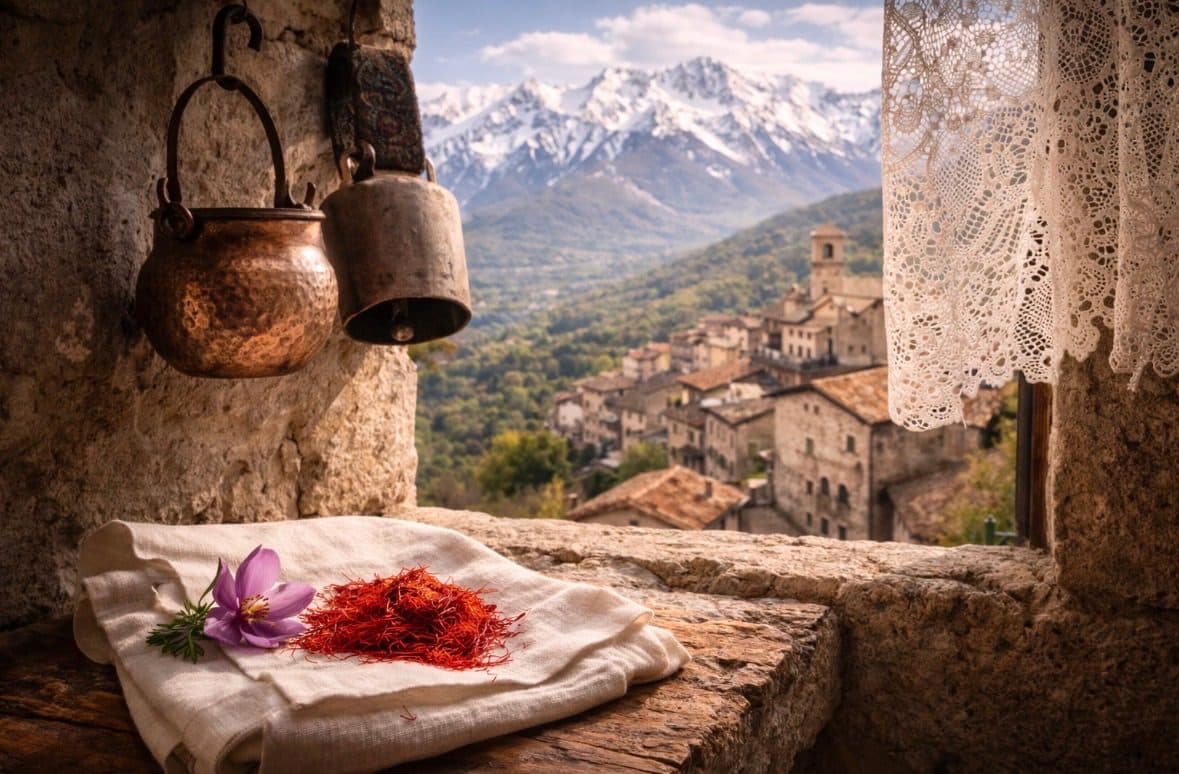
Simple objects — a copper pot, a rosary, a pinch of saffron, or a freshly baked loaf of bread — help explain why this city exists right here, in the heart of the Abruzzo Apennines.
Copper in mountain homes
Related souvenir: hammered copper object
In traditional homes of the central Apennines, copper was one of the most commonly used materials. Pots, cauldrons, jugs, and braziers were made by local artisans using the hammered copper technique, shaping the metal with repeated hammer blows.
The material was ideal for cooking because it distributes heat evenly, a useful quality for long preparations such as soups or legumes.
In the city and surrounding villages, these objects were often repaired and periodically tinned, extending their lifespan for many years. This maintenance system helps explain why copper craftsmanship remained widespread in the Apennine regions.
Copper therefore tells a very concrete story about life in L'Aquila: home cooking and the management of households in a mountain climate.
Religion in Everyday Life
Related souvenir: devotional object from L’Aquila
L’Aquila is historically linked to the figure of Celestine V, the pope who in 1294 established the Perdonanza Celestiniana, a religious celebration that grants a plenary indulgence to pilgrims who visit the Basilica di Collemaggio between August 28 and 29.
Beyond the great public festival, this tradition also influenced the daily lives of the inhabitants. In homes, small religious objects were common: rosaries, sacred images, or medals dedicated to local saints.
These objects were not tourist souvenirs in the modern sense. Rather, they were used for personal or family prayer, often kept beside the bed or in small corners of the home dedicated to devotion.
Through these objects, it becomes clear how religion was not only a public event, but also a daily practice in the families of L’Aquila.
The Bread of the Neighborhoods
Related souvenir: traditional L'Aquila bread
For centuries, bread was the staple food of the diet in Apennine towns. In L’Aquila it was made with wheat flours grown in the surrounding agricultural areas and baked in the ovens of the neighborhoods or nearby villages.
Bread production was often a collective activity: families prepared the dough at home and brought it to the communal oven for baking.
This system was particularly widespread in mountain towns because an oven required a large amount of fuel and specific structures, which were difficult to maintain in every home.
Bread therefore tells an important story about the city: the social organization of its neighborhoods and their relationship with the surrounding agricultural land.
The saffron of the Navelli plateau
Related souvenir: Zafferano dell’Aquila DOP
One of the most precious products of the L’Aquila area is Zafferano dell’Aquila DOP, cultivated mainly on the Navelli plateau.
According to documented tradition, saffron cultivation was introduced in the 15th century by Domenico Santucci, a Dominican friar from the area who had learned the technique in Spain.
The dry climate and the soil of the plateau proved particularly suitable for the Crocus sativus plant. Each flower produces only three stigmas, which must be picked by hand and then dried: for this reason saffron is a very precious spice.
In local cuisine it was used in dishes such as: • soups • pasta • meat-based preparations
The DOP certification (Protected Designation of Origin) guarantees that production takes place according to traditional methods in the historic cultivation area.
Conclusion - What These Objects Reveal
Looking at L’Aquila through everyday objects reveals a city deeply connected to its territory.
Beaten copper speaks of kitchens and mountain homes. Devotional objects show the presence of religion in family life. Bread tells the story of how neighborhoods and local communities were organized. Navelli saffron reveals the link between the city and the agricultural plateau that surrounds it.
Together, these objects explain why L’Aquila grew precisely in this part of the Apennines: a city where craftsmanship, agriculture, and religious traditions shaped the daily life of its inhabitants for centuries.
Contenu éditorial produit avec l'aide de l'intelligence artificielle et révisé par Trouvenir. Il peut contenir des inexactitudes.
Téléchargement gratuit
Emportez Trouvenir avec vous
iOS et Android. Gratuit.
Respect de la vie privéeSynchronisation multi-appareilsFonctionne hors ligne