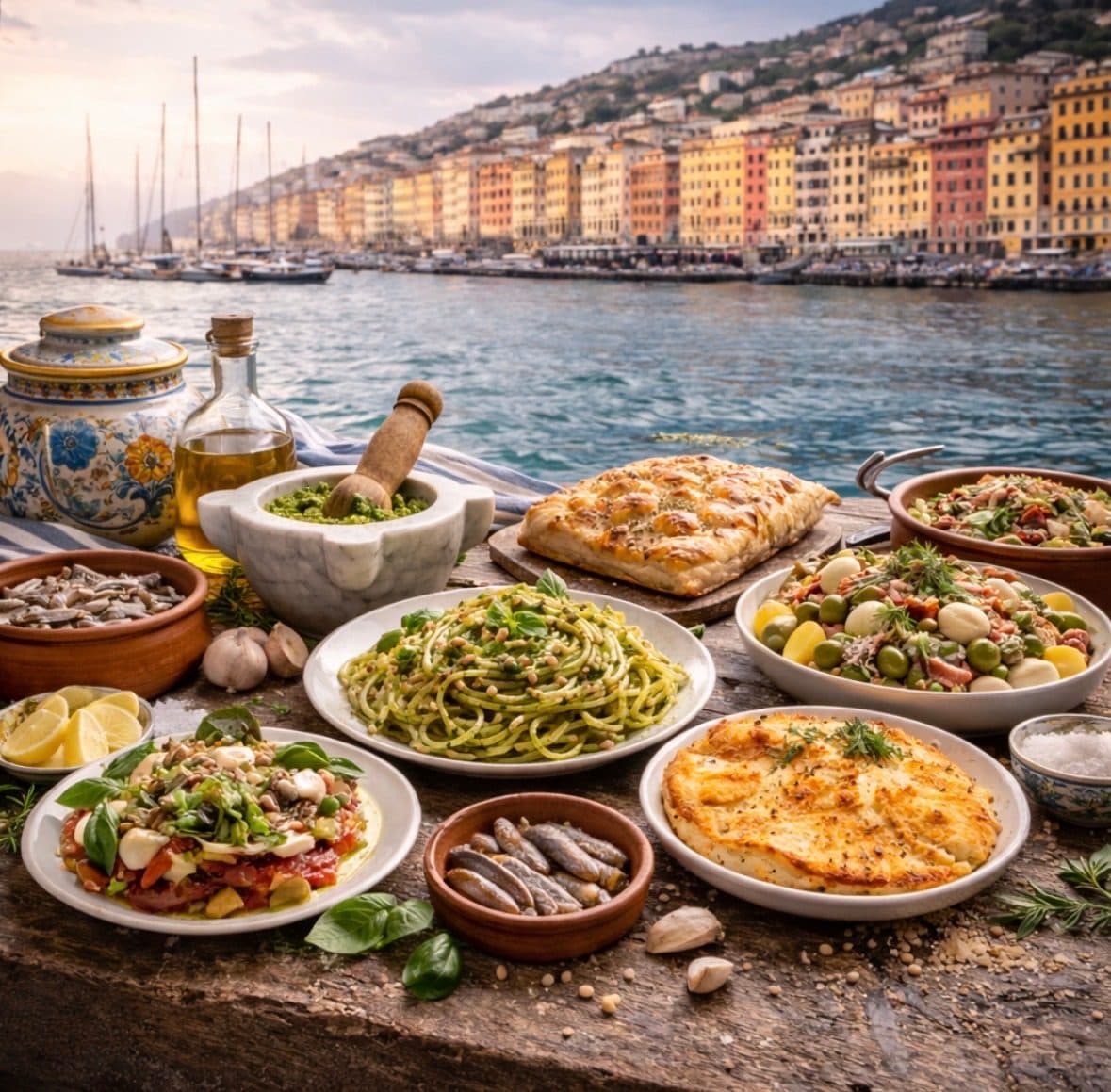
The Cultural Gastronome’s Gaze
The cultural gastronome explores a city through its dishes. They are not just looking for flavors, but want to understand where the ingredients come from, how they are prepared, and why they are cooked that way in that particular place.
In Genoa, the cuisine tells the story of three fundamental elements of local history: • the port and maritime trade • Liguria’s hilly landscape • a tradition of simple yet highly technical cooking
Many dishes were born from the meeting of local ingredients — herbs, olive oil, fish — and products that arrived by sea. 
This route follows some of the most representative dishes of Genoese cuisine to understand why they exist precisely here.
The port and preserved fish
Anchovies and stockfish
For centuries Genoa was a great maritime power of the Mediterranean. The port brought fresh fish into the city, but also goods arriving from very distant routes.
Two ingredients tell this story particularly well.
Anchovies in olive oil
Anchovies are one of the most common fish in the Ligurian Sea. To preserve them for a long time they were packed in salt or in olive oil. This method made it possible to transport and eat them even far from the coast. 
Even today anchovies are used in many Ligurian preparations: appetizers, focaccias, and sauces.
Stoccafisso accommodato
Stockfish is not a local fish. It is dried cod from Norway. It arrived in Genoa through the trade routes of the Mediterranean and Northern Europe.
In Genoa it is cooked “accommodato”, meaning stewed with: • potatoes • Taggiasca olives • pine nuts • olive oil. 
This dish shows how the port brought distant ingredients into the local cuisine.
The herbs of Liguria
Pesto and trofie
The landscape around Genoa is made up of cultivated terraces and small vegetable gardens. In these hills a great variety of aromatic herbs grows.
The dish that best represents this environment is pesto genovese.
Pesto genovese
Pesto is a sauce prepared by crushing in a mortar: • basil • pine nuts • garlic • Parmesan and Pecorino • extra virgin olive oil. 
The modern recipe has been documented since the nineteenth century and derives from older sauces in Ligurian cuisine.
The basil traditionally used is the one grown in the area of Prà, near Genoa.
Trofie or trenette with pesto
The most typical pasta served with pesto is trofie, small spirals of fresh pasta made with flour and water. This shape is traditionally linked to the Genoese area. 
The dish often also includes: • potatoes • green beans.
This combination reflects a home-style cuisine based on simple but well-combined ingredients.
The city's bread
Genoese focaccia
Genoese focaccia is one of the city's most everyday foods.
It is a simple dough made with: • flour • water • yeast • olive oil • salt. 
Before baking, it is pressed with the fingers to create small dimples where oil and salt collect.
Its origins are very ancient and probably date back to the time of the Republic of Genoa, when bread and focaccia were the basis of the urban diet. 
In Genoa, focaccia is not just a snack: many Genoese people also eat it for breakfast.
Since 1996 there has also been a collective mark to protect traditional Genoese focaccia. 
Street Food of the Port
Farinata
Among the simplest and most widespread foods in Genoa is chickpea farinata.
It is prepared with: • chickpea flour • water • olive oil • salt.
The mixture is baked in large copper pans in wood-fired ovens until it becomes thin and crispy. 
It is one of the city’s most popular dishes and is eaten especially in the old sciamadde, traditional eateries where oven-baked specialties are prepared.
Farinata shows how Genoese cuisine can transform simple ingredients into very distinctive dishes.
Holiday cuisine
Cappon magro
Cappon magro is one of the most elaborate dishes in the Genoese tradition.
It is a layered preparation that includes: • sea biscuits • fish • crustaceans • vegetables • green sauce.
The dish originated as a meal for giorni di magro, the religious days when meat could not be eaten. Over time it became a very rich festive dish. 
Its layered structure reflects the abundance of ingredients that arrived at the port of Genoa.
Conclusion
Looking at these dishes together, you can understand how Genoese cuisine was born from the meeting of the sea, trade, and the hilly landscape. • Preserved fish tells the story of the port and fishing. • Pesto and wild herbs speak of the Ligurian hills. • Focaccia and farinata show the city’s everyday cooking. • Cappon magro recalls festive occasions and the wealth of maritime trade.
Each dish exists in Genoa because it grew out of very specific conditions: a port city with little agricultural space, yet connected for centuries to the routes of the Mediterranean.
It is precisely this combination that has shaped one of Italy’s most recognizable regional cuisines.
Contenu éditorial produit avec l'aide de l'intelligence artificielle et révisé par Trouvenir. Il peut contenir des inexactitudes.
Téléchargement gratuit
Emportez Trouvenir avec vous
iOS et Android. Gratuit.
Respect de la vie privéeSynchronisation multi-appareilsFonctionne hors ligne