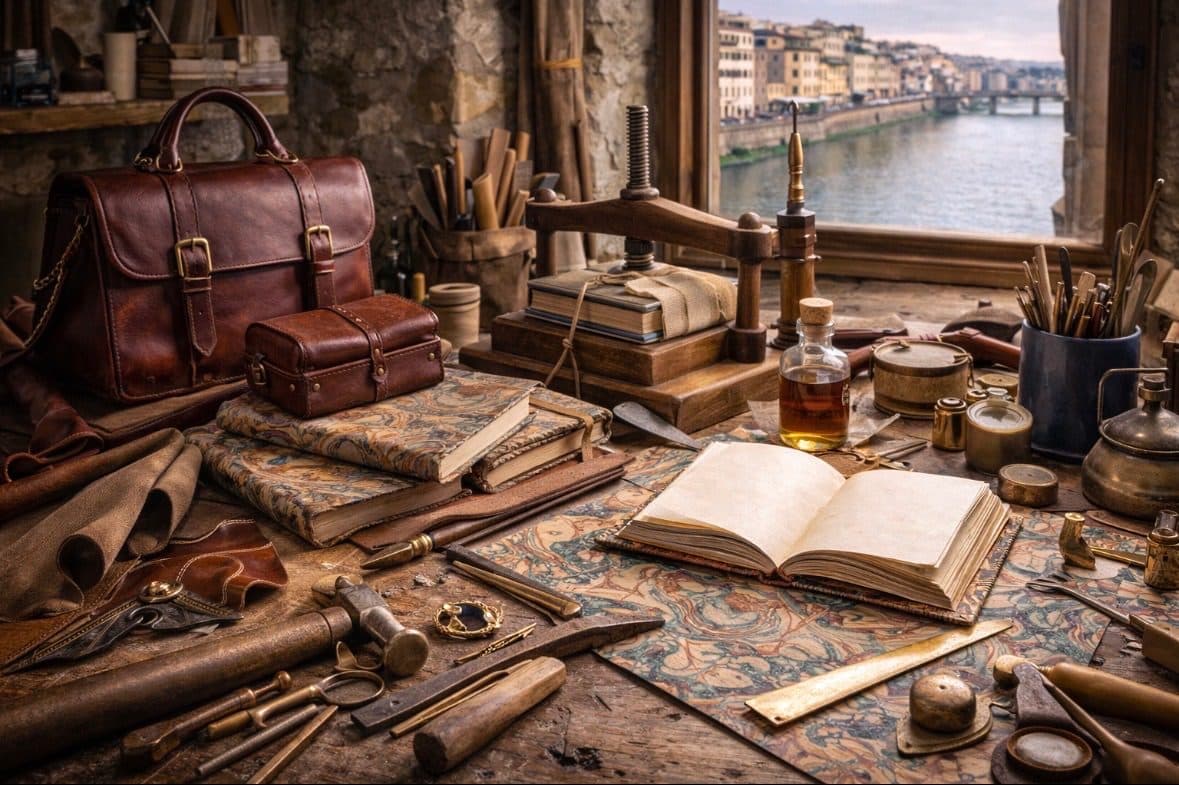
The Material Researcher’s Eye
The Material Researcher observes a city through what artisans know how to make with their hands.
They are not simply looking for decorative souvenirs. They want to understand: • which materials have been used for centuries • which techniques were developed in the workshops • why they spread precisely in that city
In Florence, this perspective is particularly fascinating. From the Middle Ages through the Renaissance, the city was one of Europe’s main centers of artisanal and manufacturing production: leather, silk, metals, paper, and perfumes were crafted within the trade guilds and the workshops of the historic center.
Many of the souvenirs found today in the workshops of the Oltrarno or near the Duomo are a continuation of these techniques.
Leather: the material that spans the centuries
Related souvenirs • Florentine leather craftsmanship • artisanal bookbinding
Leather working is one of Florence’s oldest craft traditions.
As early as the 13th century, there were trade guilds connected to leather processing: tanners, saddlers, and leather artisans were organized into guilds and specialized workshops. 
Tanned leather was used for many objects: • bags and belts • saddlery • book covers • travel accessories
Bookbinding is one of the most refined applications of this craft. In Florentine workshops, leather covers were decorated with heated tools and ornamental motifs. Some historic workshops have continued this tradition for generations. 
The reason this tradition is especially strong in Florence is historical: the city was a wealthy commercial center and produced many manuscripts and books as early as the Humanist period.
Decorated Paper and the Art of the Book
Related souvenirs • marbled paper • handmade bookbinding
Florentine marbled paper is one of the most recognizable products of local craftsmanship.
The technique did not originate in Florence: it comes from East Asia and is documented in Japan as early as the 8th century. However, European artisans refined it, and Florence became one of the most important centers of its production. 
The process is manual: 1. a thickened water solution is prepared 2. pigments are floated on the surface 3. patterns are created using combs or tools 4. the sheet is laid on the surface to transfer the design
Each sheet is different from the others.
In Florence this paper was mainly used for: • book covers • decorative papers • notebooks and stationery
Its spread is closely tied to the city’s publishing and bookmaking tradition, as during the Renaissance Florence was one of the European centers of humanist culture.
Fabrics and embroidery: the legacy of silk
Related souvenirs • Florentine silk • Florentine embroidery
In the Middle Ages, Florence developed a powerful textile industry.
One of the city’s most important guilds was the Arte della Seta, which controlled the production and trade of precious fabrics. Florentine silk textiles were exported throughout Europe.
Silk was woven on complex looms to produce: • damasks • brocades • decorative fabrics
These textiles were used mainly for: • aristocratic clothing • ecclesiastical furnishings • tapestries and curtains
Alongside silk, a tradition of decorative embroidery also developed, often applied to domestic or liturgical fabrics.
Many of the decorative motifs echo Renaissance designs and historic patterns passed down through artisan workshops.
Metals and jewelry: the precision of the workshops
Related souvenirs • brass or bronze objects • Florentine goldsmith jewelry
Metalworking is a fundamental tradition of Florentine craftsmanship.
During the Renaissance the city hosted workshops of artists and sculptors who worked with bronze, brass, and precious metals to create: • sculptures • liturgical objects • scientific instruments • jewelry
The goldsmith tradition is still visible today in the workshops of the Ponte Vecchio, where goldsmiths work gold and precious stones using techniques passed down for centuries.
Many metal souvenirs sold today draw on Renaissance techniques and motifs: candelabras, small decorative objects, or jewelry inspired by historical models.
Herbs and fragrances: the science of monasteries
Related souvenirs • herbal and apothecary products
One of Florence’s most surprising traditions was born in medieval monasteries.
In 1221 the Dominican friars of the convent of Santa Maria Novella began cultivating medicinal herbs in their gardens to prepare balms, ointments, and distillates. 
From this activity came the Officina Profumo-Farmaceutica di Santa Maria Novella, considered one of the oldest historic pharmacies in Europe.
The monks used: • roses • iris • lavender • spices and resins
To create: • scented waters • medicinal remedies • perfumes
Some historic recipes, such as the famous Acqua della Regina, are still produced today. 
This is one of the reasons why herbal products have become a typical souvenir of the city.
Conclusion — What These Objects Tell
Seen together, these souvenirs reveal something very concrete about Florence.
The city was not only an artistic center, but also a great manufacturing city.
Here, many different skills developed: • leatherworking • silk weaving • paper decoration • metal casting • the preparation of perfumes and essences
Many of these techniques originated in medieval guilds, monasteries, or Renaissance workshops.
When you buy a notebook with marbled paper, a leather bag, or an herbal perfume today, you are not just purchasing a decorative object.
You are taking with you a fragment of a city that, for centuries, built its wealth through the work of artisans’ hands.
Contenu éditorial produit avec l'aide de l'intelligence artificielle et révisé par Trouvenir. Il peut contenir des inexactitudes.
Téléchargement gratuit
Emportez Trouvenir avec vous
iOS et Android. Gratuit.
Respect de la vie privéeSynchronisation multi-appareilsFonctionne hors ligne