Histoire♛ Premium
Amalfi in everyday life: lemons, sea, and home kitchens
Everyday observer
The Everyday Observer’s Gaze
An everyday observer does not look for monuments or major historical events. Instead, they look at the objects that are part of everyday life.
In a coastal town like Amalfi, these objects mainly tell two things: • what grows on the terraced fields • what comes from the sea.
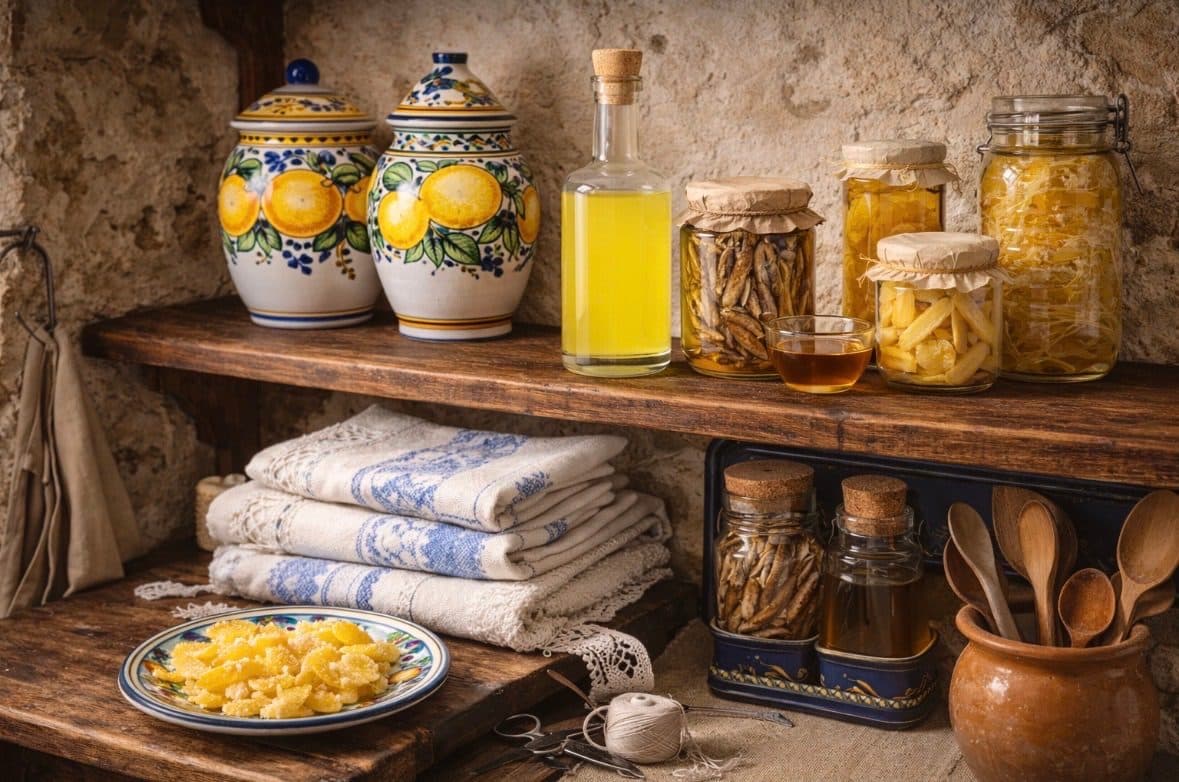
Lemons grown on the slopes of the coast, anchovies caught in the small ports, and ceramics used in home kitchens form an everyday system of production and consumption that has existed for centuries.
By following these objects, you discover how life on the Amalfi Coast really works.
The terraced lemon groves of the coast
Souvenirs: • Amalfi lemon marmalade • candied lemon peel • limoncello
The landscape of the Amalfi Coast is characterized by agricultural terraces built along the slopes of the mountains.
On these terraces, the Limone Costa d’Amalfi IGP—locally called sfusato amalfitano—has been cultivated for centuries.
This lemon is recognizable for its: • elongated shape • thick, very fragrant peel • high content of essential oils.
To protect the lemons from wind and sun, farmers build pergolas of wood and straw above the plants. This agricultural system has been documented since the Middle Ages and makes it possible to grow citrus on very steep slopes.
The presence of lemons with highly aromatic peel encouraged the use of the zest in many homemade preparations: • marmalades • candied peel • limoncello
These preparations often originated in home kitchens as a way to preserve the fruit throughout the year.
Limoncello in the kitchens of the coast
Souvenir: • Amalfi limoncello
Limoncello is a liqueur made by infusing lemon peels in alcohol, to which water and sugar are added.
On the Amalfi Coast this preparation is traditionally homemade.
The recipe takes advantage of the main characteristic of the sfusato amalfitano lemon: the peel, rich in aromatic oils.
The traditional process involves: 1. removing the peel without the white pith 2. maceration in alcohol for several days 3. adding a syrup made of water and sugar.
The liqueur is served cold at the end of a meal and has become one of the most recognizable products of the coast.
Cetara and the sea of anchovies
Souvenirs: • Cetara anchovies • colatura di alici
A few kilometers from Amalfi lies Cetara, a small village historically linked to fishing.
The town is known above all for the processing of alici (anchovies).
The anchovies are preserved using a traditional technique: 1. cleaning the freshly caught fish 2. layering them in barrels with sea salt 3. maturation for several months.
During maturation, an amber-colored liquid forms: colatura di alici.
This sauce comes from a preservation method developed in the Middle Ages and today is considered one of the area’s most representative gastronomic products.
It is used in small quantities to season pasta or vegetables.
Ceramics in the homes of the coast
Souvenir: • artistic ceramics of the coast (Vietri) The colorful ceramics found all along the coast are closely tied to the artisan tradition of Vietri sul Mare.
The production of Vietri ceramics has been documented since at least the 15th century.
Local workshops produce: • plates • jugs • decorative tiles • kitchen containers.
These objects are part of the everyday life of homes along the coast.
Many decorative motifs depict elements of the local landscape: • lemons • fish • boats • the colors of the sea.
Today this tradition is also told through the Museo della Ceramica di Vietri, which preserves historical works and documents the evolution of local craftsmanship.
Conclusion — A city told through household objects
By following these souvenirs, you discover that Amalfi is not defined only by its monuments.
The city and its coast live through very concrete everyday activities: • growing lemons on terraced slopes • preserving peels and making liqueurs at home • fishing for and salting anchovies • using handmade ceramics in the kitchen.
These objects exist here precisely because the land makes them possible: • steep mountains that require agricultural terraces • a sea rich in small fish such as anchovies • artisan traditions developed in the villages along the coast.
Observing them means understanding how everyday life on the Amalfi Coast is shaped by the meeting of landscape, work, and home cooking.
Contenu éditorial produit avec l'aide de l'intelligence artificielle et révisé par Trouvenir. Il peut contenir des inexactitudes.
Téléchargement gratuit
Emportez Trouvenir avec vous
iOS et Android. Gratuit.
Respect de la vie privéeSynchronisation multi-appareilsFonctionne hors ligne