Introduction — The Gaze of the Everyday Observer
An everyday observer does not look for famous monuments or tourist symbols. Instead, they prefer to look at the objects people actually use.
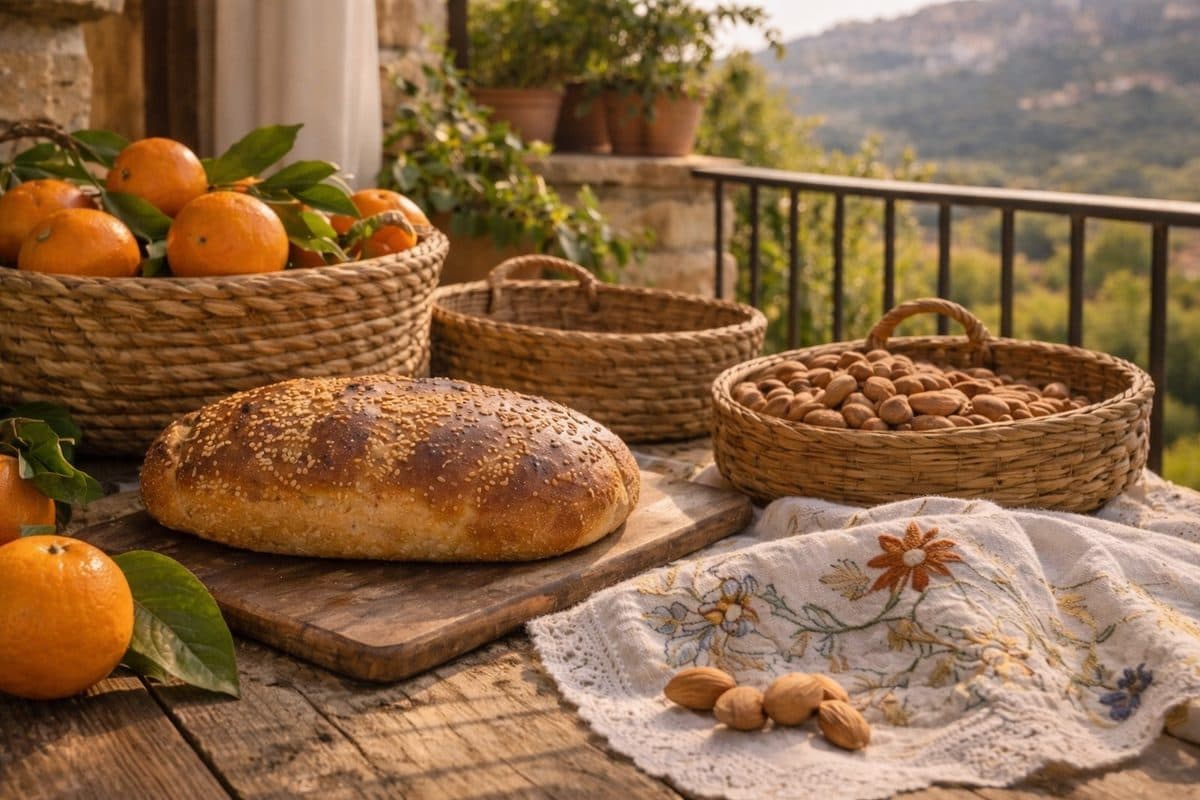
In Agrigento this means observing: • the bread that is brought to the table every day • the fruit that grows in the surrounding countryside • the baskets used in agricultural work • the embroidery that fills homes
These objects tell the story of how people once lived—and in part still live—in the province of Agrigento: between agriculture, manual work, and domestic life.
The Bread That Accompanies Work
Souvenir: Favara Bread
In the Agrigento area, traditional bread is made with durum wheat semolina, a grain that grows well in the arid soils of Sicily.
In Favara, a local bread is produced that is often called “chichireddu”, recognizable for its curved shape similar to a horseshoe. 
This bread was born in a very practical context: workers in the fields and the mines needed food that was filling and could keep for a long time. For this reason the bread was prepared with little water and baked for a long time, so that it remained crunchy and edible for several days. 
Bread was not just food: it was also something to carry along, tucked into workers’ bags or shared in the fields during a break.
👉 This is why it exists right here: Agrigento has historically been a grain‑growing area, and the processing of durum wheat is one of the fundamental elements of Sicilian cuisine.
The Oranges of the River Valley
Souvenir: Arancia di Ribera DOP
About 40 km from Agrigento lies Ribera, an agricultural area crossed by the Verdura, Magazzolo, and Platani rivers.
This is where Arancia di Ribera DOP is grown, a seedless blond orange variety famous for its juiciness. 
Its cultivation is documented as early as the nineteenth century, and over time it has developed into an organized production system that is now protected by a consortium of producers and a European DOP designation. 
The reason these oranges grow so well here is geographical: • fertile soils in the river valleys • mild Mediterranean climate • an abundance of fresh water
Thanks to these conditions, Ribera’s oranges have become one of the area’s main crops and a daily staple of the local diet.
Dwarf Palm Baskets
Souvenir: Giummarre
In the Sicilian countryside, a Mediterranean plant grows wild: the dwarf palm (Chamaerops humilis).
Once dried, its leaves become a strong fiber called curina, used to produce woven baskets and utensils. 
From this craft come the giummarre, traditional baskets used to: • transport fodder • carry agricultural products • load pack animals
Before the arrival of industrial materials, these objects were essential for agricultural work.
They exist here because the dwarf palm grows naturally in Sicily’s dry, rocky terrain, providing a natural raw material for local craftsmanship.
Embroidery in Sicilian Homes
Souvenir: Handmade embroidery from the Agrigento area
Embroidery is a very widespread tradition in Sicilian homes.
Since the Middle Ages, Sicily had an important textile production: during the Arab rule there were workshops called tiraz, specialized in weaving and embroidering precious fabrics. 
Over time, this skill also spread into domestic life.
In Sicilian homes, embroidery was mainly used to prepare the family trousseau: • sheets • tablecloths • towels • linens
Many women learned these techniques from a young age and often embroidered together outdoors, in front of their homes, turning the work into a social moment. 
It exists here because embroidery was part of the domestic economy and family culture of Sicily, where the trousseau was an important element of social life.
Conclusion – What These Objects Reveal About Agrigento
Looking at these souvenirs together, a very concrete picture of life in the province of Agrigento emerges. • Favara bread tells the story of wheat farming and work in the fields. • The Ribera orange shows the importance of cultivation in the river valleys. • Giummarre speak of craftsmanship tied to the natural resources of the land. • Household embroidery tells the story of life inside the home and the craft skills passed down through generations.
They are simple objects, yet they help explain how a community has built its everyday life over time: between the land, manual work, and domestic traditions.
Contenu éditorial produit avec l'aide de l'intelligence artificielle et révisé par Trouvenir. Il peut contenir des inexactitudes.
Téléchargement gratuit
Emportez Trouvenir avec vous
iOS et Android. Gratuit.
Respect de la vie privéeSynchronisation multi-appareilsFonctionne hors ligne