Seeing the city through food
A cultural gastronome visits a city to understand how history, landscape, and people’s work have influenced what is eaten.
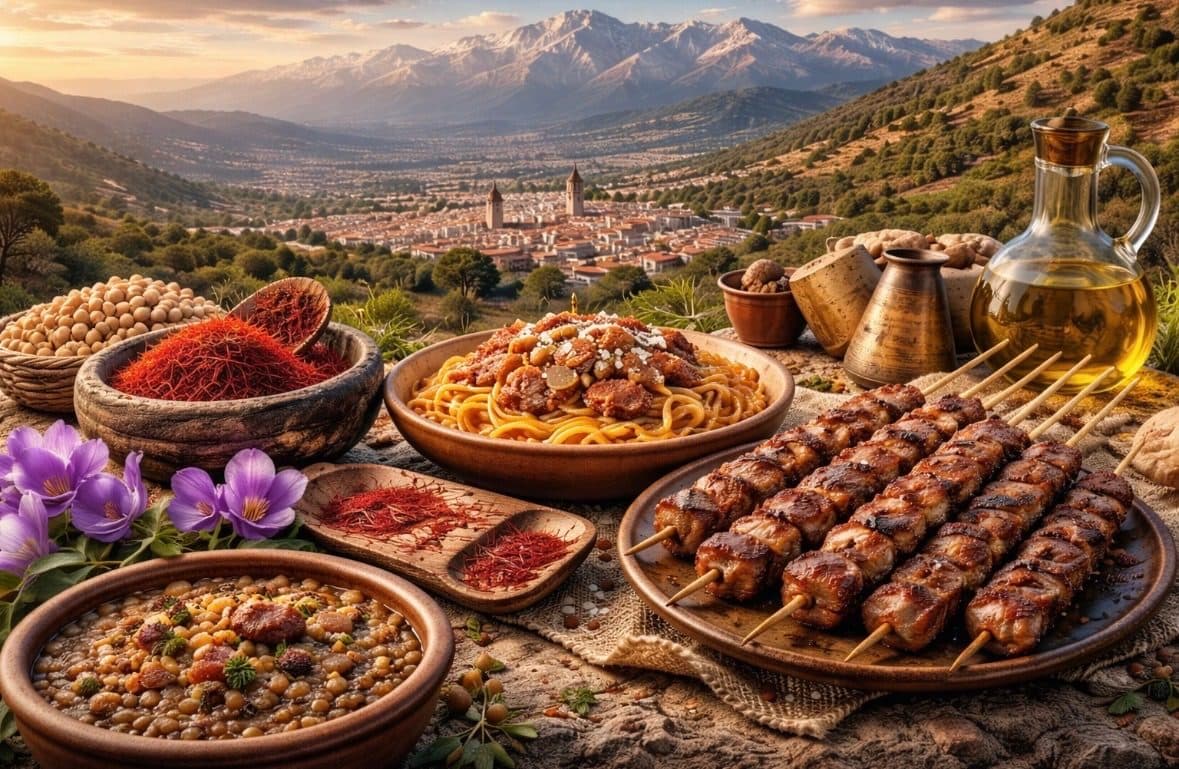
In L’Aquila this means observing three fundamental elements: • the agricultural plateaus where saffron grows • the Apennine pastures of sheep farming • the mountain home cooking made of pasta, legumes, and simple desserts.
Traditional dishes are not random: they tell the story of how residents have used the resources available in a mountainous territory of the central Apennines.
The red gold of the highlands: saffron
Related souvenirs • Zafferano dell’Aquila DOP • sagne with saffron • meats with saffron
Zafferano dell’Aquila DOP is grown mainly on the Navelli Plateau, a few kilometers from the city.
According to historical sources, its cultivation was introduced in the 13th century and quickly became an important economic resource for the L’Aquila area. During the Middle Ages, the local saffron was exported to trading cities such as Venice and Milan.
The spice comes from the stigmas of the Crocus sativus flower. Each flower produces only three stigmas, which must be picked by hand and then dried.
This rarity explains why saffron was used not only in aristocratic cuisine but also in some local recipes such as: • sagne with saffron, pasta seasoned with the spice • meats with saffron, often lamb or chicken.
Its connection with L’Aquila comes from the combination of dry climate, altitude, and limestone soils—conditions particularly well suited to its cultivation.
Pasta and household tools: the chitarra
Related souvenir • maccheroni alla chitarra
One of the most representative objects of Abruzzo’s cuisine is the chitarra, a wooden tool with tightly stretched metal strings.
The pasta dough is rolled into a sheet and then pressed over the strings: the wires cut the dough, forming spaghetti with a square cross‑section.
This domestic method gave rise to maccheroni alla chitarra, a dish found throughout Abruzzo but also very present in the cuisine of L'Aquila.
Traditionally the pasta is dressed with: • meat ragù • or lamb or mutton sauces.
The dish reflects the family cooking of the central Apennines, where homemade pasta and sheep meat were ingredients that were easily available.
Pastoral culture: arrosticini
Related souvenir • arrosticini
Arrosticini are skewers of sheep meat cut into small cubes and threaded onto wooden sticks.
They are cooked on a narrow grill called a fornacella.
The dish originated in the mountainous areas of Abruzzo, where sheep farming was very widespread. Sheep meat, less prized than lamb, was cut into small pieces and quickly roasted.
The tradition is linked to transhumance, the seasonal movement of flocks between mountains and plains, a practice recognized by UNESCO as intangible cultural heritage.
Mountain cuisine: legumes and soups
Related souvenir • L'Aquila legume soups
In the L'Aquila area, mountain agriculture encouraged the cultivation of legumes that withstand the cold climate.
Among the most common: • lentils • chickpeas • grass peas • beans.
Legume soups were everyday dishes because: • they provided nourishment during the winter • they could be stored for a long time • they required ingredients easily grown on the high plateaus.
These preparations represent the simplest and most everyday side of L'Aquila’s cuisine.
Holiday sweets: ferratelle and mostaccioli
Related souvenirs • ferratelle • mostaccioli
Ferratelle are thin waffles made with eggs, flour, sugar, and sometimes anise.
They are cooked in an engraved iron mold that imprints geometric decorations on the surface.
Mostaccioli are spiced sweets made with honey, flour, and cocoa or cooked grape must, traditionally eaten during the Christmas period.
Both sweets tell the story of holiday cooking in Abruzzo families, where household tools and simple ingredients were used to prepare desserts for special occasions.
Conclusion — What These Dishes Reveal About L’Aquila
Through these gastronomic souvenirs, three fundamental elements of the city emerge: 1. High‑plateau agriculture, which produces the most famous saffron in Italy. 2. Apennine pastoralism, which gave rise to dishes such as arrosticini. 3. Mountain home cooking, made of handmade pasta, legumes, and simple sweets.
The result is a cuisine that directly reflects the territory: a mountain landscape where farming, animal husbandry, and family traditions have shaped what people still eat today.
Redaktioneller Inhalt, erstellt mit Unterstützung künstlicher Intelligenz und von Trouvenir geprüft. Er kann Ungenauigkeiten enthalten.
Kostenlos herunterladen
Nimm Trouvenir mit
iOS und Android. Kostenlos.
Privacy firstGeräteübergreifende SynchronisierungFunktioniert offline