The perspective of the cultural gastronome
The cultural gastronome observes a city starting from its ingredients and cooking techniques.
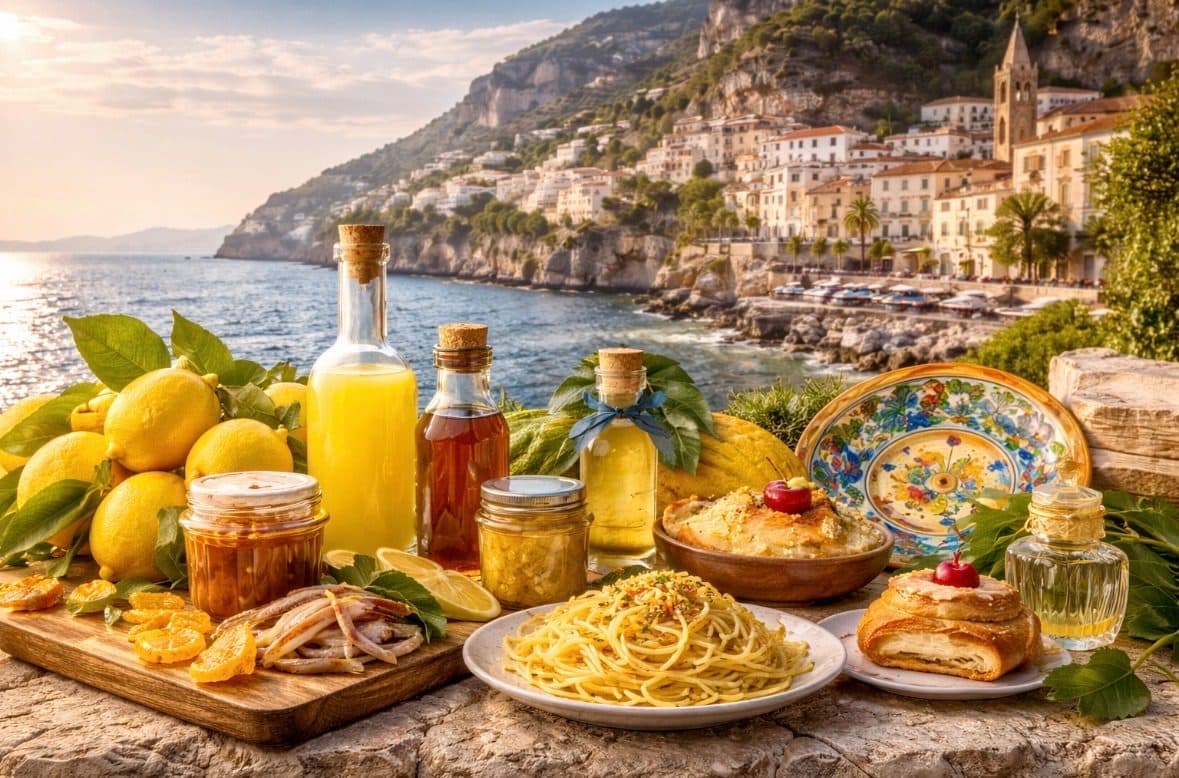
In Amalfi and the villages of the Amalfi Coast, the landscape and history have created two fundamental resources: • citrus fruits grown on the terraced slopes of the coast • fish preserved according to seafaring traditions
The gastronomic souvenirs of Amalfi tell precisely this story: a balance between hillside agriculture and fishing in the Tyrrhenian Sea.
The Lemon Groves of the Amalfi Coast
Related souvenirs • Limone sfusato amalfitano IGP • Lemon marmalade • Candied lemon peel
The Amalfi Coast is one of Italy’s main lemon‑growing areas. Here grows the variety called “Sfusato Amalfitano”, recognized as Limone Costa d’Amalfi IGP. 
This lemon has an elongated shape, a thick and very fragrant peel, rich in essential oils. 
The reason this variety developed specifically here is geographical: • the coast is sheltered from cold winds • the slopes are exposed to the sun • the lemon groves are cultivated on terraces supported by dry‑stone walls
These agricultural structures make it possible to grow citrus even on very steep slopes.
The aromatic peel of the Sfusato lemon is used in many local products: • candied peel, obtained by boiling the peel and preserving it in sugar • lemon marmalade, prepared with pulp, peel, and sugar
These products originated from the traditional need to preserve large quantities of citrus throughout the year.
From Lemon to Liqueur: Limoncello
Related souvenir • Amalfi Limoncello
Limoncello is a liqueur obtained by macerating lemon peels in alcohol, to which water and sugar are then added.
The liqueur spread especially during the 20th century along the Amalfi Coast and on the Sorrentine Peninsula. Its production is closely linked to the Sfusato lemon, because the peel contains a high quantity of aromatic essential oils. 
The technique is simple but precise: 1. the lemons are peeled, avoiding the white part of the rind 2. the peels are left to infuse in alcohol 3. a syrup of water and sugar is added
The result is a very fragrant liqueur that is traditionally served cold after meals.
Limoncello exists precisely in this territory because a lemon with a particularly aromatic peel grows here, perfectly suited for maceration.
The sea of Cetara and anchovy colatura
Related souvenirs • Anchovies and anchovy colatura from Cetara • Spaghetti with anchovy colatura
A few kilometers from Amalfi lies Cetara, a small village historically dedicated to fishing.
This is where anchovy colatura was born, a liquid sauce obtained from the maturation of salted anchovies.
The traditional process is as follows: 1. the caught anchovies are cleaned 2. they are arranged in layers with salt in wooden barrels 3. the pressure releases a very concentrated liquid 4. the liquid is filtered and bottled
This technique has ancient roots: a similar sauce was already produced in ancient Rome under the name garum.
The most common way to use colatura is in the dish:
spaghetti with anchovy colatura
The pasta is cooked without salt and dressed with: • colatura • extra virgin olive oil • garlic • parsley.
The dish is especially traditional on Christmas Eve.
This product exists here because Cetara is one of the villages on the Amalfi Coast where anchovy fishing has historically been very widespread.
Sweets of the Amalfi Coast
Related souvenirs • Lemon Delight • Sfogliatella Santa Rosa
Lemon Delight is a modern dessert from the Amalfi Coast. It is a dome of sponge cake filled with lemon cream and covered with glaze or cream flavored with limoncello.
Its main ingredient is once again the lemon of the Coast, which gives the dessert its characteristic fragrance.
A much older dessert, on the other hand, is the sfogliatella Santa Rosa.
This dessert originated in the 17th century in the monastery of Santa Rosa in Conca dei Marini. 
According to monastic tradition: • a nun used leftover cooked semolina • she added sugar, dried fruit, and lemon liqueur • she enclosed the filling between two sheets of pastry
The dessert was later enriched with custard and sour cherries.
Sfogliatella Santa Rosa is considered the original version of the Neapolitan sfogliatella.
Conclusion
The gastronomic souvenirs of Amalfi tell the story of two fundamental elements of the Coast:
lemon cultivation and anchovy fishing. • Lemons grow on the terraces that shape the agricultural landscape of the coast. • Anchovies come from the Tyrrhenian Sea and are preserved using techniques developed in fishing villages.
Liqueurs, jams, sweets, and pasta dishes are therefore the result of local ingredients transformed by traditional cuisine.
By observing these gastronomic items, it becomes clear that Amalfi is not only a tourist destination: it is also a place where agriculture, fishing, and cooking have built a very distinctive gastronomic culture.
本编辑内容在人工智能辅助下制作并经编辑团队审核,可能存在不准确之处。