Historia♛ Premium
Trieste: working with matter between rock, sea, and wind
Materials researcher
The Materials Researcher’s Perspective
A materials researcher looks at the city starting from the objects and the substances that compose them.
They observe: • the rocks used for building • the crops that grow in a particular soil • the goods that arrive in the ports • the transformations that allow a food to be preserved.
Trieste is an ideal place for this kind of observation. The city lies between the Adriatic Sea and the Karst Plateau, two very different environments.
The Karst is a territory of limestone rocks, thin soils, and strong winds, while the port connects the city to international trade routes.
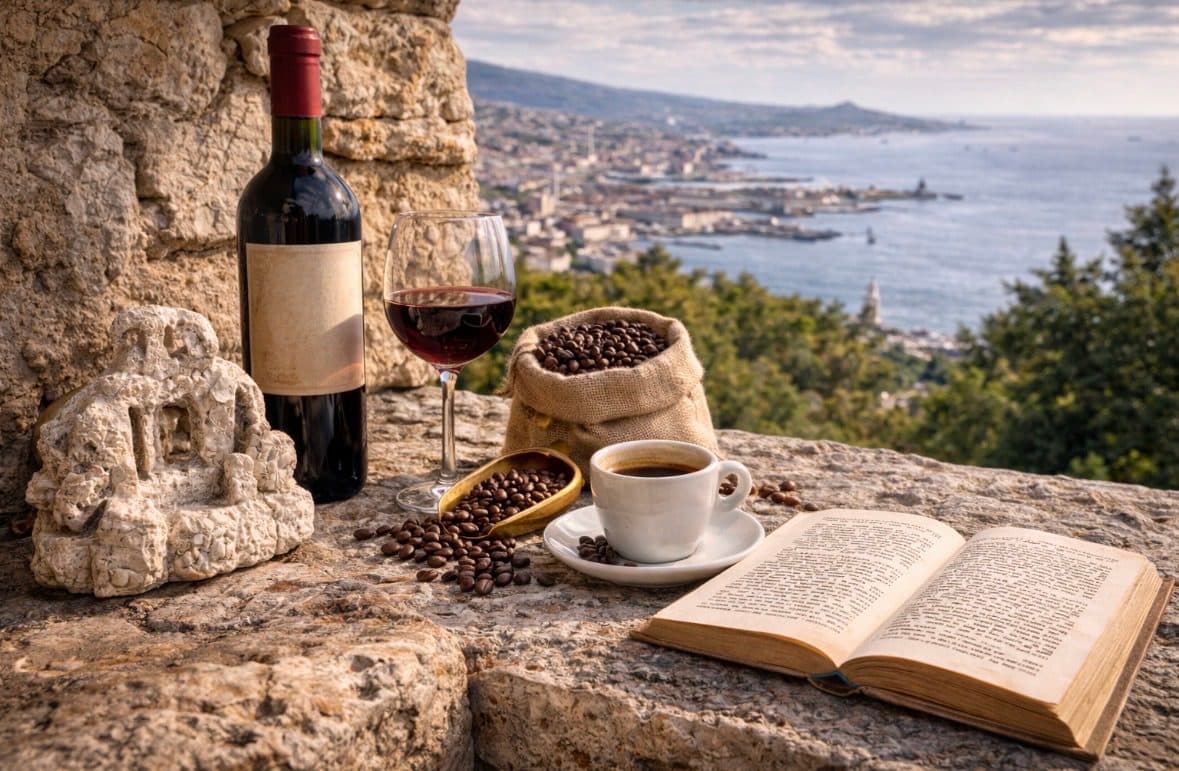
By following a few souvenirs — stone, wine, coffee, and oil — it is possible to understand how different forms of matter are worked and transformed in this borderland.
Karst stone: extracting and shaping the rock
Souvenirs: objects in Karst stone
The Karst plateau is made up of limestone rocks formed from ancient marine sediments compressed over millions of years.
This stone has characteristics that make it suitable for working: • it is compact but workable • it resists compression well • it can be cut into regular blocks.
For this reason, Karst stone has been used for centuries in: • rural buildings of the Karst • architectural elements • sculptures and handcrafted objects.
The souvenir objects made today in Karst stone come from this tradition of craftsmanship.
They exist in Trieste precisely because the raw material — limestone rock — is found immediately around the city.
Growing Among the Rocks: Wine from the Karst
Souvenir: Karst wine (Terrano, Vitovska)
On the Karst plateau, the fertile soil is often very thin and mixed with limestone rock.
To cultivate vines, farmers historically: • removed large quantities of stones • built dry-stone walls • piled up soil between the rocks.
This work made it possible to grow vines in a challenging landscape.
Among the most characteristic grape varieties:
Terrano red wine with high acidity, traditionally grown on the Karst.
Vitovska an indigenous white wine of the Karst area.
Production falls under the DOC Carso / Kras designation.
This wine exists precisely here because it derives from the specific geological and climatic conditions of the Karst plateau.
From the port to the roastery: transforming coffee
Souvenir: Trieste coffee blend
Trieste is one of the main European ports for the import of green coffee.
In the 18th century the city obtained free port status under the Habsburg Empire, facilitating the arrival of goods from all over the world.
Coffee arrives at the port in the form of raw, unroasted beans.
To become a beverage it must be transformed through several steps: 1. selection of varieties 2. high‑temperature roasting 3. grinding 4. blending.
Trieste roasteries have developed blends specifically for espresso.
The souvenir — a Trieste blend — exists here because Trieste is a historic center for processing coffee imported by sea.
Olive oil between sea and Karst: extracting and preserving
The area around Trieste produces one of the northernmost olive oils in the Mediterranean.
Production is recognized under the Tergeste DOP designation, which includes the Trieste area and the Karst.
Cultivation is possible thanks to particular conditions: • the Adriatic Sea moderates temperatures • the Karst slopes receive abundant light • the wind keeps the soil dry.
The production process includes: 1. holive harvesting 2. crushing 3. oil extraction 4. separation and storage.
The result is an extra virgin olive oil characterized by fruity and slightly peppery notes.
This product exists in Trieste because the local microclimate allows olive cultivation in one of the northernmost areas of its growing range.
Closing — What These Objects Tell
Seen together, these souvenirs show how different materials are transformed within the Trieste area. • the limestone of the Karst becomes worked stone • the vine cultivated among the rocks becomes wine • the beans imported by sea become roasted coffee • the olives grown on coastal slopes become extra virgin olive oil.
These objects exist in Trieste for concrete reasons:
the presence of the Karst plateau, the proximity of the Adriatic Sea, and the historic role of the port.
Observed through the lens of a material culture researcher, the city appears as a place where rock, cultivated land, and maritime goods are transformed through precise techniques into objects that tell the story of the territory.
Contenido editorial elaborado con ayuda de la inteligencia artificial y revisado por Trouvenir. Puede contener imprecisiones.
Descarga gratis
Lleva Trouvenir contigo
iOS y Android. Gratis.
Privacidad primeroSincronización entre dispositivosFunciona sin conexión