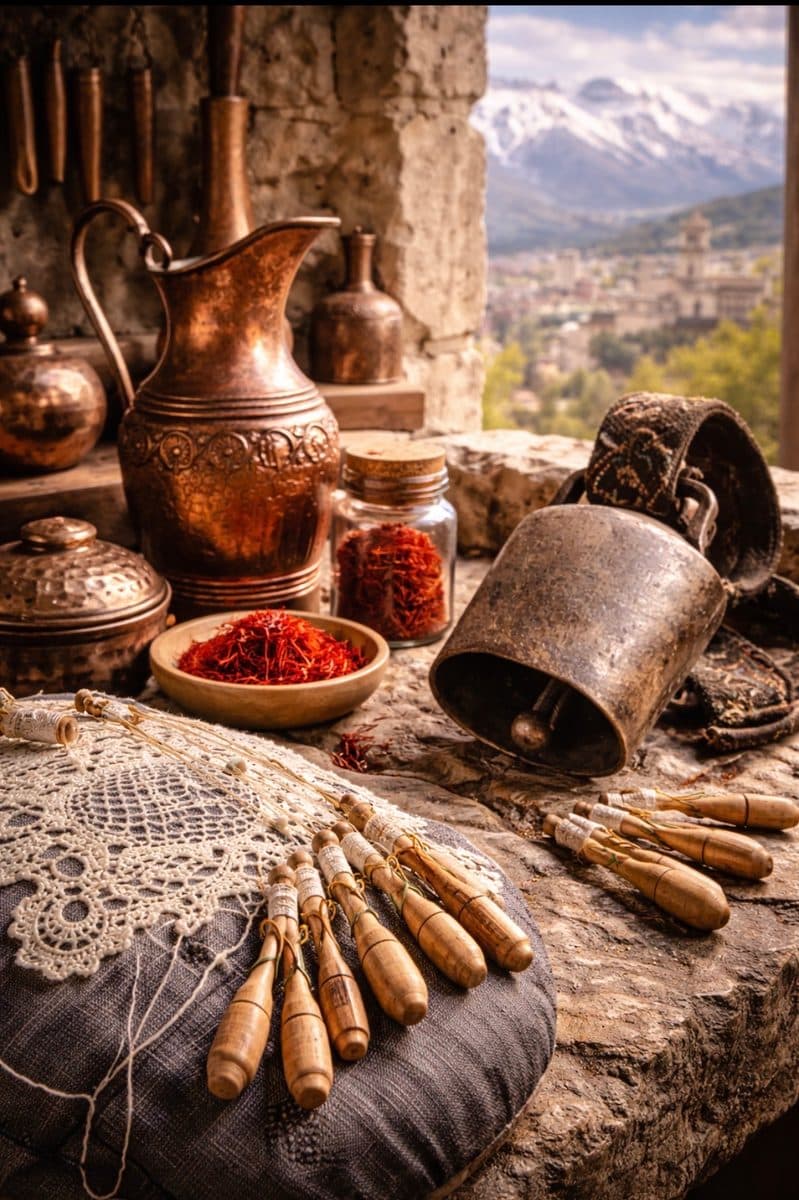
The Material Researcher's Eye
The material researcher observes a city starting from the materials that define it: metals, textile fibers, agricultural products.
In L’Aquila this perspective leads to three fundamental environments of the territory: • the mountains and pastoralism • the artisan workshops • the agricultural plateau of Navelli
The objects along the route — hammered copper, lace, cowbells, and saffron — tell the story of how local resources have been transformed into useful or precious objects through human work.
Hammered copper from the workshops of Abruzzo
Related souvenir: hammered copper object
Copper working is one of Abruzzo’s historic craft techniques. Artisans heat the metal and shape it with a hammer and anvil until it becomes household utensils or decorative objects. 
Among the most common items are: • cauldrons and pots • ladles • water basins • candlesticks and household objects
The copper basin was especially common in villages of the Apennines: it was used to carry water from public fountains to homes. 
These objects exist in this area because mountain communities needed sturdy utensils for cooking over open fires and for everyday domestic tasks.
The artisan workshops of the L’Aquila area have preserved these manual techniques, turning a simple material into long‑lasting objects.
Intertwined Threads: L’Aquila Lace
Related souvenir: bobbin lace
L’Aquila lace is made using the bobbin technique on a tombolo, a cylindrical cushion on which the threads are intertwined following a pattern fixed in place with pins.
Historical records indicate that by the end of the 15th century, L’Aquila already had a widespread production of lace. 
This tradition is linked to passementerie, the art of producing decorative trimmings for clothing and textiles.
Lace exists in this city for two historical reasons: 1. L’Aquila was an active commercial center in the Middle Ages. 2. Artisan workshops produced textiles and decorations for clothing and religious furnishings.
The result is an extremely light fabric, created solely by intertwining threads, without any backing fabric.
The sound of shepherding: cowbells
Related souvenir: pastoral cowbell
The mountains surrounding L’Aquila are part of the Apennine system of Gran Sasso and Maiella, territories historically devoted to shepherding.
For centuries, shepherds practiced transhumance, moving their flocks between Abruzzo and Puglia along the tratturi drovers’ roads.
It is in this context that the pastoral cowbell originated.
Its function is simple: • it is made of metal • it is hung around the animals’ necks • the sound allows the flock to be located while grazing.
Each cowbell has a specific shape and tone, which help the shepherd recognize the different animals.
This object exists precisely in territories like the L’Aquila area because the region’s traditional economy was strongly based on sheep farming and the long seasonal movements of flocks.
The red gold of the Navelli plateau
Related souvenir: Zafferano dell’Aquila DOP
Zafferano dell’Aquila DOP is one of Italy’s most precious agricultural products.
The spice is obtained from the stigmas of the Crocus sativus flower, harvested by hand and then dried. 
Cultivation is concentrated on the Navelli plateau, near L’Aquila. Here the karst soil and dry climate favor the plant’s growth. 
According to historical tradition, saffron was introduced to the area in the 13th century by a Dominican monk from Navelli who brought the bulbs back from Spain. 
In the 16th century the spice became an important commercial product for the city: European merchants came to L’Aquila to purchase it. 
Today the product is protected by the Protected Designation of Origin (DOP), which guarantees its origin from the municipalities of the L’Aquila area.
Conclusion
Through these objects, three fundamental characteristics of the L'Aquila area become clear. • The mountains encouraged pastoralism, from which the cowbell originates. • Artisan workshops developed techniques such as copperworking and bobbin lace. • The Navelli Plateau created the ideal conditions for a rare agricultural crop: saffron.
By observing different materials — metal, textile thread, and spices — the same logic emerges: the objects of the L'Aquila tradition are born from the meeting of the natural environment and artisanal work.
Contenido editorial elaborado con ayuda de la inteligencia artificial y revisado por Trouvenir. Puede contener imprecisiones.
Descarga gratis
Lleva Trouvenir contigo
iOS y Android. Gratis.
Privacidad primeroSincronización entre dispositivosFunciona sin conexión