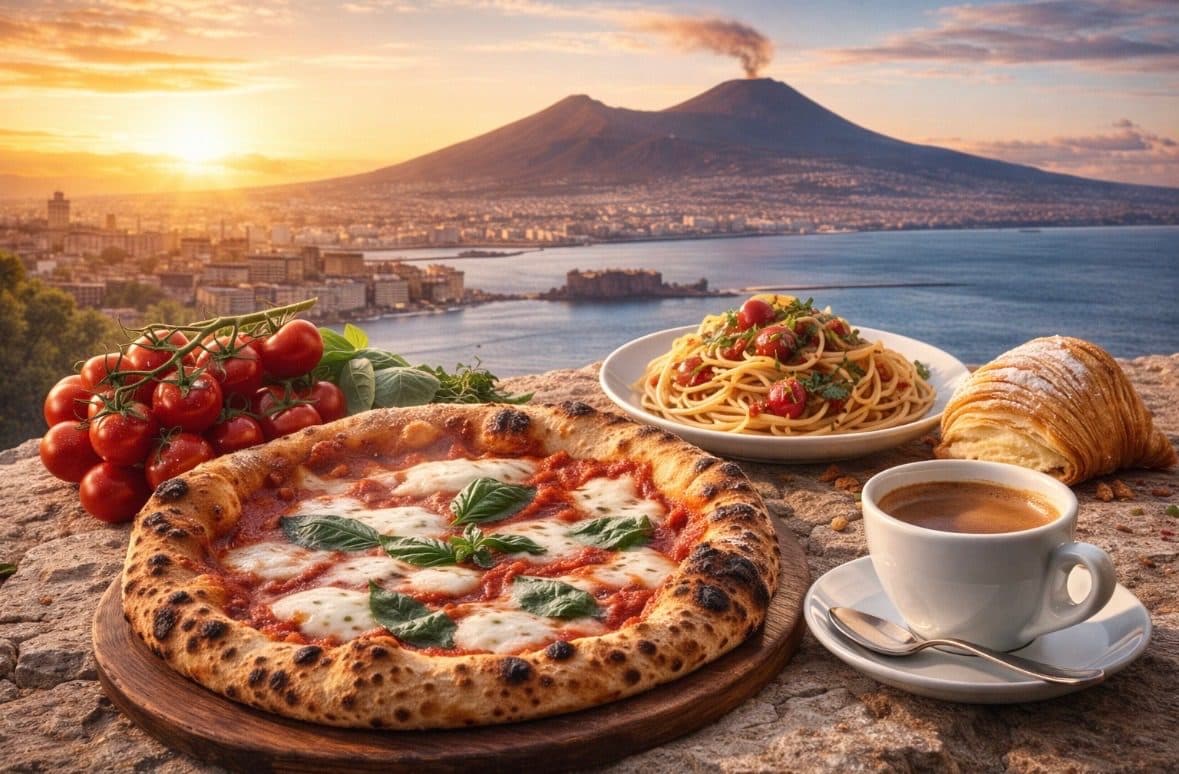
Introduction — The Cultural Gastronome’s Perspective
The cultural gastronome explores a city starting from its food. They are not only looking for delicious dishes, but want to understand: • where the ingredients come from • who produces them • the historical contexts in which they originated • why that particular city developed them.
Naples is one of the places best suited to this kind of journey. Its cuisine was born from the meeting of Vesuvian agriculture, fishing from the Gulf of Naples, and urban popular cooking.
The gastronomic souvenirs of this city tell the story of exactly this intertwining.
Vesuvius on the plate
Related souvenirs • Piennolo cherry tomatoes from Vesuvius • Neapolitan pizza
On the slopes of Mount Vesuvius grows one of Campania’s most distinctive agricultural products: Pomodorino del Piennolo del Vesuvio DOP.
This variety of tomato is cultivated in the volcanic soils of the Somma-Vesuvius complex, rich in minerals. After harvesting, the cherry tomatoes are tied into clusters called piennoli and hung in storage rooms to preserve them throughout the winter. 
These tomatoes have a thick skin and a high concentration of sugars and acidity, characteristics that make them ideal for Neapolitan cooking.
One of their most famous uses is Neapolitan pizza.
Modern pizza developed in Naples between the 18th and 19th centuries as a popular street food sold in the city’s streets. The art of its preparation — dough-making, hand-stretching, and baking in a wood-fired oven — is now recognized as UNESCO intangible cultural heritage. 
Pizza was born here because Naples had three fundamental elements: • flour and a strong breadmaking tradition • tomatoes grown in the Vesuvian countryside • mozzarella produced in inland Campania.
Pasta between the sea and the hills
Related souvenirs • Pasta di Gragnano IGP • Spaghetti with veraci clams
A few kilometers from Naples lies Gragnano, a town that since the 18th century has been one of the main centers of dried pasta production in Italy.
Its geographic position has been decisive: between the sea and the Lattari Mountains a natural ventilation forms that once favored the air-drying of pasta. For this reason, production became concentrated right here.
Today Pasta di Gragnano IGP is officially recognized and continues to be produced using bronze dies and durum wheat.
One of the most representative dishes of Neapolitan cuisine is spaghetti with veraci clams.
The dish originated from the availability of clams caught in the Gulf of Naples and from the widespread use of long pasta produced in the region.
The preparation is simple: • spaghetti • veraci clams • olive oil • garlic • parsley.
It is a perfect example of Mediterranean coastal cuisine.
The city's popular cuisine
Related souvenirs • Pasta with potatoes and provola • Neapolitan ragù • Neapolitan Genovese
Naples has developed a very rich home-style cuisine, born in households and in popular trattorias.
One example is pasta with potatoes and provola.
The dish combines: • short pasta • potatoes • smoked Campanian provola.
It is a typical recipe of Neapolitan home cooking and represents the tradition of inexpensive but hearty dishes.
Two of the city's most important sauces, instead, are:
Neapolitan ragù
It is a tomato sauce cooked very slowly with pieces of meat. The cooking can last several hours, often from the morning until Sunday lunch.
Neapolitan Genovese
Despite the name, it is a Neapolitan dish. It is a long cooking of: • onions • meat • wine.
According to food historians, the name may derive from Ligurian cooks active in Naples between the Middle Ages and the Renaissance.
The city's pastry shops
Related souvenirs • Sfogliatella • Babà • Pastiera
Neapolitan pastry shops have created some of the most recognizable desserts in the Italian tradition.
Sfogliatella
It originated in the 18th century in the monastery of Santa Rosa on the Amalfi Coast. It was later adopted by Neapolitan pastry shops.
It is made with: • puff pastry or shortcrust pastry • a ricotta filling • semolina • citrus zest.
Babà
It arrived in Eastern Europe and France in the 18th century and was later adopted in Naples, where pastry chefs transformed it into the rum-soaked dessert that is famous today.
Pastiera napoletana
A traditional Easter dessert prepared with: • ricotta • cooked wheat • eggs • orange blossom water.
It is closely linked to Neapolitan Easter celebrations and is traditionally prepared at home a few days before the holiday.
Conclusion
Through these gastronomic souvenirs, a clear characteristic of the city emerges.
Neapolitan cuisine is born from the meeting of: • volcanic land (Vesuvius tomatoes) • the sea (clams from the Gulf) • artisanal food craft (Gragnano pasta) • humble home cooking • the tradition of urban pastry shops.
Every dish exists in Naples for concrete reasons: • the Vesuvian soil suited to growing tomatoes • the port and fishing • the ideal climate for pasta production • a long tradition of family cooking.
Looking at these foods as gastronomic souvenirs, it becomes clear that Naples is not just a city famous for its food: it is a place where history, geography, and everyday life have shaped one of the most recognizable cuisines of the Mediterranean.
Editorial content produced with AI assistance and reviewed by our editors. It may contain inaccuracies.
Free download
Take Trouvenir with you
iOS and Android. Free.
Privacy-firstCross-device syncOffline ready