The Perspective of the Material Researcher
The material researcher explores a city by observing concrete objects and the materials they are made from.
They are not only looking for symbols or monuments. They want to understand: • which materials were used • which trades worked them • which economic activities made those objects common.
In Genoa this approach is particularly effective. The city grew as a commercial port and maritime hub, and many traditional objects were born precisely from its relationship with the sea, trade, and craftsmanship.
The route follows four fundamental materials: • marble • clay • durable textiles • cartographic paper
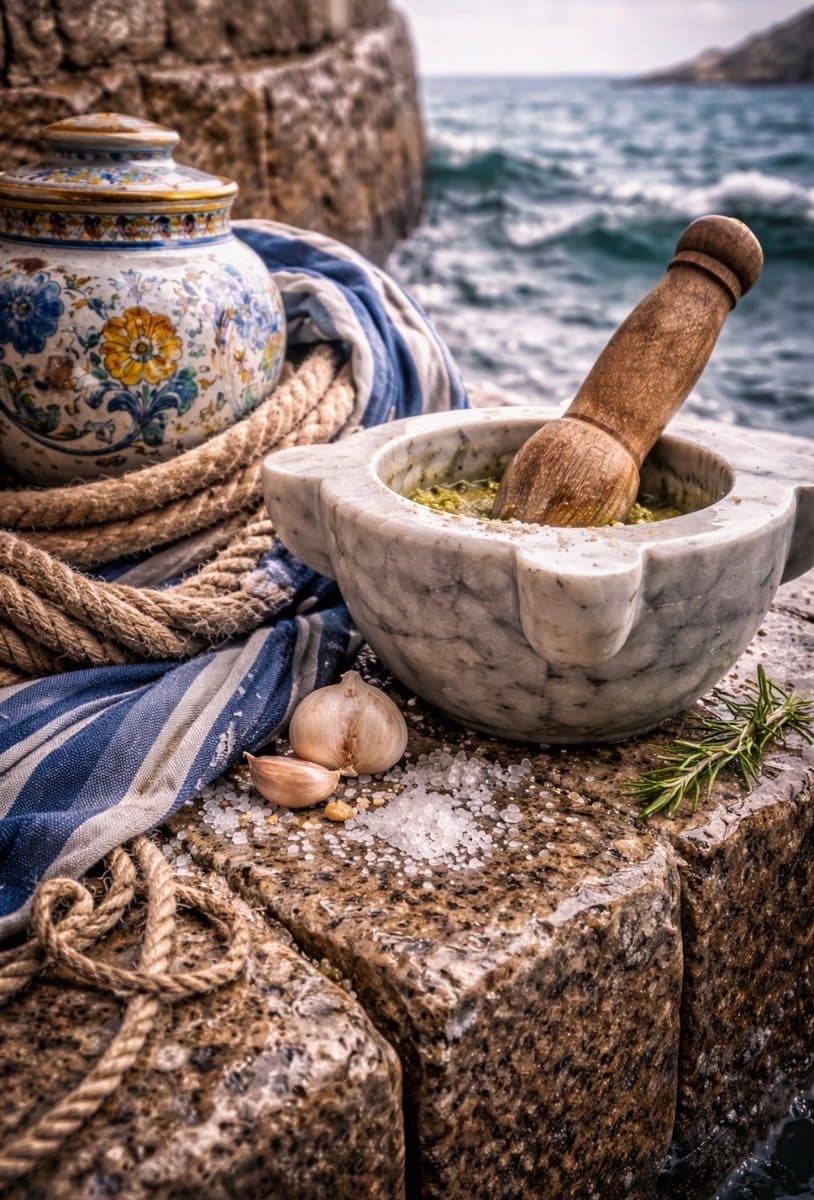
The marble mortar: the technique of pesto
Souvenir: Genoese marble mortar
The mortar is the traditional tool used to prepare pesto genovese, a sauce documented in Ligurian cuisine since at least the nineteenth century.
Pesto is prepared by crushing: • basil • garlic • pine nuts • parmesan or Pecorino • extra virgin olive oil • salt
The traditional technique requires a marble mortar and a wooden pestle.
Marble is chosen for practical reasons: • it is hard and durable • it does not absorb odors • it allows the leaves to be crushed without cutting them.
This utensil exists in Genoa because the local cuisine uses ingredients that must be crushed slowly, not blended.
The mortar therefore becomes a typical household tool in Ligurian homes.
Liguria’s clay: kitchen and pharmacy ceramics
Souvenir: decorated Ligurian ceramics
Between the 16th and 18th centuries, the Ligurian coast—especially Savona and Albisola—became one of the most important centers of Italian ceramics.
Here, glazed majolica was produced for: • plates • containers • apothecary jars • household objects.
The process involved: 1. shaping the clay 2. first firing 3. glazing with mineral oxides 4. second firing.
Ligurian decorations include: • plant motifs • stylized animals • symbolic figures.
Some historical examples also feature decorations with stylized spiders, incorporated into the ornamental motifs of majolica.
These objects were common in homes and workshops because glazed ceramics were durable and easy to clean, ideal for the kitchen.
The cloth of Genoa: the sailors’ fabric
Souvenir: Genoese cloth
For centuries, Genoa was one of the busiest ports in the Mediterranean. Port activities required very durable fabrics.
For this reason, a sturdy cotton or fustian cloth became widespread, used for: • sails • covers • sailors’ work clothes.
The fabric was exported to many European countries. In France it was called “bleu de Gênes”, meaning “blue of Genoa”.
From this expression comes the word jeans, now used all over the world to refer to denim trousers.
The fabric therefore originated in Genoa because the city needed strong materials for maritime and port work.
The Maps of the Mediterranean: Genoese Cartography
Souvenir: historical nautical chart
Between the 13th and 15th centuries, Genoa was a great maritime power.
To navigate, precise instruments were needed. For this reason, Genoese cartographers developed portolan nautical charts, maps that indicated: • coasts • ports • sea routes • distances.
One of the most important cartographers was Pietro Vesconte, active in the 14th century and author of some of the first detailed nautical charts of the Mediterranean.
These maps were working tools for merchants and navigators.
The cartographic tradition continued into the modern era with the founding in Genoa, in 1872, of the Istituto Idrografico della Marina, which still produces official nautical charts today.
Conclusion — What These Objects Reveal About Genoa
Looking at these four souvenirs, a very concrete picture of the city emerges.
The marble of the mortar tells the story of Ligurian home cooking. The clay of the ceramics shows a craft tradition spread along the coast. The sturdy canvas comes from the work of sailors and from port trade. Nautical charts reveal the technical knowledge required to navigate the Mediterranean.
Together these objects explain why Genoa has for centuries been: • a commercial port • a city of artisans • a center of navigation.
The material-focused researcher therefore discovers Genoa not only in its monuments, but in the materials that have supported the city’s daily life and work.
Editorial content produced with AI assistance and reviewed by our editors. It may contain inaccuracies.
Free download
Take Trouvenir with you
iOS and Android. Free.
Privacy-firstCross-device syncOffline ready