The Everyday Observer’s Gaze
The everyday observer explores a city through objects connected to people’s ordinary lives: the food they eat, the utensils used at home, the materials crafted in the region.
In Aosta, these objects tell the story of life in an alpine valley. The mountain climate, the availability of wood, agricultural cycles, and convivial traditions have shaped the population’s habits for centuries.
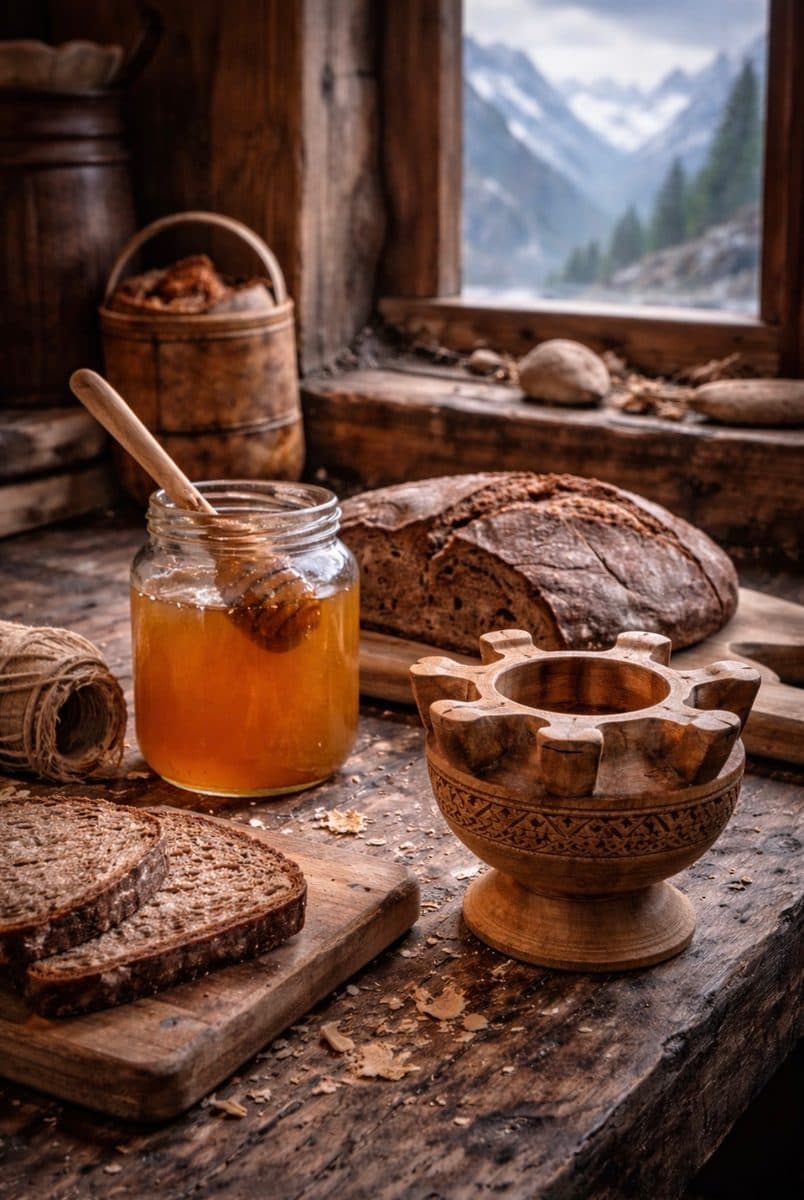
Through four objects — rye bread, mountain honey, the friendship cup, and wood carving — it is possible to observe how daily life has adapted to the conditions of the Aosta Valley.
The bread that lasted for months: rye black bread
Related souvenir: Rye black bread
In the Alpine areas, growing wheat was difficult. Rye, on the other hand, grows better in cold climates and on mountain soils.
For this reason, for centuries in the Aosta Valley the everyday bread was rye black bread.
Traditionally it was prepared once or twice a year in the communal ovens of the villages. Families kneaded large quantities of rye flour and baked many loaves on the same day.
After baking, the bread was dried on wooden racks so it could be stored for months. When it became very hard, it was softened with water or milk.
This system allowed families to face the long winter periods with a supply of bread.
Today black bread is still produced in bakeries across the Aosta Valley and celebrated during the Black Bread Festival, organized in several villages of the region.
Honey from Alpine Blossoms
Related souvenir: Aosta Valley mountain honey
The Aosta Valley has an alpine environment rich in wild blossoms: chestnut, rhododendron, linden, and high‑mountain flowers.
This biodiversity has encouraged the development of local beekeeping.
Beekeepers often move their hives between different altitudes during the summer season to take advantage of the various blooms. In this way, several types of honey are produced: • rhododendron honey, typical of alpine areas • chestnut honey • mountain wildflower honey
Honey is used in local cuisine, for example in the preparation of traditional desserts or as an accompaniment to alpine cheeses.
Production is also coordinated by the Aosta Valley Beekeepers' Consortium, which promotes quality and protects local products.
Drinking together: the grolla and caffè alla valdostana
Related souvenir: Grolla / friendship cup
The grolla, or friendship cup, is a wooden cup with several spouts.
It is used to drink caffè alla valdostana, a hot beverage prepared with: • coffee • Aosta Valley grappa • sugar • spices such as cinnamon or cloves
The cup is passed from hand to hand among the diners, and each person drinks from a different spout.
This gesture is tied to home conviviality and gatherings among friends or family, especially during the colder months.
Many grolle are made by local artisans and decorated with traditional carvings.
Winter and Wood: Craftsmanship of the Aosta Valley
Related souvenir: carved wooden object
Wood is one of the most important materials in the artisanal tradition of the Aosta Valley.
During the long winters, when work in the fields slowed down, many villagers devoted themselves to wood carving.
They created: • household utensils • containers • decorative sculptures • objects for rural life
The most commonly used woods are walnut, maple, cherry, and larch, all found in Alpine forests.
This tradition is still alive today and is celebrated through the Fiera di Sant’Orso, a major craft event held every year in Aosta on January 30 and 31.
Conclusion — A city told through everyday objects
The objects in this itinerary show how everyday life in Aosta has been shaped by the Alpine environment. • Rye bread comes from mountain agriculture. • Honey tells the story of the biodiversity of the Alpine valleys. • The grolla reflects the value of conviviality in Valle d’Aosta homes. • Carved wooden objects derive from the abundance of forests and the winter work of local inhabitants.
Seen together, these objects are not just souvenirs. They are tangible traces of the activities, materials, and habits that have shaped everyday life in the Aosta Valley.
Editorial content produced with AI assistance and reviewed by our editors. It may contain inaccuracies.
Free download
Take Trouvenir with you
iOS and Android. Free.
Privacy-firstCross-device syncOffline ready