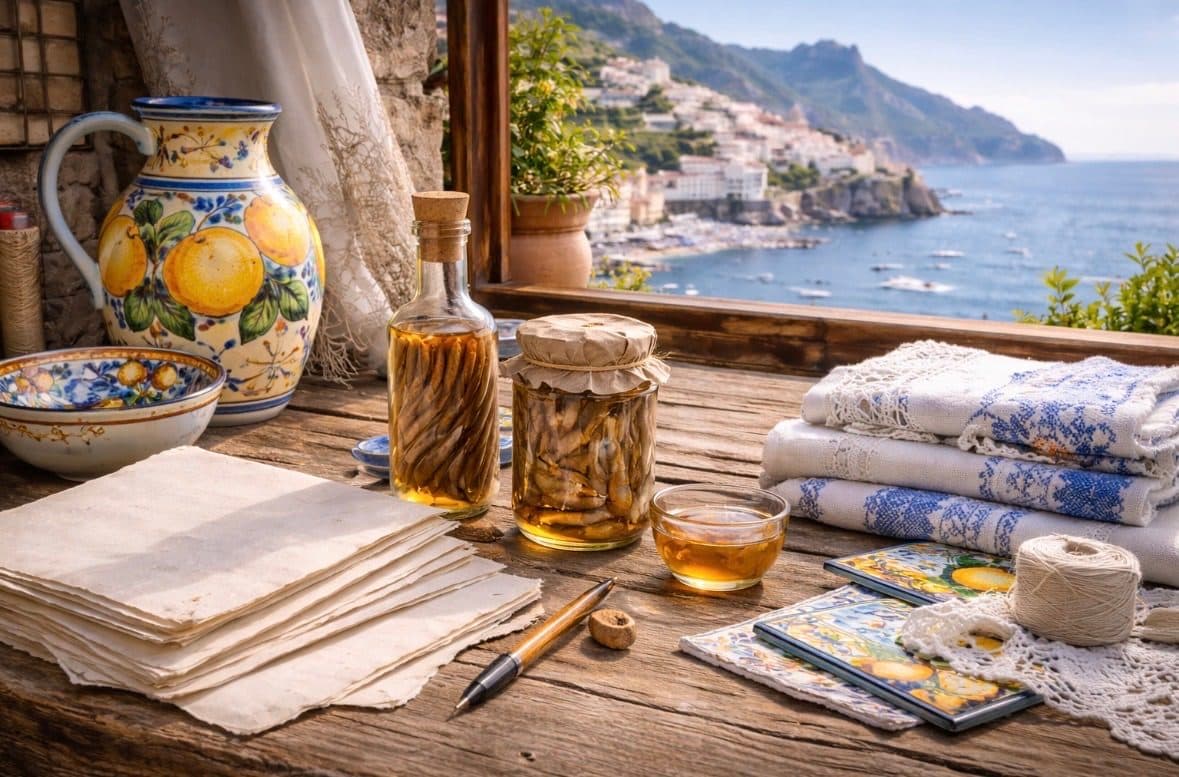
The Material Researcher’s Perspective
Those who visit Amalfi as a material researcher observe the city starting from the objects and the techniques that make them possible.
They do not simply look at the finished souvenir. They ask: • what material it is made from • where that material comes from • which technique was developed to work it • why that technique originated right here
The Amalfi Coast is a narrow land between steep mountains and the sea, where for centuries inhabitants developed activities that made use of specific local resources: stream water, clays, fish from the Tyrrhenian Sea, and Mediterranean crops.
By following these objects — paper, ceramics, textiles, and colatura di alici — it is possible to reconstruct a small geography of the coast’s artisanal techniques.
The paper of Amalfi’s mills
Souvenir: Amalfi paper
Between the 13th and 18th centuries, Amalfi hosted one of the main paper production centers in southern Italy.
Production took place in the Valle dei Mulini, a valley not far from the historic center where small streams from the Monti Lattari flow. The power of the water drove the mill machinery needed for processing.
Amalfi paper, also called bambagina, was produced from linen and cotton rags. The process involved: 1. soaking the rags 2. reducing them to a fibrous pulp 3. immersing the frame in the vat 4. pressing and drying the sheets.
This paper was valued for its strength and durability, which is why it was used for official documents and notarial records.
Even today, some artisan workshops continue the manual production, and the history of the craft is told at the Museo della Carta of Amalfi, housed in an ancient paper mill.
Clay and colors of Vietri ceramics
Souvenir: Artistic ceramics of the Amalfi Coast
About 20 km from Amalfi lies Vietri sul Mare, one of the most important centers of Italian artistic ceramics.
Local production developed thanks to the presence of clays suitable for ceramic work and the coastal location, which made trade easier.
The main technique is maiolica, a ceramic coated with white glaze on which decorative motifs are painted before the second firing.
Traditional motifs often depict: • lemons of the Amalfi Coast • fish • Mediterranean landscapes • geometric decorations.
In the twentieth century, production received renewed attention thanks to Italian and European artists and ceramists who worked in Vietri, helping spread the Vietri style.
Today ceramics are still produced by artisan workshops and local studios.
Fabrics and Embroidery of the Coast
Souvenir: Fabrics and Embroidery of the Amalfi Coast
The textile tradition of the Amalfi Coast is mainly linked to the production of household fabrics such as: • tablecloths • curtains • bedspreads • decorative furnishing fabrics.
Historically, linen and cotton were used, fibers common in Mediterranean textile production.
The fabrics were often decorated with hand embroidery, made for domestic use or for a bride’s trousseau, a practice widespread in many areas of southern Italy until the 20th century.
In the artisan workshops along the coast, you can still find fabrics featuring patterns inspired by the local landscape, such as: • lemons • olive branches • marine elements.
These textiles reflect the craft tradition connected to domestic life and hospitality, central elements of the culture of the Amalfi Coast.
Colatura di Alici di Cetara
Souvenir: Colatura di Alici di Cetara DOP
A few kilometers from Amalfi lies Cetara, one of the main fishing villages of the Amalfi Coast.
This is where colatura di alici is produced, a sauce obtained from the aging of anchovies packed in salt.
The traditional process involves: 1. cleaning anchovies caught in the Gulf of Salerno 2. placing them in small wooden barrels called terzigni 3. alternating layers of fish and salt 4. aging for several months.
During the maturation process, a liquid forms that is collected and filtered: this is the colatura.
The product received the Denomination of Protected Origin (DOP) status in 2020.
Traditionally it is used to dress spaghetti with colatura di alici, a typical dish of Campanian cuisine.
Conclusion — The Materials of the Coast
Seen together, these objects tell the story of how the inhabitants of the Amalfi Coast gradually built artisanal activities connected to the resources available in their territory. • The water of the streams powered the paper mills. • Local clays made Vietri ceramics possible. • Domestic traditions kept the production of embroidered textiles alive. • The waters of the Tyrrhenian Sea gave rise to Cetara anchovy colatura.
These are not simple souvenirs: they are the result of techniques, materials, and knowledge developed in a specific territory, where sea and mountains have shaped the economic and artisanal activities of the local population for centuries.
Editorial content produced with AI assistance and reviewed by our editors. It may contain inaccuracies.
Free download
Take Trouvenir with you
iOS and Android. Free.
Privacy-firstCross-device syncOffline ready