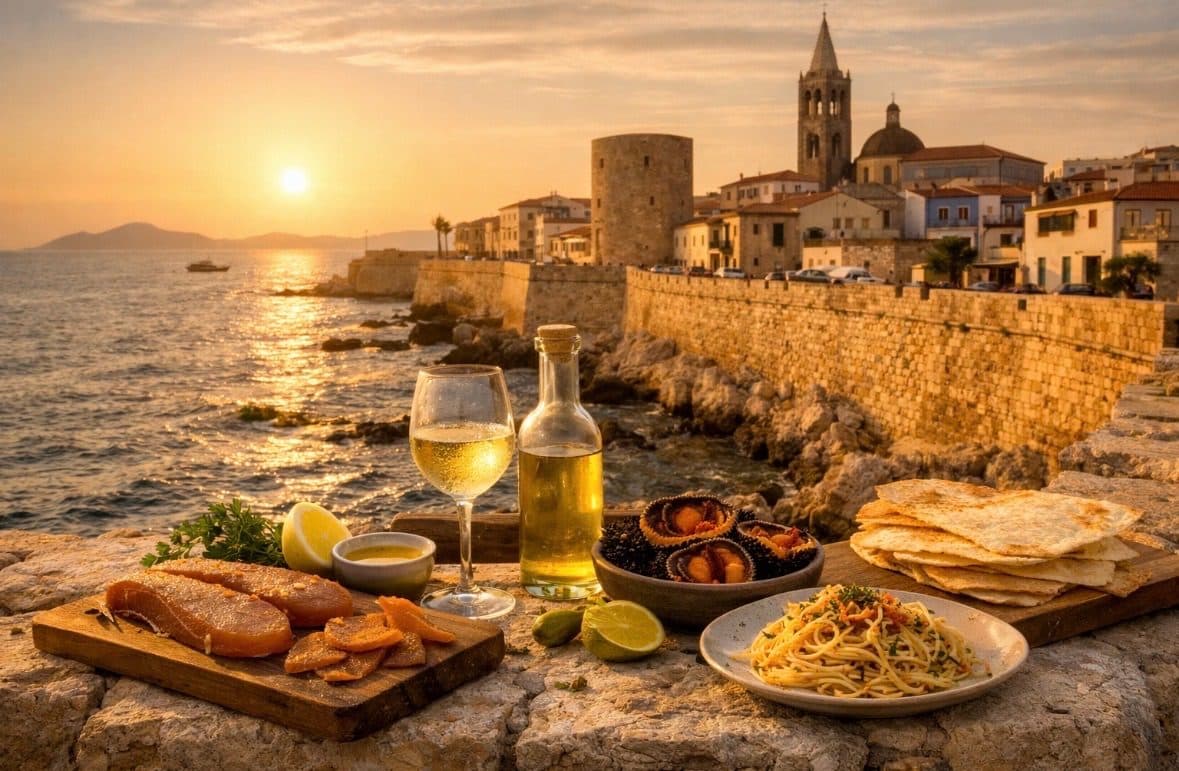
The Cultural Gastronomist’s Perspective
The cultural gastronomist explores a city through its food.
They are not just looking for good dishes: they want to understand where the ingredients come from, how they are prepared, and what story they tell.
In Alghero, this perspective is particularly interesting. The city lies on the northwestern coast of Sardinia and for centuries was part of the Catalan world. For this reason, the local cuisine brings together Sardinian tradition, seafood, and Catalan influences.
By following a few typical products — from bottarga to Torbato wine — it is possible to trace the relationship between the sea, agriculture, and the city’s history.
The sea as the city’s pantry
Related souvenirs • grilled fish from the gulf • fregola with seafood • sea urchins with pane carasau
Alghero looks out over a wide gulf of the Mediterranean. For centuries, coastal fishing supplied much of the city’s daily food.
In the restaurants along the harbor, fish is often cooked simply on the grill. This technique makes it possible to use the day’s catch without complex preparation.
One of the most common dishes is fregola with seafood. Fregola is a pasta made from durum wheat semolina shaped into small granules and then toasted. This step gives it a more intense flavor and makes it particularly suited to fish soups or seafood broths. 
During winter and early spring, another highly prized product is sea urchins. They are eaten raw or served with pane carasau, the ultra-thin bread born from the pastoral tradition of Sardinia and designed to keep for a long time. 
This chapter introduces the first essential element of local cuisine: the sea as a daily source of ingredients.
Preserving the sea: bottarga and tuna
Related souvenirs • bottarga • pasta with bottarga • tuna in olive oil
Not all fish is eaten fresh. In the Mediterranean, techniques for preserving the catch have existed for centuries.
One of the most famous is bottarga, made from grey mullet roe that is salted and dried. The product is sold whole or grated and used as a seasoning for pasta. 
The technique is very ancient and was already widespread across the Mediterranean during Phoenician and Arab times. 
In Alghero, bottarga is often grated over simple pasta with olive oil, creating a dish that is very common in coastal restaurants.
Another form of preservation is tuna in olive oil, linked to the tradition of Mediterranean tuna fisheries. In Sardinia, tuna fishing has a long history and has given rise to several local gastronomic preparations. 
These techniques made it possible to preserve fish for long periods and are still part of regional cuisine today.
The wine that grows only here: Torbato di Alghero
Related souvenir • Torbato di Alghero
The wine most closely tied to the territory of Alghero is Torbato.
It is a rare grape variety cultivated mainly around the city and protected by the DOC Alghero.
According to several historical accounts, the grape arrived in Sardinia through contacts with the Catalan-Aragonese world and adapted particularly well to the limestone soils and maritime climate of the area.
Today Torbato is vinified in several styles — still or sparkling — and is known for its fresh, mineral profile, which pairs well with fish dishes.
This wine tells an important part of Alghero’s agricultural history: the meeting of Mediterranean viticulture and local tradition.
Catalan influences: menjar blanc
Related souvenir • menjar blanc
Alghero is often called “Barceloneta”, because in the 14th century the city came under the control of the Crown of Aragon.
This history has also left traces in the local cuisine.
One example is menjar blanc, a dessert of Catalan origin made with milk, sugar, and starch, flavored with lemon zest or cinnamon.
Similar sweets also exist in Catalonia and in southern France, a sign of the cultural connections of the western Mediterranean.
In Alghero, menjar blanc has remained part of the local tradition and is often served as a dessert in the city’s restaurants.
Sardinia’s aromatic finale: mirto
Related souvenir • mirto
The traditional meal in Sardinia often ends with a small glass of mirto.
The liqueur is made by macerating the berries of the myrtle plant in alcohol, a shrub typical of the Mediterranean scrub.
After maceration, the liquid is filtered and sweetened, resulting in a dark, aromatic liqueur.
The widespread presence of the plant in Sardinian vegetation explains why this liqueur has become one of the island’s most representative specialties.
Conclusion
Through these dishes and ingredients, you can read the gastronomic history of Alghero. • the sea provides fish, sea urchins, and seafood • Mediterranean techniques make it possible to preserve the catch, as in the case of bottarga • local viticulture produces a rare wine such as Torbato • Catalan history survives in desserts like menjar blanc • the Mediterranean scrubland offers aromas such as myrtle
These gastronomic items are not simple souvenirs: they tell how the land, the sea, and history have shaped the city’s cuisine.
Editorial content produced with AI assistance and reviewed by our editors. It may contain inaccuracies.
Free download
Take Trouvenir with you
iOS and Android. Free.
Privacy-firstCross-device syncOffline ready