Geschichte♛ Premium
Reggio Calabria between sea and mountains: symbols of a land of the Strait
Symbolic explorer
Introduction — The Gaze of the Symbolic Explorer
A symbolic explorer does not simply look for objects to take home. They look for objects that help explain how a city tells its story through its landscape, the work of its people, and its local traditions.
In Reggio Calabria these signs emerge clearly: • the landscape of the Strait of Messina, • the devotion of the seafaring communities, • the unique agriculture of bergamot, • the rural craftsmanship of the Aspromonte.
By following these objects, you move through a territory wedged between sea and mountains, where maritime activities and rural culture have coexisted for centuries.
The Strait Seen by Travelers
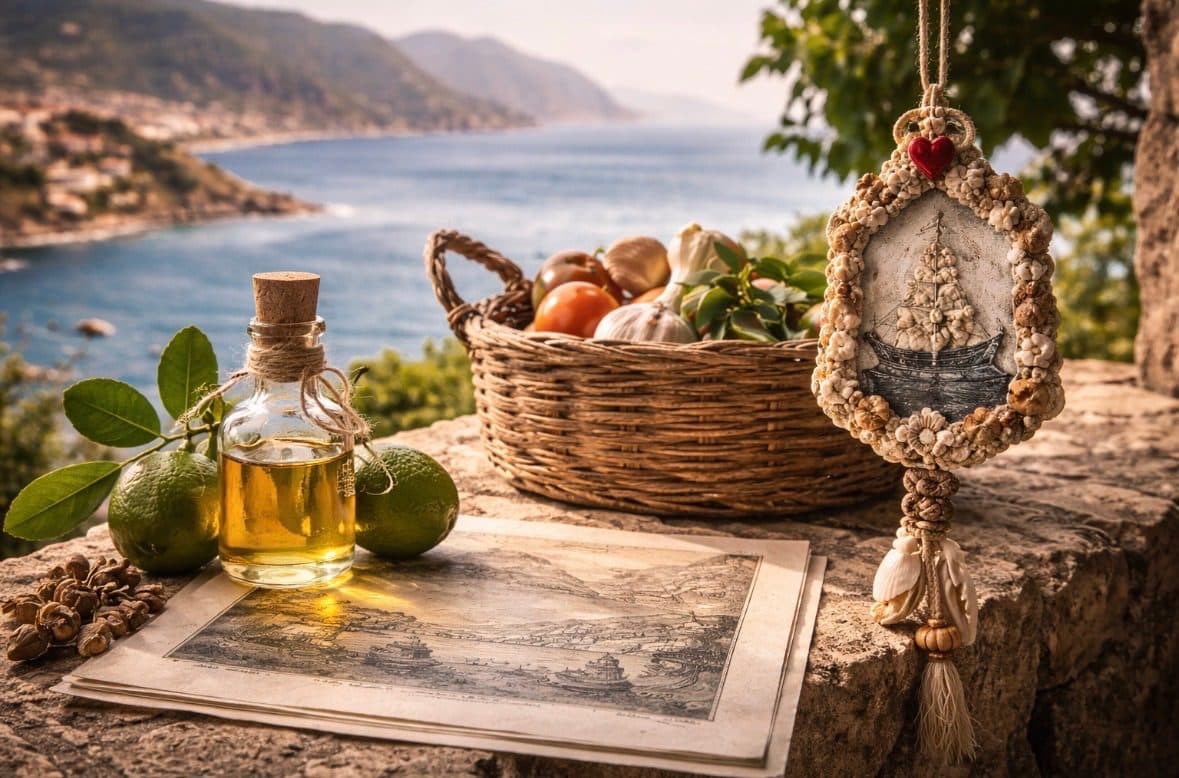
Related souvenir: Historical print or engraving of the Strait
Between the 17th and 19th centuries the Strait of Messina frequently appeared in maps, panoramic views, and engravings created for European travelers.
Many of these visitors were taking part in the Grand Tour, the educational journey that brought aristocrats and scholars to visit Italian cities.
The strait was a privileged observation point for several reasons: • it is the narrowest passage between the Italian peninsula and Sicily, about 3 km wide at its narrowest point • it was a key route for Mediterranean navigation • the landscape has fueled since antiquity the myth of Scylla and Charybdis, mentioned by Greek and Latin authors.
The engravings depicting the strait were not only artistic souvenirs: they also served as geographic and scientific documentation for scholars and cartographers.
For this reason, one of the most common memories associated with Reggio is precisely the image of its seascape.
The Sea and the Protection of Sailors
Related souvenir: Devotional maritime object from Reggio
The coastal communities of the Strait have developed over the centuries a strong religious tradition connected to the sea.
Fishermen and sailors entrusted the safety of their voyages to sacred images, medals, or small ex-votos. These objects were often kept on boats or donated to churches after a difficult journey or a storm.
In the Mediterranean, maritime ex-votos have been documented since at least the 16th century and often take the form of: • models of boats • painted panels depicting a rescue at sea • objects offered in thanks to the Madonna or to patron saints.
In Reggio Calabria these practices reflect the daily relationship with one of the most complex stretches of sea in the Mediterranean, characterized by strong currents and constant maritime traffic.
Maritime devotional objects therefore tell the real-life story of the fishermen of the Strait.
The fragrance that exists only here: bergamot
Related souvenir: Bergamot essence from Reggio Calabria
Bergamot (Citrus bergamia) is one of the most distinctive citrus fruits grown in Italy.
Almost all of the world’s production grows along a very specific coastal strip in the province of Reggio Calabria, about 100 km long between Villa San Giovanni and Gioiosa Ionica.
This concentration depends on very precise environmental conditions: • mild climate • coastal soils • exposure to the sea • the absence of severe frosts.
From the fruit, an aromatic essence is extracted that is used mainly in perfumery. Bergamot essential oil is in fact one of the base ingredients in many fragrances.
Production is protected by the Consorzio del Bergamotto di Reggio Calabria, which manages the DOP designation.
For this reason, a small bottle of the essence is one of the city’s most representative souvenirs: it tells the story of a crop that exists almost exclusively in this territory.
The Baskets of Aspromonte
Related souvenir: Woven basket from the Aspromonte area
A few kilometers from the coast of the Strait rises the Aspromonte massif, a mountainous area with a long agricultural and pastoral tradition.
Here, the weaving of plant fibers was for centuries a widespread skill in rural communities. Baskets were used for many everyday activities: • collecting olives and citrus fruits • transporting agricultural products • storing bread or other foods.
Craftsmen used local materials such as: • rush • willow • river reeds.
The object therefore reflects the mountain side of the Reggio area. If bergamot tells the story of the coast, woven baskets tell the story of agricultural life in the Aspromonte hinterland.
Conclusion — What These Objects Reveal About Reggio Calabria
Seen together, these souvenirs reveal the true structure of the Reggio Calabria area. • engravings of the Strait tell of the landscape that attracted travelers and cartographers for centuries • maritime devotional objects recall the lives of fishermen and sailors • bergamot essence documents a cultivation that is almost unique in the world • baskets from Aspromonte show the agricultural work of the inland areas.
Reggio Calabria thus emerges as a city built on two very different yet closely connected environments: the waters of the Strait and the mountains of Aspromonte.
The objects people take home from here are not just souvenirs: they are tangible traces of the activities and landscapes that have shaped this territory.
Redaktioneller Inhalt, erstellt mit Unterstützung künstlicher Intelligenz und von Trouvenir geprüft. Er kann Ungenauigkeiten enthalten.
Kostenlos herunterladen
Nimm Trouvenir mit
iOS und Android. Kostenlos.
Privacy firstGeräteübergreifende SynchronisierungFunktioniert offline