Geschichte♛ Premium
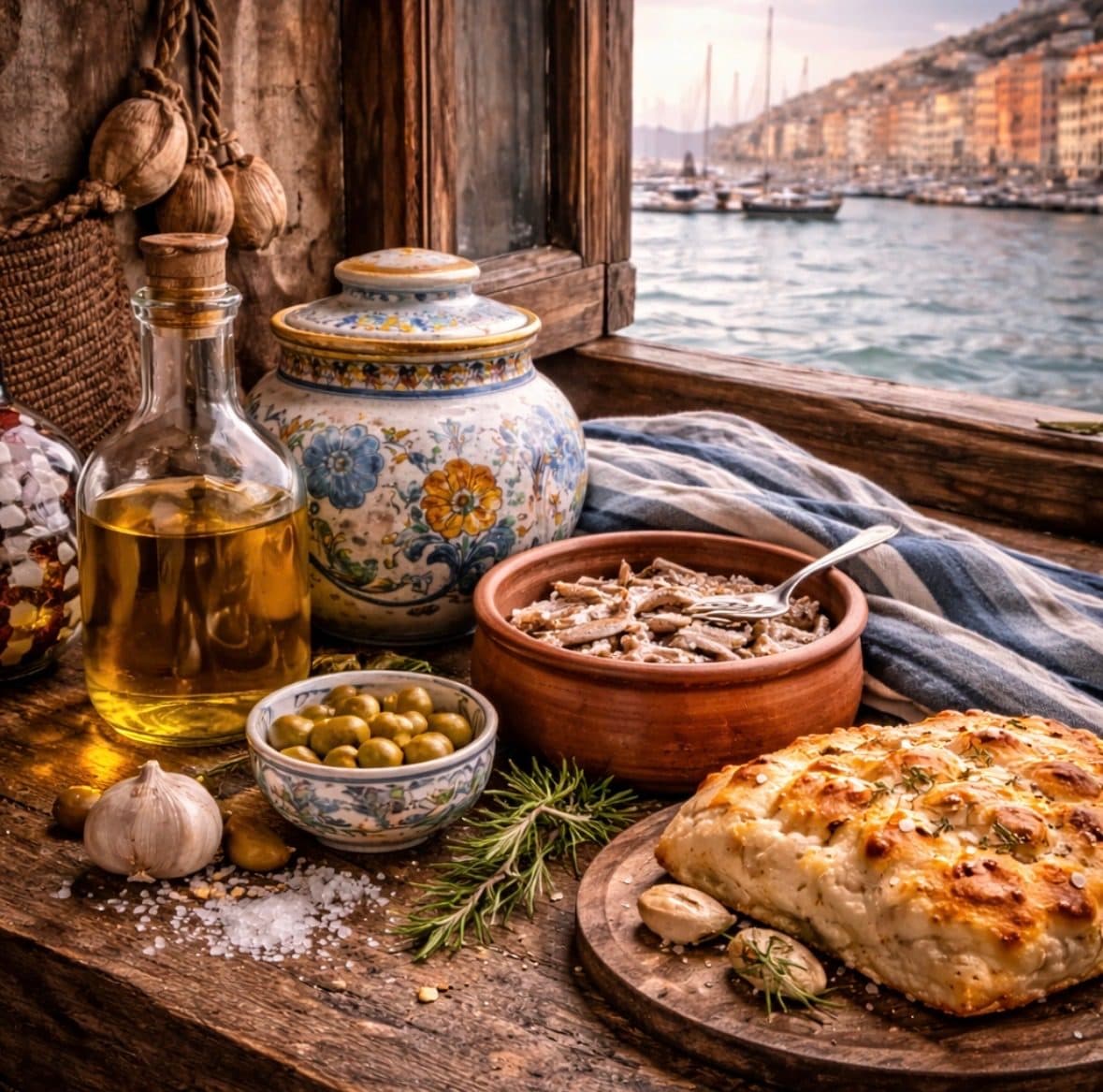
Everyday Genoa: food, textiles, and objects of port life
Everyday Observer
The Everyday Observer’s Gaze
Those who visit Genoa with the gaze of an everyday observer do not start with noble palaces or grand monuments.
Instead, they notice the most ordinary objects: those that make their way into kitchens, boats, and homes.
In Genoa, many of these objects are tied to its history as a port and trading city. Preserved foods, sturdy textiles, and simple tableware tell the story of how sailors, fishermen, and families once lived.
This route moves through four objects born from the same reality: a city wedged between sea and hills, where work, trade, and home cooking have always played a central role.
The oil of the terraced hills
Souvenir: Ligurian extra virgin olive oil
Just behind Genoa, very steep hills begin. To cultivate them, over the centuries local inhabitants built thousands of terraces supported by dry-stone walls.
These structures make it possible to grow olive trees even on difficult slopes. 
From these groves comes Riviera Ligure DOP extra virgin olive oil, a designation that identifies oils produced in different areas of the region using local olive varieties, including Taggiasca. 
The flavor is generally delicate and slightly sweet, a characteristic that makes it well suited to the simple dishes of Ligurian cuisine, often based on fish or vegetables. 
For this reason, olive oil is one of the most common ingredients in everyday cooking: it dresses focaccia, vegetable soups, fish, and pasta.
In a city where butter has historically been little used, olive oil became the main seasoning in Ligurian homes.
Preserving the Fish of the Port
Souvenir: Salt-packed anchovies
Genoa was for centuries one of the main ports of the Mediterranean. Blue fish — especially anchovies — were abundant in the waters of the Ligurian Sea.
But fresh fish does not keep for long.
For this reason, a very simple technique spread: anchovies are cleaned, arranged in layers, and covered with salt in terracotta or wooden containers.
The salt draws out the water and allows the fish to be preserved for months.
This method was essential for: • fishermen • sailors • families in the port districts
Salt-packed anchovies thus became an ingredient that was always available for many home dishes, such as: • savory pies • sauces • seasonings for vegetables.
In a seaside city, preserving fish is an integral part of everyday cooking.
Tableware of the Ligurian kitchen
Souvenir: Ligurian utilitarian ceramics
Many pieces of tableware used in Ligurian kitchens came from the region’s ceramic centers, particularly Albisola, on the coast near Genoa.
Ceramic production here has been documented since at least the 16th century and mainly included: • plates • bowls • kitchen containers.
Decorations were often simple: plant motifs or traditional colors such as blue.
These objects were not intended as artistic souvenirs but as household utensils. They were used for cooking, serving, and storing food.
Even today, Ligurian ceramics maintain this connection with the everyday life of the kitchen.
The Fabric of the Port Workers
Souvenir: Traditional Genoese canvas
One of the most surprising products linked to Genoa is a work fabric: Genoese canvas.
Since the 16th century, the city produced a sturdy fabric made of cotton or fustian, often dyed with blue indigo. 
It was inexpensive and durable—ideal qualities for: • sailors • dockworkers • port laborers.
For this reason it was used to make work trousers and ship coverings.
Genoese fabric was exported to many European countries and, in the 19th century, inspired the trousers worn by gold prospectors in the United States. 
From this tradition, modern jeans would be born.
Behind one of the most widespread garments in the world lies a fabric that originated in the everyday life of a port city.
Conclusion - A city told through everyday objects
Looking at these four objects, a very concrete image of Genoa emerges.
The olive oil tells the story of terraced hillsides cultivated with olive trees. Salt-cured anchovies speak of fishing and the preservation of fish. Ceramics reveal Ligurian home kitchens. Genoese canvas recalls work in the port and international trade.
These are not souvenirs created for tourists.
They are objects that exist because, for centuries, the city has had: • a difficult landscape to cultivate • a major commercial port • a cuisine based on simple ingredients • a strong culture of maritime work.
Looking at these everyday objects, it becomes clear that Genoa is not only a city of historic palaces.
Above all, it is a city built around the sea, work, and home cooking.
Redaktioneller Inhalt, erstellt mit Unterstützung künstlicher Intelligenz und von Trouvenir geprüft. Er kann Ungenauigkeiten enthalten.
Kostenlos herunterladen
Nimm Trouvenir mit
iOS und Android. Kostenlos.
Privacy firstGeräteübergreifende SynchronisierungFunktioniert offline