Kunst♛ Premium
Genoa between sea, devotion, and cuisine: a journey through the city’s symbolic objects
Symbolic Explorer
The Symbolic Explorer’s Gaze
The symbolic explorer observes a city through objects that tell the story of its identity.
They are not simply looking for decorative souvenirs. They look for objects that explain how the city took shape, which activities sustained its economy, and how its inhabitants lived in their territory.
In Genoa many of these objects are born from the relationship with the sea. For centuries the city was a great commercial power of the Mediterranean, and even today its cultural landscape reflects this history.
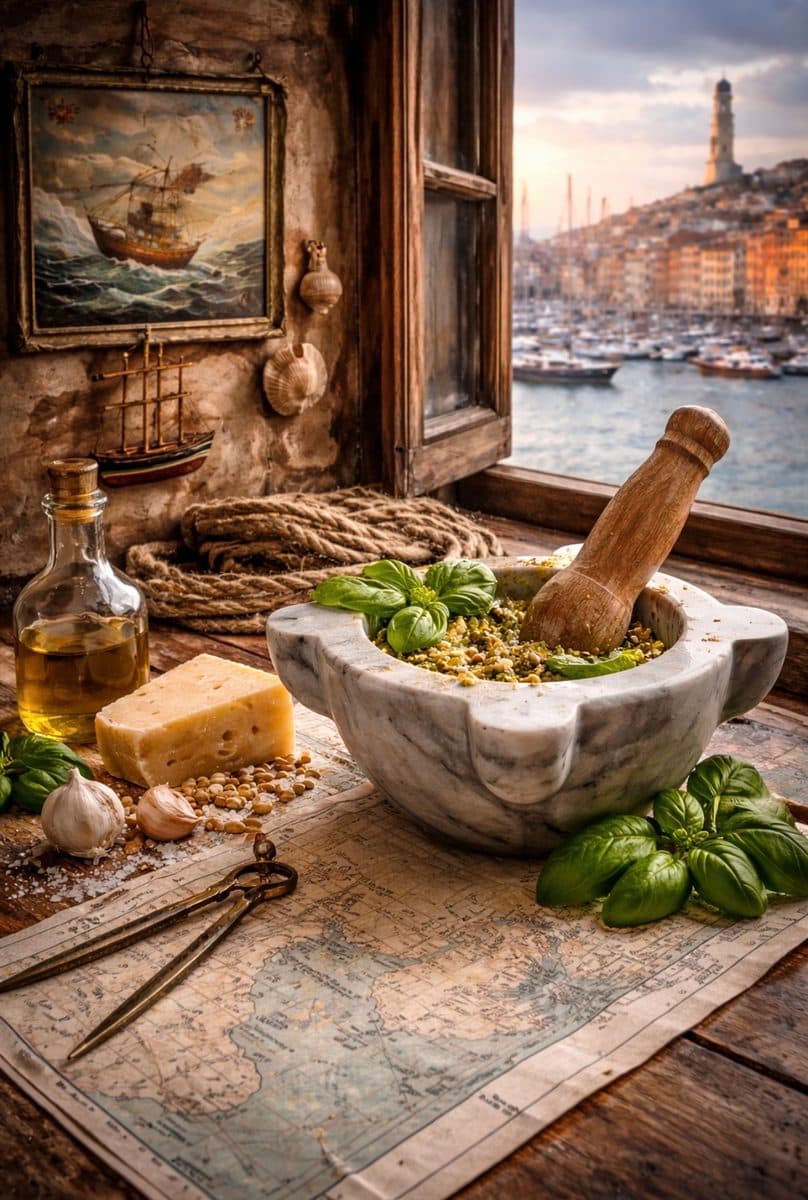
Nautical charts, maritime votive offerings, basil grown on the hills, and marble mortars in the kitchens tell four dimensions of the same city: navigation, faith, agriculture, and cuisine.
The Sea and Fear: Sailors’ Ex Votos
Related souvenir: • Ligurian maritime ex voto
Sailing in the Mediterranean until the modern era was dangerous. Storms, pirates, and shipwrecks were part of sailors’ lives.
For this reason, the tradition of maritime ex votos is widespread in Ligurian churches. They are small paintings, model ships, or votive objects offered by sailors as thanks for surviving a danger at sea.
Many of these objects depict the moment of the storm or the shipwreck. Beside the scene there is often the image of a saint or the Madonna, indicating divine protection.
A significant collection was exhibited at the Museo Diocesano di Genova, with works from Ligurian churches and sanctuaries dating between the 17th and 19th centuries. 
These objects explain something essential about the city’s maritime culture: the sea was an economic resource, but also a constant source of danger.
The basil of the hills of Prà
Related souvenir: • Genoese basil
Basil does not grow in the same way across all Mediterranean regions. Basilico Genovese is a particular variety grown mainly in the area of Prà, today a district of Genoa.
The mild climate, proximity to the sea, and the soils of the Ligurian hills favor a plant with small leaves and a delicate aroma.
This variety is now protected by the Basilico Genovese DOP designation, which defines the production area and the characteristics of its cultivation. 
For this reason, basil has become one of the most representative ingredients of the city.
It is not simply an aromatic herb: it is the result of a very specific agricultural environment, closely tied to the Ligurian coast.
Pesto and the mortar: Genoese home cooking
Related souvenirs: • Genoese pesto • Genoese marble mortar
Pesto is one of the best-known dishes in Italian cuisine, but it was born in a very specific context: the home cooking of Genoa.
The first written recipe appears in the book “The True Genoese Cook” (1852). The sauce is prepared by crushing basil, garlic, pine nuts, cheeses, and olive oil. 
The verb “to crush” also explains the name of the sauce. Traditionally the ingredients are worked in a marble mortar with a wooden pestle, which allows the leaves to be crushed slowly without heating them. 
The mortar is therefore not just a kitchen tool: it represents the traditional preparation method.
Even today, Genoa hosts the World Pesto Championship with mortar and pestle, organized to promote the traditional recipe.
Conclusion — Objects That Tell the Story of the City
Looking at these souvenirs together reveals a coherent story. • Nautical charts tell the story of Genoa’s navigators and its Mediterranean trade. • Maritime ex votos show the everyday life of sailors and their devotion. • Basil reveals the relationship between the city and its agricultural hinterland. • Pesto and the mortar tell the story of a home cuisine born from these local ingredients.
Very different objects thus end up describing the same cultural landscape: a city built between its port, cultivated hills, and seafaring tradition.
Through these objects, Genoa appears not only as a place to visit, but as a city where the sea, cuisine, and daily life have always been closely connected.
Redaktioneller Inhalt, erstellt mit Unterstützung künstlicher Intelligenz und von Trouvenir geprüft. Er kann Ungenauigkeiten enthalten.
Kostenlos herunterladen
Nimm Trouvenir mit
iOS und Android. Kostenlos.
Privacy firstGeräteübergreifende SynchronisierungFunktioniert offline