The Gaze of the Everyday Observer
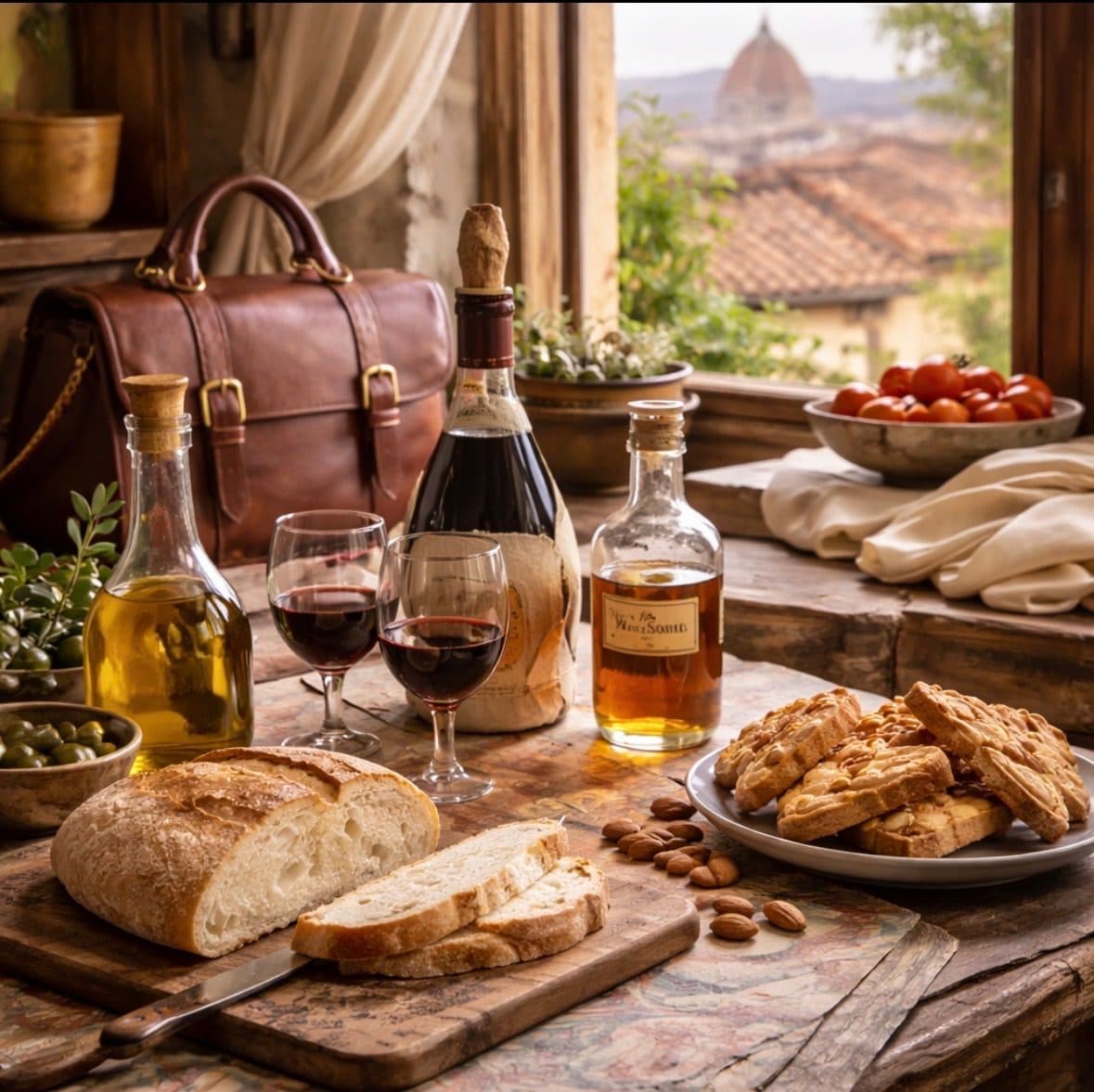
The everyday observer explores a city through objects that are part of people’s real lives: what is eaten every day, what is used in workshops, what is found in homes.
In Florence, this means looking beyond the monuments and noticing bread, oil, biscuits, paper, and craft materials. Many of these objects come from very concrete economic activities: agriculture in the Tuscan countryside, arts and trades organized in medieval guilds, and workshops still present in the historic center.
By following these products, a city emerges that was built not only by artists and architects, but also by bakers, farmers, papermakers, tanners, and bookbinders.
Saltless bread: the Florentine table
Souvenir: • Pane sciocco (unsalted bread) • Tuscan extra virgin olive oil
Tuscan bread is known for an unusual characteristic: it contains no salt.
According to several historical sources, this habit dates back at least to the Middle Ages. A widely shared explanation involves the commercial tensions between Florence and Pisa in the 12th century, which reportedly made salt very expensive. Over time, the salt‑free recipe became a well‑established tradition.
Pane Toscano DOP is made with soft wheat flour, water, and natural yeast. The absence of salt gives it a neutral flavor, allowing it to accompany the richly seasoned dishes of the local cuisine.
For this reason, the bread is often eaten with Toscano IGP extra virgin olive oil, produced from olives grown in the region’s hills.
The regulations for Toscano IGP oil establish that the oil must come from olives grown in Tuscany and processed within specific timeframes to preserve aroma and quality.
Bread and oil are still today one of the simplest gestures of Florentine home cooking.
The sweet moment: cantucci and Vin Santo
Souvenir: • Cantucci • Vin Santo
Cantucci are dry almond biscuits typical of Tuscany. Their name already appears in Italian dictionaries from the 17th century.
They are made with simple ingredients: flour, sugar, eggs, and almonds.
Their main characteristic is the double baking: first the dough is baked in long loaves, then sliced and returned to the oven to make it very crunchy.
They are traditionally served with Vin Santo, a sweet Tuscan wine made from dried white grapes.
The grapes are left to dry for weeks or months, then the wine matures in small barrels called caratelli.
The gesture of dipping cantucci into Vin Santo is a common practice in Tuscan restaurants and homes.
The Leather Quarter
Souvenir: • Florentine leather craftsmanship
In the Santa Croce district you’ll find one of Florence’s most renowned artisanal traditions: leatherworking.
Since the Middle Ages, tanning activities were concentrated along the Arno River, where water was essential for treating hides.
Today many workshops still produce bags, belts, wallets, and notebooks using traditional craft techniques.
One of the best-known institutions is the Scuola del Cuoio, founded in 1950 within the Santa Croce complex to teach the traditional techniques of leather craftsmanship.
This tradition exists in Florence because the city was an important commercial and artisanal center, with guilds regulating professions as far back as the Middle Ages.
Precious textiles: Florentine silk
Souvenir: • Florentine silk
Between the 14th and 15th centuries, Florence was one of the main European centers for the production of luxury textiles.
Guilds of the arts, such as the Arte della Seta, controlled the production and trade of fabrics.
These textiles were exported throughout Europe and used for noble garments, furnishings, and religious vestments.
Today this tradition survives in the Fondazione Arte della Seta Lisio, which still uses historic looms to produce fabrics using traditional techniques.
The city of books: marbled paper and bookbinding
Souvenir: • Marbled paper • Handmade bookbinding
For centuries, Florence has been an important center for the production and preservation of books.
With the arrival of printing in the 15th century, the city developed a strong tradition of artisanal bookbinding.
Marbled paper, decorated with patterns that resemble marble, is often used for book covers, notebooks, and albums.
The technique involves floating colors on a liquid surface and transferring them onto paper, creating unique designs.
Even today, some workshops in the historic center produce marbled paper and create hand-bound books, continuing a tradition linked to the city’s publishing history.
Conclusion — Florence beyond the monuments
Looking at these objects reveals a different Florence from the one found in tourist guidebooks.
Saltless bread tells the story of Tuscany’s agriculture and home cooking. Cantucci and Vin Santo reflect local convivial traditions. Leather, silk, and paper reveal a city built by workshops and crafts.
These objects exist in Florence because for centuries the city has been a commercial, agricultural, and artisanal center connected to the Tuscan countryside and to European economic networks.
Observing them helps us understand how everyday life has helped shape the city’s history, alongside its works of art and great monuments.
Redaktioneller Inhalt, erstellt mit Unterstützung künstlicher Intelligenz und von Trouvenir geprüft. Er kann Ungenauigkeiten enthalten.
Kostenlos herunterladen
Nimm Trouvenir mit
iOS und Android. Kostenlos.
Privacy firstGeräteübergreifende SynchronisierungFunktioniert offline