The Gaze of the Everyday Observer
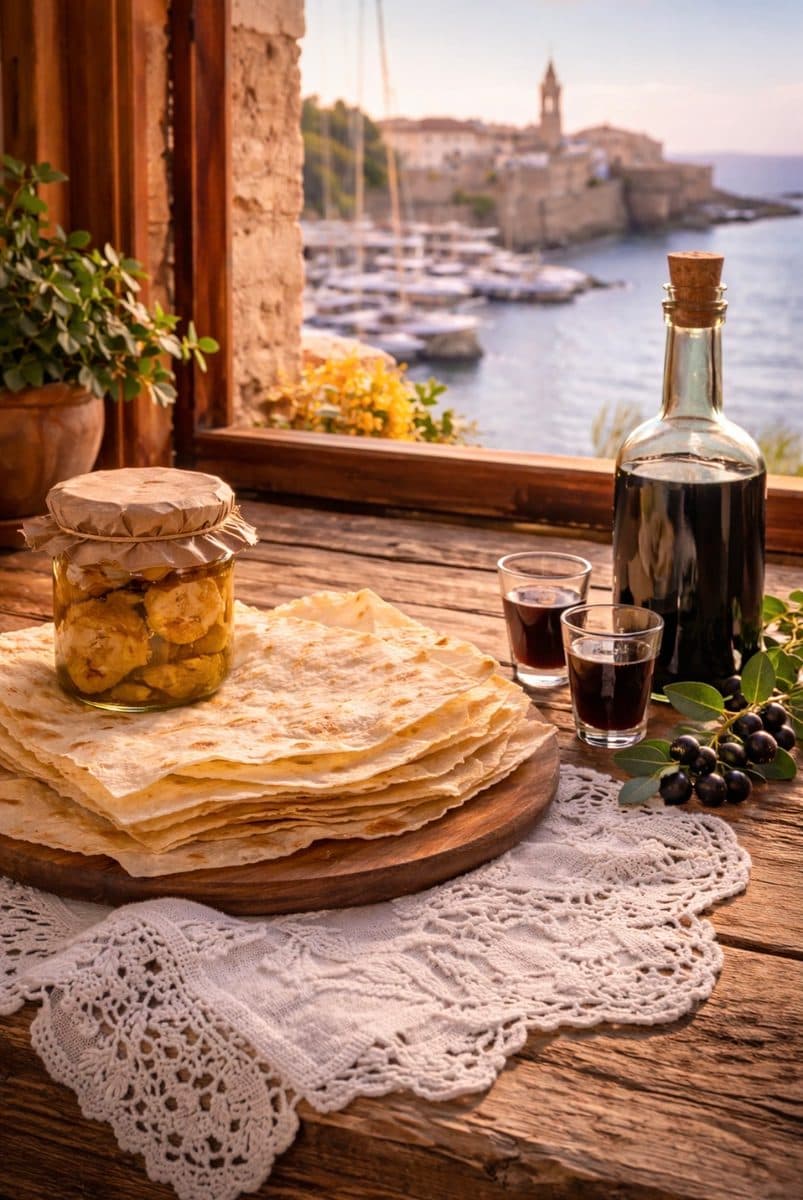
An everyday observer does not look for rare objects or famous monuments. Instead, they notice the things that are part of daily life: bread on the table, fish preserved in the pantry, a homemade liqueur, or embroidery used to set the table.
In Alghero, a coastal city in northwestern Sardinia, many souvenirs tell precisely this story: the relationship between the sea, the Mediterranean scrubland, and domestic life.
By following a few ordinary items — pane carasau, tuna in olive oil, mirto, and filet embroidery — it is possible to understand how families live and where some local traditions come from.
The Thin Bread of the Shepherds
Souvenir: Pane carasau
Pane carasau is one of the oldest breads in Sardinia. It is made of thin, crispy sheets prepared with durum wheat semolina, water, salt, and yeast. After the first baking, the bread is split in two and put back in the oven, a process called carasatura, which makes it dry and long-lasting. 
This characteristic has a specific reason. In the inland areas of Sardinia, shepherds spent long periods away from home during transhumance. Families therefore prepared a bread that could last for weeks or months without spoiling. 
In Alghero, pane carasau arrived from the island’s pastoral regions and today accompanies many everyday meals: with cheeses, cured meats, or simply with olive oil.
Why it also exists here: The city is an important urban center in Sardinia and historically received products from the island’s inland agricultural and pastoral areas.
Tuna and the Life of the Sea
Souvenir: Tuna in olive oil
Alghero is a maritime city with a long fishing tradition. For centuries many families have made their living thanks to activities connected to the sea.
Tuna is one of the most important fish in the Mediterranean. In Sardinia its fishing has been documented since ancient times and continued over the centuries through organized fishing systems. 
Tuna was often preserved in olive oil, a simple technique that made it possible to: • use fish caught in large quantities • preserve it for months • transport it easily.
For this reason, tuna in olive oil became a common staple in the pantries of coastal homes.
Why it exists in Alghero: The city overlooks a stretch of sea rich in fishing activity and has historically hosted fishing and seafaring communities.
The scent of the Mediterranean scrub
Souvenir: Myrtle
Myrtle is a shrub typical of the Mediterranean scrub that grows wild across much of Sardinia.
The dark berries are harvested between late summer and autumn and used to prepare myrtle liqueur, made by leaving the berries to infuse in alcohol with sugar.
In many Sardinian families this preparation is traditionally homemade. The liqueur is then served after meals.
Why it exists in Alghero: The area around the city is rich in Mediterranean scrub, where myrtle grows naturally. This makes it easy to gather and use in the local cuisine.
The embroidery of Alghero’s homes
Souvenir: Traditional Alghero filet embroidery
Alghero filet is an embroidery technique worked on a square‑mesh net.
The technique probably derives from fishermen’s nets: the knotted structure of the net is similar to the base on which the embroidery develops. Over time, the women of the city transformed this structure into a decorative technique.
With filet, household items were made: • tablecloths • curtains • table covers • items for the bridal trousseau.
For this reason, filet is connected to the domestic life of Alghero families, not only to tourist handicrafts.
Why it exists in Alghero: The city has a long maritime tradition, and the structure of the embroidery is linked to the making of fishing nets.
Conclusion - The City Inside Objects
Looking at these four objects helps you understand how everyday life works in Alghero. • Pane carasau tells the story of the connections with the pastoral areas of Sardinia. • Tuna in olive oil recalls the work of fishermen and the relationship with the sea. • Mirto comes from the vegetation of the Mediterranean maquis that surrounds the city. • Embroidered filet lace belongs to the homes and family trousseaus.
These are not simple souvenirs. They are objects that exist in Alghero because the territory offers the sea, Mediterranean maquis, domestic craftsmanship, and exchanges with the island’s interior.
By observing these everyday objects, you discover how the city truly lives, beyond the monuments and the tourist guides.
Redaktioneller Inhalt, erstellt mit Unterstützung künstlicher Intelligenz und von Trouvenir geprüft. Er kann Ungenauigkeiten enthalten.
Kostenlos herunterladen
Nimm Trouvenir mit
iOS und Android. Kostenlos.
Privacy firstGeräteübergreifende SynchronisierungFunktioniert offline