Introduction — The Cultural Gastronomist’s Perspective
A cultural gastronomist observes a city through what people eat. They are not just looking for recipes, but want to understand why those dishes exist precisely there.
In Venice, food is shaped by three very concrete factors: • the lagoon, which provides fish, crustaceans, and mollusks • the trade of the Serenissima, which brought spices, sugar, and ingredients from the East • the everyday life of sailors and merchants, which required foods that could be preserved or were easy to prepare.
By following a few traditional dishes, it is possible to read the history of the city: a city built on water, yet connected for centuries to the entire Mediterranean.
The Food of the Lagoon’s Fishermen
sarde in saor • moeche • seppie al nero • granzoe • bisato
Venetian cuisine is rooted first and foremost in fishing in the lagoon.
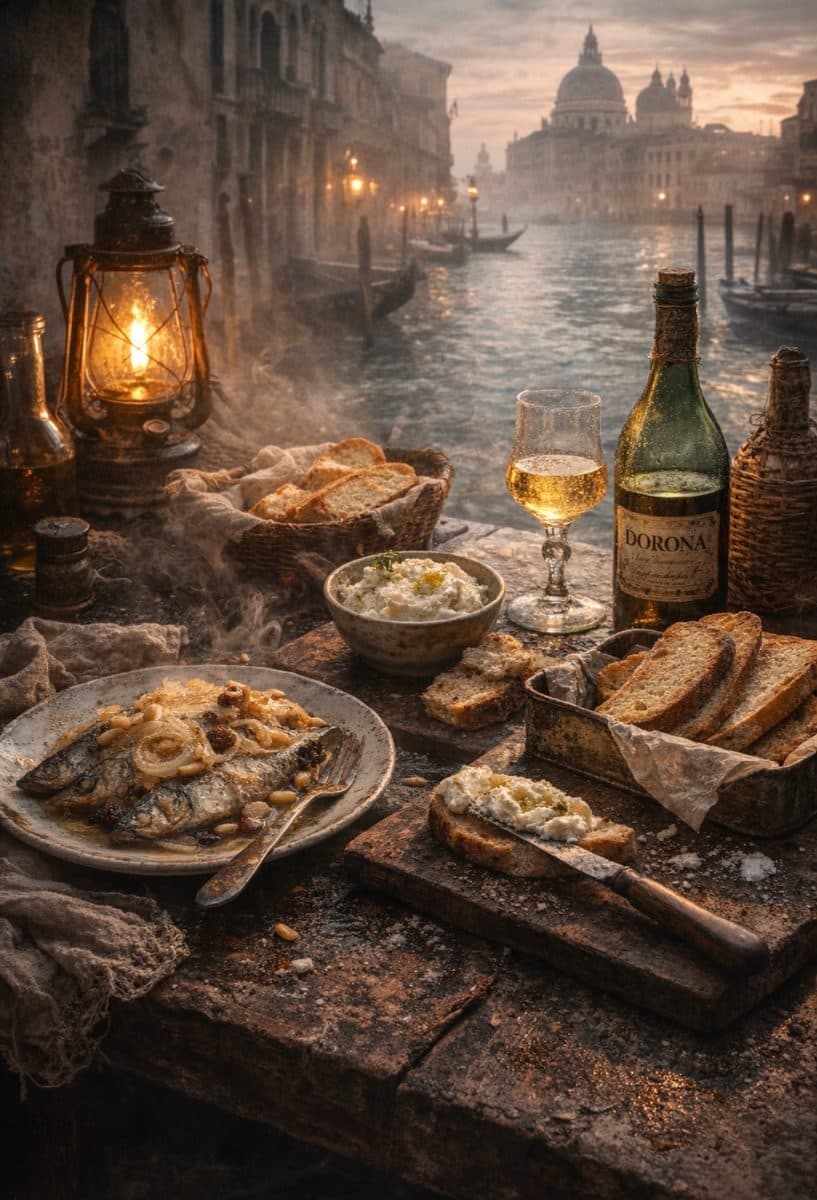
One of the oldest dishes is sarde in saor. The recipe already appears in the Middle Ages and arose from a practical need: sailors of the Serenissima had to preserve fish during long journeys. For this reason they fried sardines and covered them with onions cooked in vinegar and oil, creating a marinade that slowed the deterioration of the fish. Later, raisins and pine nuts were added, ingredients linked to Venetian trade with the East. 
The lagoon also produces other very specific ingredients.
Moeche are small green crabs caught only at certain times of the year, when they shed their shells. At this stage they become soft and are fried whole. Their rarity depends on the biological cycle of the lagoon crabs and on the farming technique used by local fishermen.
Seppie al nero, on the other hand, use the ink contained in the animal’s sac, which during cooking colors the sauce and gives it an intense flavor of the sea.
Among the most common crustaceans is the granzoe, the lagoon crab, often served boiled and dressed with olive oil and lemon.
Finally, bisato—the eel from the lagoon fishing valleys—is traditionally grilled or stewed. The lagoon’s fishing valleys are in fact ideal environments for breeding and catching eels.
Why these dishes exist in Venice: because the lagoon offers an ecosystem rich in fish, crustaceans, and mollusks that for centuries formed the basis of the local diet.
The Soups and Pastas of the Serenissima
Souvenir • bigoli in salsa • pasta e fasioi • risi e bisi
Alongside fish, Venetian cuisine makes use of simple ingredients from the Venetian mainland: grains, legumes, and rice.
Bigoli in salsa is a long, thick pasta similar to spaghetti. The traditional dressing is a sauce of stewed onions and anchovies or salted sardines—ingredients that keep well and were common in Venetian kitchens.
Pasta e fasioi (pasta and beans) is a thick soup made with beans, short pasta, and sometimes pancetta. This type of dish was common in ordinary households because it was nourishing and inexpensive.
The most representative dish, however, is risi e bisi, a preparation halfway between a soup and a risotto made with rice and fresh peas. During the Republic of Venice it was served to the Doge on Saint Mark’s Day, April 25. 
Rice arrived in Veneto in the late Middle Ages and became important thanks to cultivation in the wetlands of the Po Valley plain.
Why these dishes exist in Venice: because the city was economically connected to the Venetian mainland, from which rice, legumes, and grains arrived.
Bread, cakes and biscuits of the merchants
Souvenirs • baicoli • zaeti • bussolà • Burano S-shaped biscuits • Venetian fugassa
Venice was a city of merchants, and this is reflected in its sweets.
Baicoli are thin, very dry biscuits that originated in the eighteenth century. They were sliced from small loaves and then baked again in the oven, creating a light product that kept well. They were often enjoyed with coffee, sweet wine, or hot chocolate.
Zaeti are rustic biscuits made with cornmeal, raisins, and sugar. The use of cornmeal reflects the spread of maize in the Veneto after the sixteenth century.
Bussolà and the Burano S-shaped biscuits are traditional biscuits from the island of Burano. They were prepared in compact shapes so fishermen could take them along during their trips out to sea.
Venetian fugassa, on the other hand, is a leavened cake associated with Easter, enriched with butter, eggs, and sugar.
Why these sweets exist in Venice: because the city had access to ingredients from international trade, such as sugar and spices, and needed products that could be preserved for sailors and travelers.
The wine of the lagoon
Souvenir • Dorona
Among the lesser-known Venetian products is Dorona di Venezia wine.
It is made from the Dorona grape, historically grown in the gardens and sandy soils of the lagoon, particularly on the island of Sant’Erasmo.
The grape variety almost disappeared after the 1966 flood, but in recent decades some Venetian producers have recovered it and brought it back into cultivation on the lagoon’s islands.
The lagoon’s brackish, sandy soil contributes to the wine’s aromatic characteristics.
Why it exists in Venice: because some lagoon islands have sandy agricultural soils that allow the cultivation of grape varieties adapted to the brackish environment.
Conclusion
Looking at these gastronomic souvenirs reveals a very concrete picture of the city. • The lagoon provides fish, shellfish, and eels. • The Venetian mainland brings rice, beans, and cereals. • The trade of the Serenissima introduces spices, sugar, and exotic ingredients. • The life of sailors requires foods that keep well, such as sarde in saor and dry biscuits.
For this reason, Venetian cuisine is not just a culinary tradition: it is the direct result of the city’s geography, economy, and history.
Following these dishes, you discover that Venice is not only a city of art, but also a city built around the sea, trade, and the table.
本编辑内容在人工智能辅助下制作并经编辑团队审核,可能存在不准确之处。