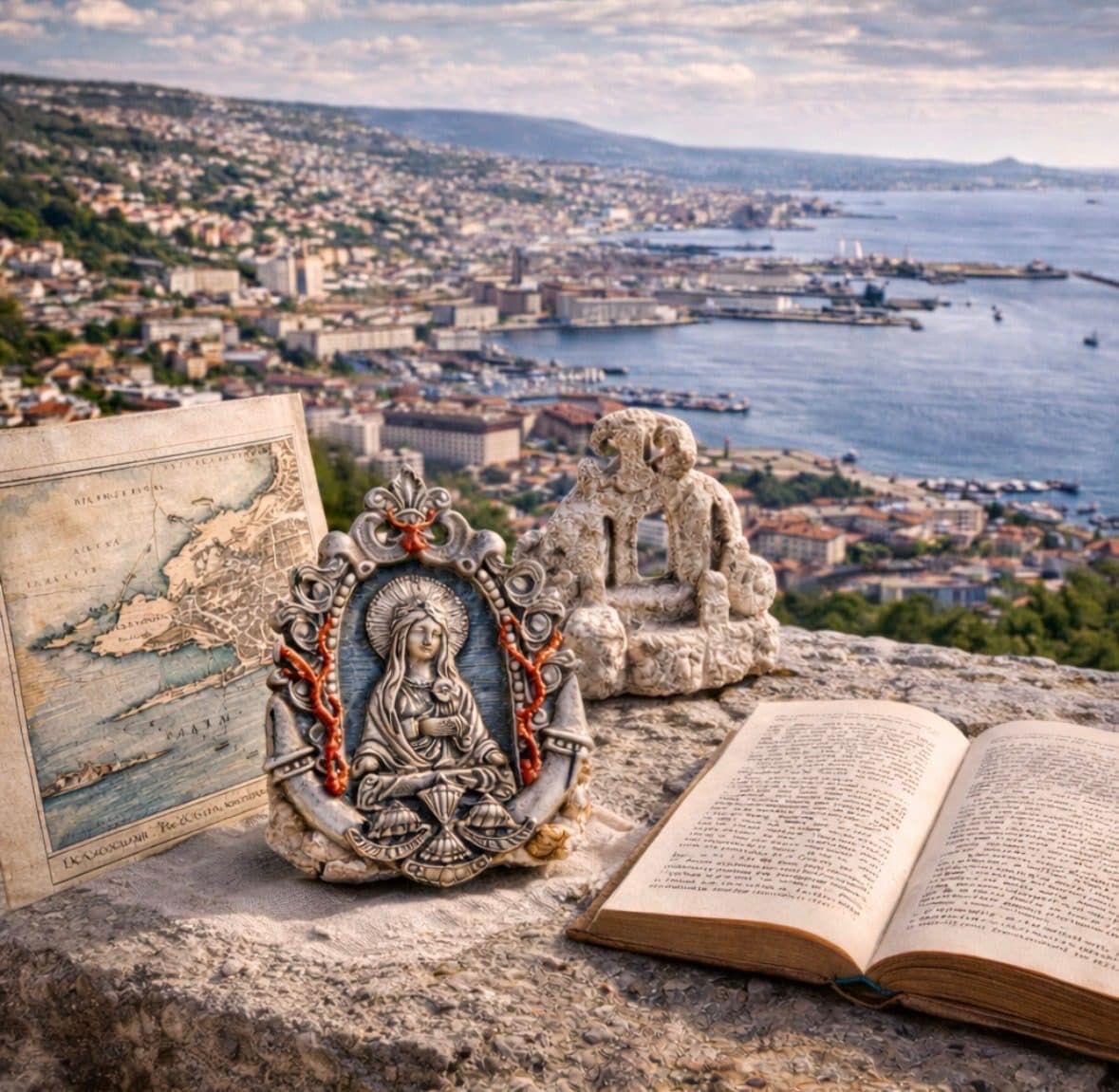
The Gaze of the Symbolic Explorer
A symbolic explorer does not simply look for objects to take home.
They look for traces of a city’s identity.
In Trieste this means observing objects that tell the story of three fundamental elements: • the port and the sea • the border between different worlds • the city’s cultural production
The souvenirs along this route are not random. Each one arises from a specific condition: for centuries Trieste was an international port of the Habsburg Empire, commercially and culturally connected with Central Europe and the Mediterranean.
Here Nothing Belongs to Just One Place
Souvenir: historical print or map of Trieste
Historical maps of Trieste show a very precise transformation.
In 1719 Emperor Charles VI declared Trieste a free port, removing many commercial duties to encourage maritime trade.
This change attracted merchants from many parts of the Habsburg Empire and the Mediterranean: Italians, Slovenians, Greeks, Jews, Austrians.
Maps of the city therefore begin to depict: • new piers • port warehouses • commercial districts
A historical map of Trieste is not just a geographical representation. It shows how the city was designed to connect trade routes and different cultures.
This is why it exists precisely here: Trieste was built as the maritime gateway of Central Europe.
The Faith of Sailors
Souvenir: maritime devotional object
For centuries the economic life of Trieste was closely tied to navigation.
The sea brought trade and wealth, but also risks.
For this reason, devotional objects used by sailors and their families were common in Adriatic ports: sacred images, ex votos, and small religious items carried on voyages.
These religious practices are also documented in local maritime museums and in the port traditions of the Adriatic.
The maritime devotional object therefore tells a very real story: • long sea voyages • the dangers of navigation • the request for religious protection.
It is an object that exists here because Trieste has been one of the main ports of the northern Adriatic.
Between the Karst and the Sea
Souvenir: object carved from Karst stone
Behind Trieste lies the Karst, a limestone plateau that stretches between Italy and Slovenia.
Karst stone has been used for centuries to build: • rural houses • dry stone walls • urban architectural elements.
The material is durable and easily found in the area.
For this reason, many historic buildings and urban structures in Trieste use this stone sourced from the surrounding territory.
An object carved from Karst stone therefore tells the story of the relationship between two very different environments: • the port city • the rocky Karst landscape.
Trieste lies exactly between these two spaces.
Writing from a Border City
Souvenir: a book from the Triestine literary tradition
Between the late nineteenth and early twentieth centuries, Trieste became one of the most important literary centers in Europe.
In the city lived or worked authors such as: • Italo Svevo • Umberto Saba • Scipio Slataper • James Joyce
Trieste was a unique place: an Italian city under Austro-Hungarian administration, where multiple languages were spoken and different cultures met.
This context deeply influenced local literary production.
A book from this tradition does not only tell a story: it tells the cultural condition of a border city.
Trieste through its objects
This route passes through four very different objects: • a map • a Karst stone • a maritime devotional object • a book from the literary tradition
Together they tell the same story.
Trieste exists thanks to the meeting of: • the sea and the Karst plateau • European trade routes • different languages and cultures.
The objects in this route are not simple souvenirs. They are material traces of a city built over time as a place of passage, trade, and cultural exchange.
本编辑内容在人工智能辅助下制作并经编辑团队审核,可能存在不准确之处。