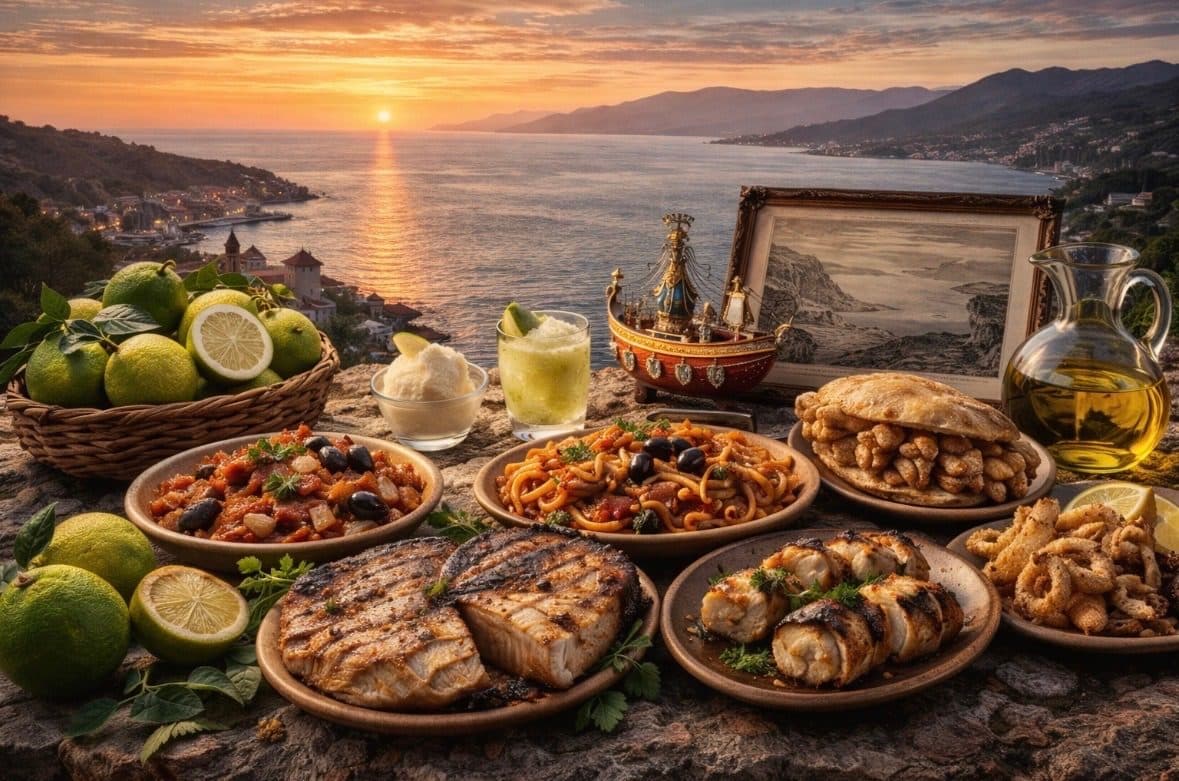
Introduction – The Cultural Gastronomist’s View
A cultural gastronomist looks at a city by starting with what people eat. They don’t look only for typical dishes, but for ingredients, cooking techniques, and food traditions that tell the story of a place.
In Reggio Calabria, this journey passes through two fundamental elements: • the citrus fruits of the Ionian coast, especially bergamot • fishing in the Strait of Messina, which for centuries has supplied fish to coastal communities.
By following these ingredients, you discover why certain dishes exist precisely here and not elsewhere.
The citrus landscape: bergamot of Reggio Calabria
Related souvenirs • Bergamot • Bergamot granita • Bergamot gelato • Bergamot desserts
Bergamot is a citrus fruit grown almost exclusively along the Ionian coast of the province of Reggio Calabria.
According to the Accademia del Bergamotto and agronomic studies, more than 90% of the world’s production comes from a coastal strip of about 100 km between Villa San Giovanni and Monasterace.
This happens for very specific reasons: • mild microclimate • mineral-rich coastal soils • exposure to sun and sea breeze.
The fruit is best known for its essential oil used in perfumery, but in the city it is also used in cooking.
The juice and aromatic zest are used for: • summer granitas • artisanal gelato • biscuits and pastry creams
Today, bergamot granita and gelato are among the most recognizable gastronomic products of Reggio Calabria because they use an ingredient that is almost impossible to cultivate elsewhere.
Aspromonte stockfish: the stocco of Mammola
Related souvenirs • Stocco di Mammola • Pasta with stockfish
About 50 km from Reggio Calabria, in the town of Mammola, one of the best-known dishes of southern Calabrian cuisine is prepared: stocco di Mammola.
Stockfish is wind-dried cod traditionally originating from Northern Europe. It arrived in Calabria as early as the 16th century through maritime trade.
In the inland areas of Aspromonte, this preserved fish became very widespread because: • it could be transported easily • it kept for months • it made it possible to have fish even far from the coast.
In Mammola, a distinctive preparation developed:
The stockfish is soaked for several days, then slowly cooked with: • tomato • potatoes • olives • Calabrian extra virgin olive oil.
The sauce is often also used to dress homemade pasta, creating a dish that brings together seafaring tradition and inland cooking.
Fish of the Strait: swordfish and traditional fishing
Related souvenirs • Grilled swordfish • Swordfish rolls • Swordfish sandwich
The Strait of Messina, between Calabria and Sicily, is one of the most distinctive areas of the Mediterranean.
Marine currents and migratory routes bring large schools of swordfish through these waters every year.
Swordfish fishing has been documented for centuries and was traditionally practiced using techniques such as the feluca, a boat equipped with a lookout tower.
This fish has become one of the main ingredients of coastal cuisine.
In Reggio Calabria it is prepared in several ways:
Grilled swordfish • steak cooked directly over hot coals • seasoned with extra virgin olive oil and lemon.
Swordfish rolls • thin slices filled with breadcrumbs, parsley, and sometimes cheese • rolled and grilled.
Swordfish sandwich • a street food version commonly found in the coastal towns of the Strait.
Fried fish and Calabrian olive oil
Related souvenirs • Strait fried fish • Calabrian extra virgin olive oil
Another dish commonly found in the coastal cuisine of the Reggio area is Strait fried fish.
It is prepared with small fish caught locally, including: • anchovies • red mullet • squid or flying squid • small rockfish.
The frying is traditionally done with Calabrian extra virgin olive oil, produced throughout the region.
Calabria is one of Italy’s main olive-growing areas and is home to native varieties such as: • Ottobratica • Carolea • Sinopolese
These cultivars are used to produce Olio Calabria IGP, certified by the Ministry of Agriculture.
The oil is not just a condiment: it is the basic ingredient of the local cuisine, used for frying, cooking, and preserving food.
What these dishes reveal about Reggio Calabria
Through these products you can understand how the cuisine of Reggio Calabria is tied to two different environments.
The Ionian coast, where bergamot grows, provides unique citrus fruits used in gelato and desserts.
The Strait of Messina offers fish such as swordfish and many species well suited to frying.
The inland area of Aspromonte, on the other hand, developed dishes such as stocco of Mammola, which tell the story of historical trade and the need to preserve fish.
These ingredients are not random: they exist here because they depend on environmental conditions, trade routes, and agricultural traditions specific to the Reggio area.
By following these dishes, you can read the city not only through its monuments, but through its real food history.
本编辑内容在人工智能辅助下制作并经编辑团队审核,可能存在不准确之处。