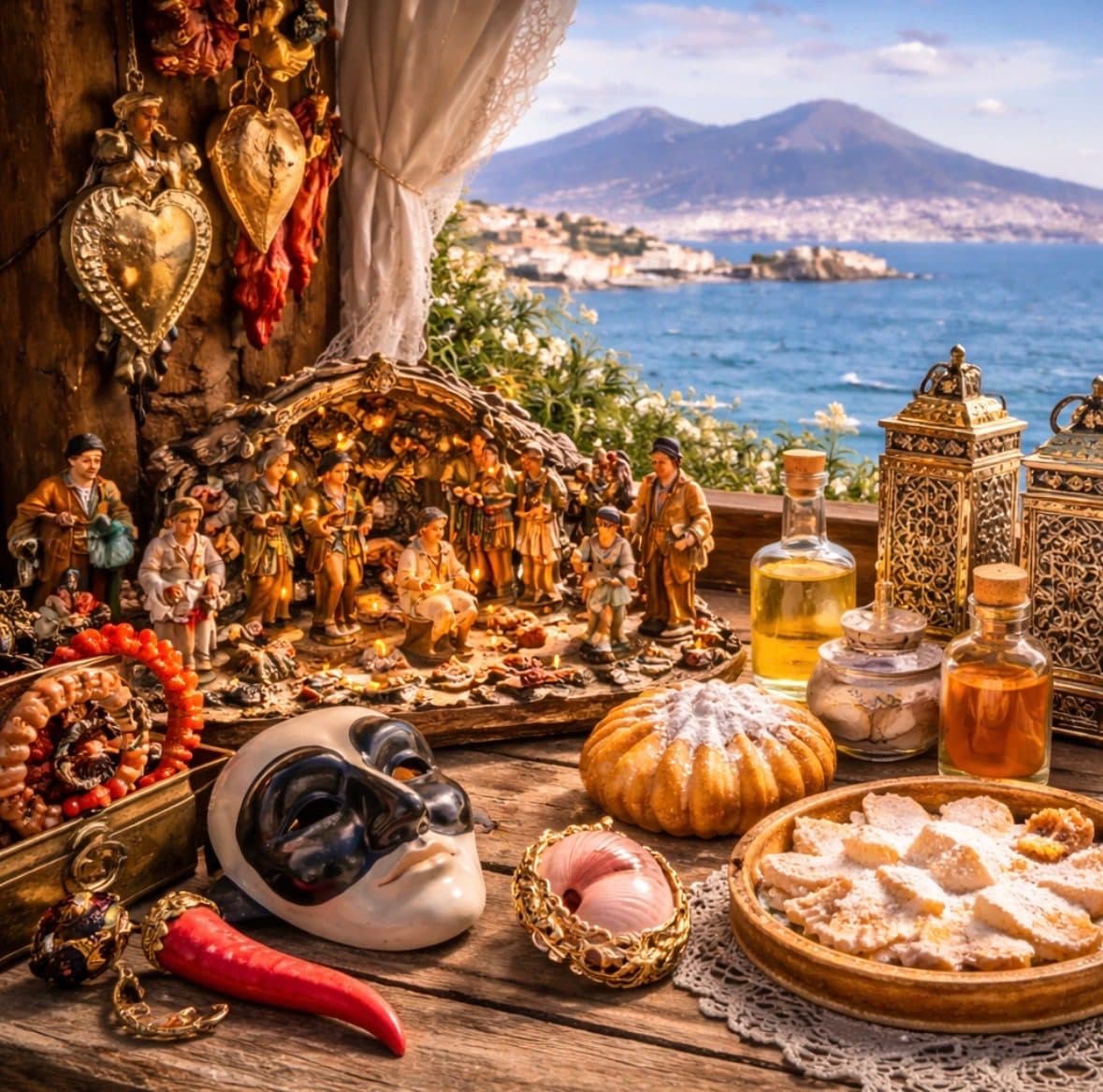
Introduction — The Gaze of the Symbolic Explorer
A symbolic explorer observes a city through the objects that tell the story of its cultural identity.
They are not just looking for decorative souvenirs. They want to understand why those particular objects exist in that city, who produces them, and what role they play in the local culture.
In Naples, some objects appear again and again in shops, markets, and artisan workshops: • the figures of the Neapolitan nativity scene • the lucky horn charm • the Pulcinella mask
These objects arise from different contexts: religious traditions, popular theater, and beliefs rooted in the everyday life of the city.
San Gregorio Armeno and the theatre of the Neapolitan nativity scene
In the historic center of Naples lies Via San Gregorio Armeno, a street famous for its workshops that produce nativity scene figurines.
The tradition of the Neapolitan nativity scene developed especially during the 17th and 18th centuries, when Naples was the capital of the Kingdom of Naples and one of Europe’s main cultural centers.
Unlike other nativity scenes, the Neapolitan one includes many characters from everyday life: • fish sellers • tavern keepers and innkeepers • musicians • farmers.
The figures are made using traditional artisanal techniques: • head and limbs in modeled terracotta • body made of wire and tow • hand-sewn clothing made from fabric.
This tradition continues today in the family-run workshops along the street.
Why Naples in particular?
In the 18th century, the nativity scene became a form of scenic representation of the city. Neapolitan aristocratic families commissioned complex nativity scenes that recreated urban settings and scenes of everyday popular life.
The Neapolitan horn: amulets and folk beliefs
The Neapolitan horn is a small red horn-shaped amulet, often worn as a piece of jewelry or used as a keychain.
According to popular tradition, it protects against the evil eye and bad luck.
Protective amulets have very ancient roots in the Mediterranean. In some interpretations, the horn’s shape is linked to symbols of fertility and strength already present in Roman culture.
Over time the horn became especially widespread in Naples, where it is made by artisans using different materials: • coral • horn • silver • ceramic.
Today it can easily be found in markets and shops throughout the city.
Why Naples in particular?
The spread of this object is connected to the strong presence of popular traditions and superstitions in Neapolitan urban culture, documented by many anthropological studies on Southern Italy.
Pulcinella: the character born in Neapolitan theater
Pulcinella is one of the most famous masks of the Commedia dell’Arte, the popular theater that emerged in Italy in the 16th century.
The figure is especially linked to the city of Naples.
The character was defined in the 17th century by the Neapolitan actor Silvio Fiorillo, who portrayed an ironic and clever servant.
Pulcinella is recognizable thanks to several distinctive elements: • very wide white clothing • a pointed hat • a black mask with a curved nose.
In theatrical stories he often represents the common people: a figure who manages to get by with wit even in difficult situations.
For this reason his image continues to appear in: • theater performances • popular festivals • statues and souvenirs sold throughout the city.
Why Naples in particular?
Pulcinella was born in the Neapolitan theatrical scene of the 17th century and remains associated with the city thanks to its strong tradition of popular theater and Carnival masks.
Conclusion — Three Objects to Understand Naples
Through these three objects, it is possible to observe three concrete aspects of Neapolitan culture: • the handcrafted nativity scene, linked to the city’s religious and theatrical traditions • the good‑luck horn, connected to popular beliefs widespread in everyday life • Pulcinella, born in the theater and later becoming a representative cultural figure.
These objects exist in Naples because the city has developed over time a particular combination of: • religious traditions • popular theatrical culture • urban craftsmanship.
Looking at them together helps explain how Neapolitan culture has taken shape through concrete practices — workshops, performances, and popular beliefs — that remain visible even today.
本编辑内容在人工智能辅助下制作并经编辑团队审核,可能存在不准确之处。