历史♛ Premium
Milan through materials: paper, print, design, and leavening
Material Researcher
The Gaze of the Material Researcher
The Material Researcher explores a city through concrete objects: paper, doughs, printing techniques, industrial manufacturing.
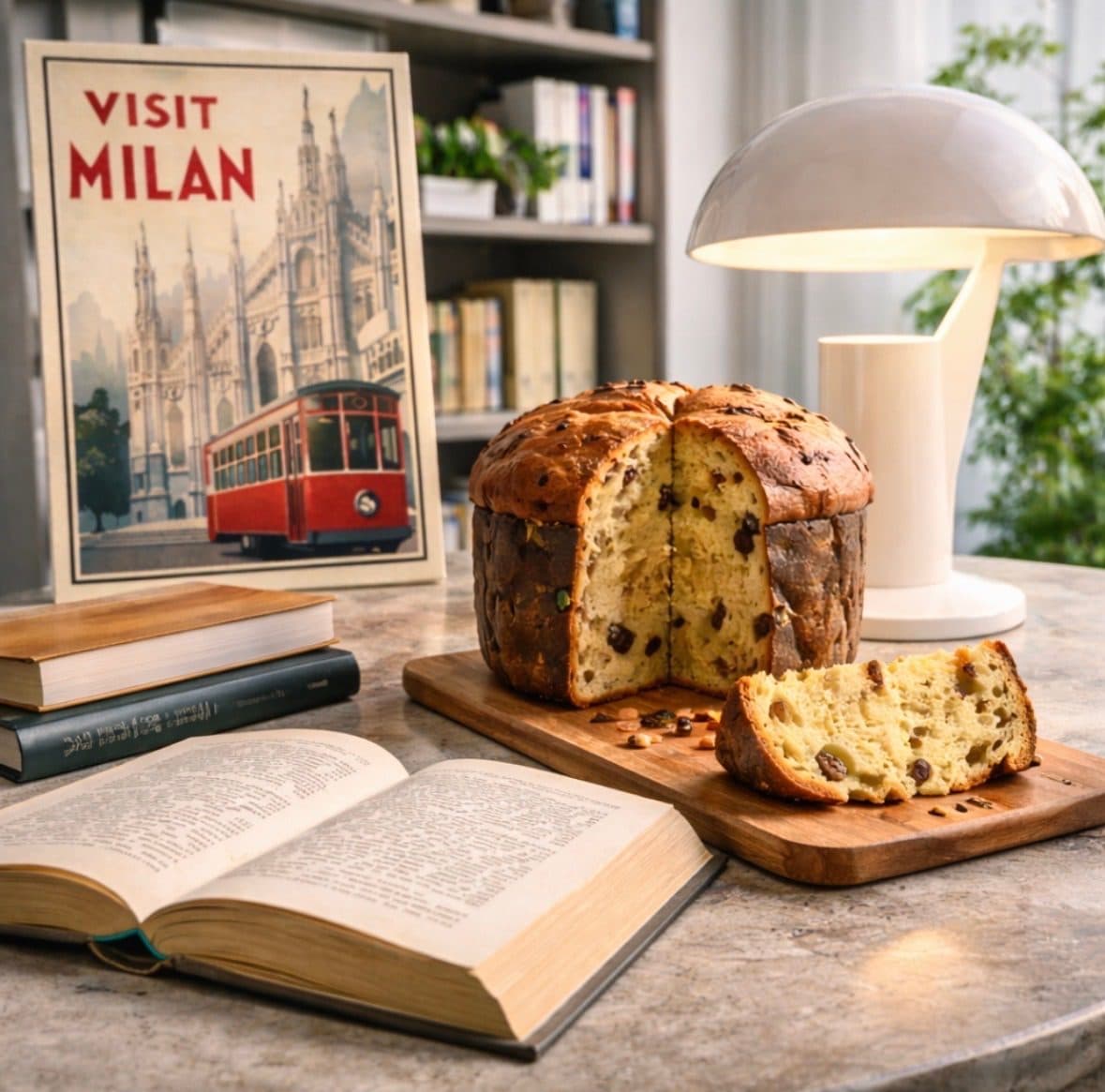
In this journey Milan is not told through monuments or historical events, but through four tangible objects: • a book from the Milanese literary tradition • a design object • a printed poster • an artisanal panettone
Each object reveals a different material aspect of the city: • the paper of books • the printing industry • the design process • the artisanal craftsmanship of food.
The Written City: Books and the Milanese Language
Souvenir: a book from the Milanese literary tradition
Milan has a long literary tradition linked both to Italian and to the Milanese dialect, part of the Gallo‑Italic varieties of northern Italy. 
Among the most important authors is Carlo Porta (1775–1821), a poet who wrote many works in the Milanese dialect and who described everyday life in the city between the late eighteenth and early nineteenth centuries. 
The book therefore becomes an object that contains the living language of the city.
Why Milan in particular?
In the 18th and 19th centuries the city was an important cultural center in northern Italy and hosted intellectual circles and printing houses, encouraging the spread of literary and political works during the Lombard Enlightenment. 
The souvenir-book therefore tells the story of a Milan made of: • printing houses • literary circles • publishing activity.
Designing Objects: Milan, Capital of Design
Souvenir: Milanese design object
Milan is now one of the world’s main centers of industrial design. This position emerged in the twentieth century, when the city became a major hub of industry, production, and design.
Designers, companies, and schools work together to design objects intended for industrial production: furniture, lamps, and household tools.
Events such as the Salone del Mobile, founded in 1961, have strengthened Milan’s role as an international point of reference for design.
For the Material Researcher, a Milanese design object makes it possible to observe: • materials (metal, plastic, wood) • industrial techniques • the relationship between design and production.
This link between industry and creativity explains why many iconic objects of Italian design were born in Milan.
The Printed City: Posters and Urban Graphics
Souvenir: historic poster or graphic print
Between the late nineteenth and early twentieth centuries, Milan became one of Italy’s centers of advertising graphics.
The city’s industrial and commercial expansion created a strong need for visual communication: • advertising • theater posters • promotion of products and trade fairs.
Milanese print shops developed printing techniques such as lithography and chromolithography, which made it possible to produce colorful posters distributed throughout urban spaces.
The poster therefore became an object that tells the story of: • the development of industry • the birth of modern advertising • the city’s visual transformation.
For this reason, a historic Milan poster is not only an aesthetic keepsake: it is also a product of urban typographic technology.
The Christmas workshop: Milanese panettone
Souvenir: traditional Milanese panettone
Panettone is one of the gastronomic products most closely associated with Milan.
Its origins date back to the medieval tradition of preparing a richer bread during Christmas, enriched with costly ingredients such as raisins and sugar.
Over time this festive bread evolved into the dessert we know today.
Main ingredients • wheat flour • natural sourdough starter • butter • eggs • sugar • raisins • candied citrus peel
The preparation requires a long natural leavening process, often lasting several days.
In the twentieth century, panettone took on its tall, domed shape thanks to innovations introduced by Milan’s confectionery industry.
Why did it originate in Milan?
Because the city was already a wealthy commercial center in the Middle Ages, where costly ingredients such as sugar and spices could be used to create a more elaborate festive bread.
Panettone is therefore an example of an urban food tradition linked to artisanal baking.
Conclusion — The Milan of Materials
Looking at these four objects, a defining trait of the city emerges.
Milan is a city that produces tangible things: • books printed in its printing houses • posters produced by the graphic arts industry • objects designed by industrial design • baked goods born of artisanal traditions.
Paper, metal, ink, and dough tell the same story: Milan grew as a city of production, design, and manufacturing, where culture and industry meet in everyday objects.
本编辑内容在人工智能辅助下制作并经编辑团队审核,可能存在不准确之处。