The Everyday Observer’s Gaze
An everyday observer does not look for spectacular monuments but for objects that are part of the city’s normal life.
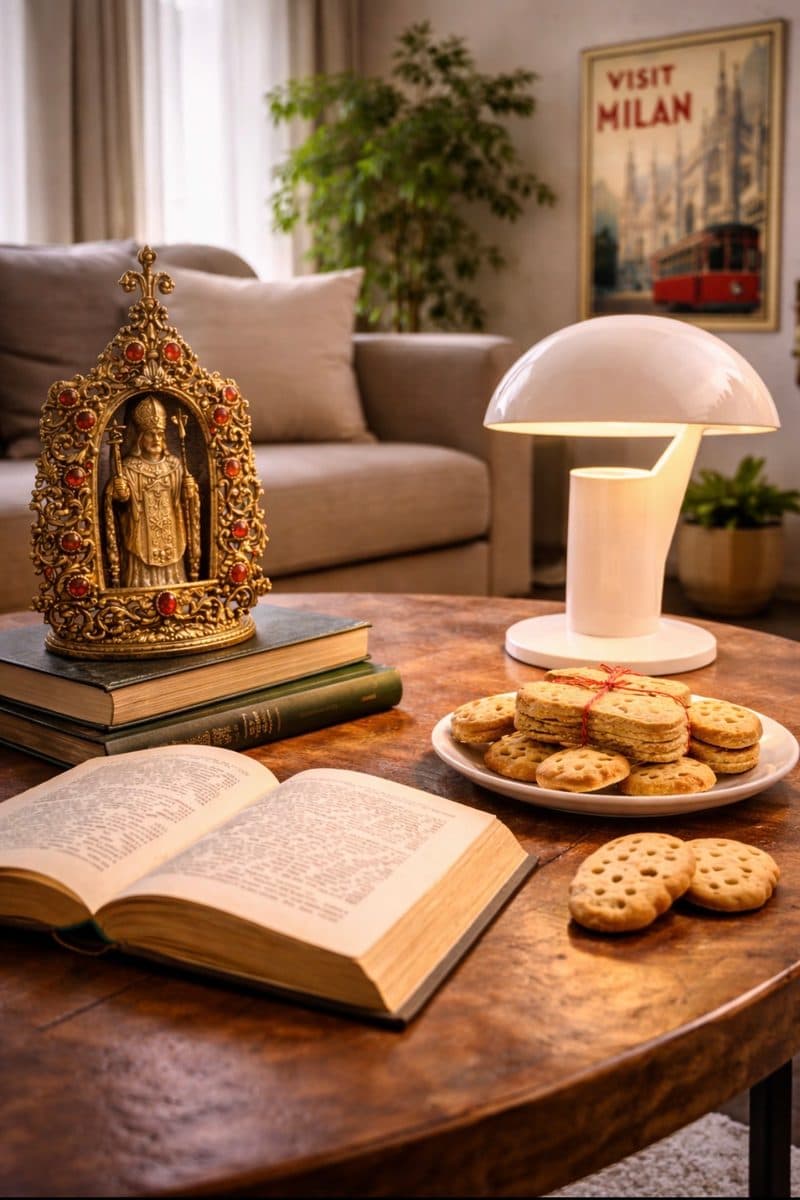
In Milan, these objects tell the story of concrete activities: • books circulating in schools and bookshops • design objects found in homes • small religious items sold in churches • biscuits bought in neighborhood pastry shops.
By following these objects, you discover how Milan really works: how it works, what it eats, and which traditions it maintains.
The City That Prints Books
Souvenir: book from the Milanese publishing tradition
Milan is Italy’s main publishing center. Some of the country’s most important publishing houses are based here, including Mondadori, Rizzoli and Feltrinelli.
Milan’s publishing tradition began as early as the 19th century, when the city became one of the industrial hubs of the Kingdom of Italy. The presence of universities, newspapers and printing houses encouraged the growth of the publishing industry.
Today this tradition continues through: • major publishers • bookshops spread throughout the neighborhoods • events such as BookCity Milano, a festival dedicated to reading.
For this reason, a book is a souvenir perfectly tied to the city: it represents one of the economic and cultural activities most deeply rooted in its urban fabric.
Design in Milanese homes
Souvenir: a Milanese design object
Milan is considered one of the world capitals of industrial design.
In the postwar period, many Italian companies began collaborating with designers and architects to create objects intended for domestic life: chairs, lamps, utensils, and furnishings.
This tradition is documented by institutions such as Triennale Milano, a museum dedicated to design, architecture, and the applied arts.
Many objects designed in Milan are not museum pieces but items used every day in people’s homes. For this reason they have become a typical souvenir: they represent the city’s ability to combine industry, creativity, and production.
Ambrosian Devotion
Souvenirs: religious items linked to the Ambrosian tradition
Milan has a specific religious tradition called the Ambrosian rite, linked to the figure of Sant’Ambrogio, bishop of the city in the 4th century.
The Ambrosian rite is still used today in many churches of the Diocese of Milan and presents some differences compared to the Roman rite, especially in the liturgy and the religious calendar.
For this reason, in religious bookstores and shops near churches you can find devotional objects connected to this tradition: • images of Sant’Ambrogio • rosaries • small liturgical objects.
These items exist in Milan because the Ambrosian diocese is one of the largest in Europe and maintains its own liturgical tradition.
Souvenir: religious objects linked to the Ambrosian tradition Milan has its own specific religious tradition called the Ambrosian rite, linked to the figure of Saint Ambrose, bishop of the city in the 4th century. The Ambrosian rite is still used today in many churches of the Diocese of Milan and shows some differences compared to the Roman rite, especially in the liturgy and the religious calendar. For this reason, in religious bookstores and shops near churches you can find devotional objects connected to this tradition: • images of Saint Ambrose • rosaries • small liturgical objects. These items exist in Milan because the Ambrosian diocese is one of the largest in Europe and maintains its own liturgical tradition.
Souvenir: biscuits from the Milanese tradition
Milanese pastry shops produce several traditional biscuits linked to Lombard cuisine.
Among the most common are: • ossi da mordere, dry almond biscuits • meliga biscuits, made with cornmeal and butter • other dry biscuits typical of Lombard pastry-making.
These sweets originated as simple products that could be stored for a long time and enjoyed with coffee or sweet wine.
Even today they can be found in the city’s historic pastry shops and are also sold as small gastronomic souvenirs.
Conclusion
Looking at Milan through these everyday objects reveals a very concrete city. • Books tell the story of the city’s role in Italian publishing. • Design objects show the connection between industry and creativity. • Ambrosian devotional objects recall a religious tradition that is still alive. • Pastry shop biscuits reflect local eating habits.
Together, these objects explain why Milan is not only a city of monuments or fashion: it is a city where work, culture, and everyday life constantly intertwine.
本编辑内容在人工智能辅助下制作并经编辑团队审核,可能存在不准确之处。