The Materials Researcher's Eye
A materials researcher observes a city starting from a concrete question: what materials does the territory offer, and how are they transformed by the people who live there?
In Aosta and the Aosta Valley, the Alpine landscape profoundly shapes everyday life. Mountains, forests, and pastures determine the materials that are available: • wood from Alpine forests • stone quarried from the mountains • metal linked to pastoral life.
The valley’s traditional objects therefore tell the story of how Alpine communities have used these resources to live, work, and share social moments.
The Sound of Alpine Pastures
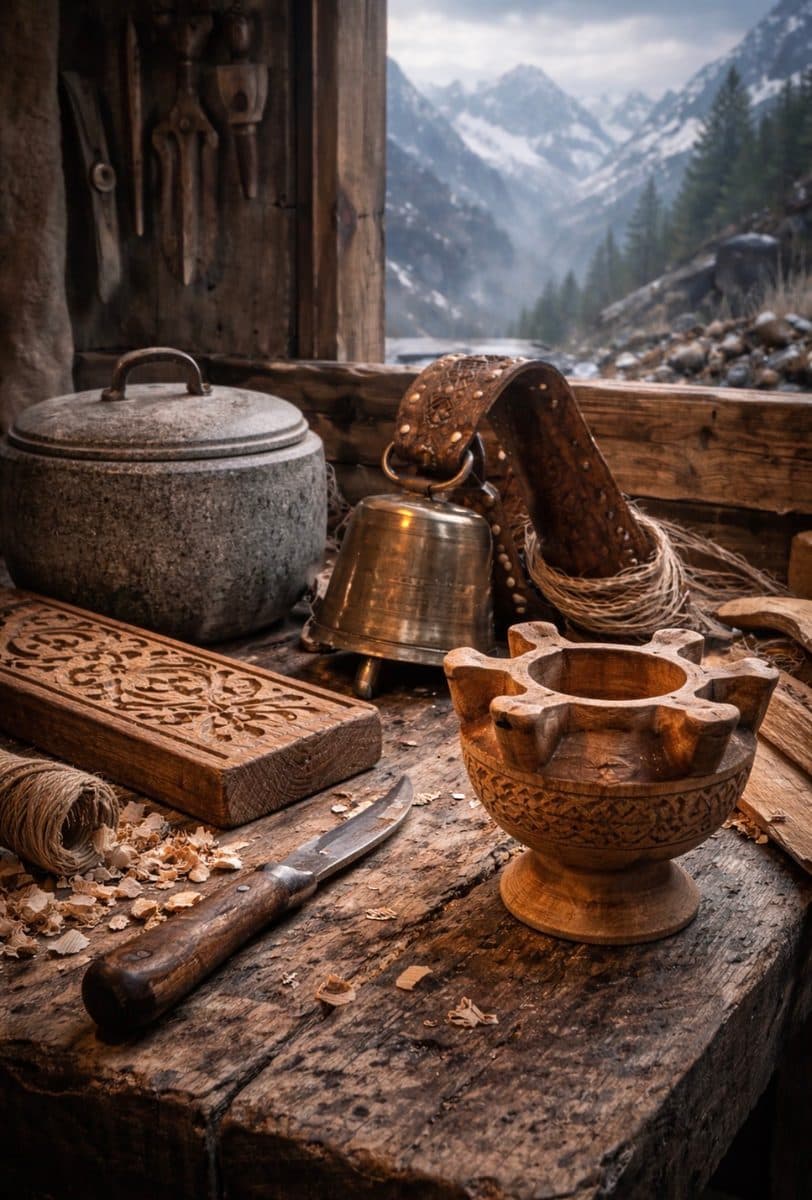
The pastoral cowbell
In the pastures of the Aosta Valley, cattle farming is one of the main agricultural activities. During the summer, herds are taken up to high‑altitude alpine pastures.
To recognize and keep track of the animals, metal cowbells are used, fastened around the cows’ necks.
Each cowbell has: • a particular shape • a recognizable sound • a different size depending on the animal.
These objects are made by metal artisans and are part of the culture of alpine grazing.
Their use can still be seen during the “désarpa”, the autumn descent of the herds from the alpine pastures.
The cowbell exists in this form precisely in the Alps because herding on mountain pastures makes it necessary to identify animals even from a distance, thanks to their sound.
The stone that becomes a utensil
Soapstone objects
Soapstone is a talc-rich metamorphic rock found in several Alpine areas.
This stone has useful characteristics for cooking: • it withstands high temperatures • it distributes heat slowly • it retains heat for a long time.
For this reason it has been used for centuries to produce: • pots • pans • mortars.
The crafting process involves turning and carving, transforming the block of stone into a container.
In the Aosta Valley these objects were very common in mountain homes, where slow cooking over the hearth was typical.
The presence of soapstone in the Alps explains why this type of utensil is typical of Alpine regions and not of the plains.
Wood from the Alpine forests
Valdostan wood carving
The Aosta Valley is rich in forests of larch, fir, and Swiss stone pine.
The wood from these trees has for centuries been one of the most widely used materials to make: • household utensils • agricultural tools • decorative objects.
Wood carving often began as a winter activity for farmers, when work in the fields slowed down.
With knives and gouges they created: • spoons • containers • small pieces of furniture • decorative sculptures.
Many objects are decorated with geometric patterns or alpine animals, reflecting the region’s natural environment.
This craft tradition is now documented and celebrated by the Museo dell’Artigianato Valdostano di Tradizione.
Sharing a drink in mountain homes
The grolla of friendship
The grolla of friendship is a wooden cup with several spouts.
It is used to drink Valdostana coffee, a hot beverage prepared with: • coffee • grappa • sugar • spices such as cinnamon or cloves.
The grolla is passed from person to person and each person drinks from a different spout.
This object originated in an Alpine context where sharing a warm drink played an important social role during the winter.
The cup is made from turned and carved wood, often decorated with traditional motifs.
Its shape is typical of the Aosta Valley and the surrounding Alpine regions.
Now you know what you are really looking at
By observing these objects, it becomes clear how the material culture of the Aosta Valley is closely tied to the Alpine environment.
Each object comes from a specific resource of the territory: • the metal of the cowbells linked to mountain pastoralism • soapstone quarried in the Alps and shaped into kitchen utensils • the wood of the Alpine forests, worked during the winter months • the grolla, which brings together woodcraft and convivial traditions.
Together they show how the valley’s inhabitants used the materials available to meet practical needs: working in the pastures, cooking, building tools, and sharing social moments.
The result is an artisanal culture that continues to be documented and preserved by the region’s cultural institutions.
本编辑内容在人工智能辅助下制作并经编辑团队审核,可能存在不准确之处。