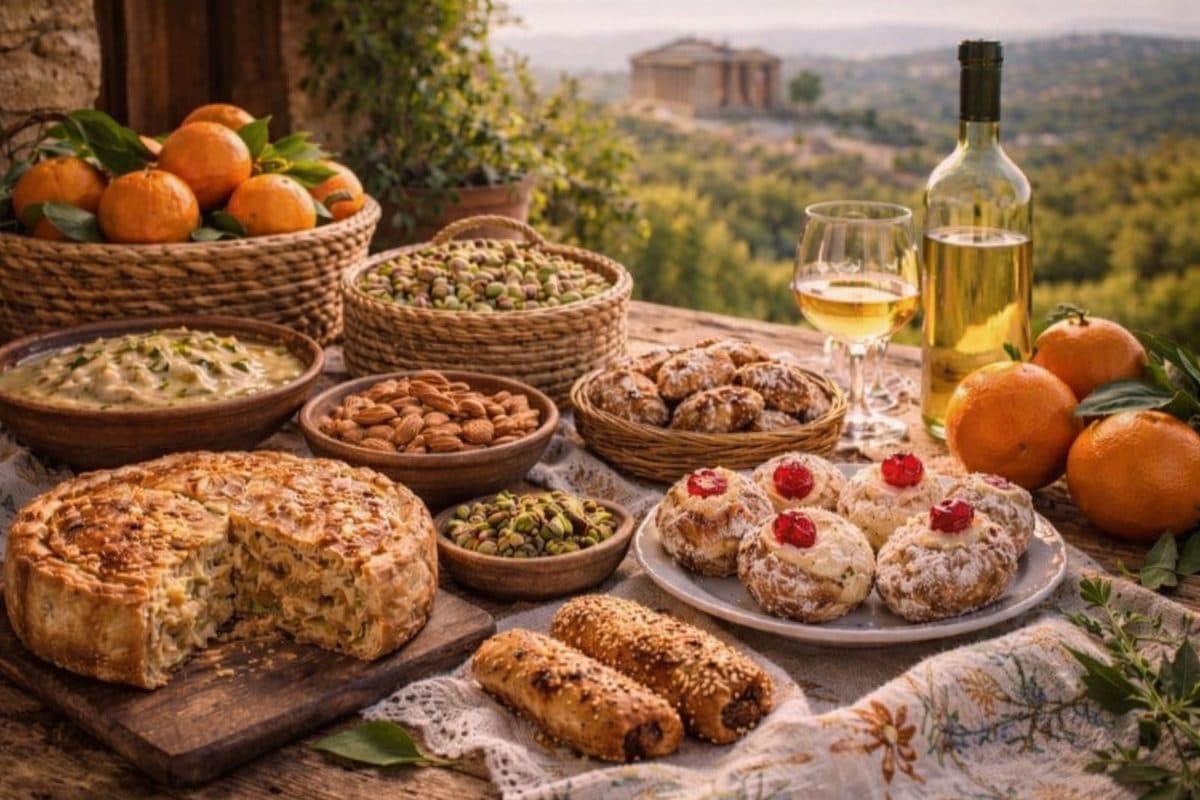
Introduction — The Cultural Gastronomist’s Gaze
A cultural gastronomist visits a city through its ingredients and its dishes.
They are not just looking for something good to eat: they want to understand where the ingredients come from, who grows them, and how they enter the local cuisine.
In the territory of Agrigento, founded as a Greek colony in the 6th century BC and which later became one of the most important centers of ancient Sicily, agriculture has always played a central role in shaping both the landscape and the cuisine. 
The hills, rivers, and Mediterranean climate have favored crops such as almond trees, citrus fruits, pistachios, and vineyards, which still define the local gastronomy today.
The Almond Trees of the Valley
The Agrigento area is one of the main centers of almond cultivation in Sicily. Almond trees thrive here thanks to mild winters and limestone hillside soils, which allow the trees to bloom as early as February.
The widespread presence of almond trees is so characteristic that every year Agrigento celebrates the Festa del Mandorlo in Fiore, which symbolically marks the beginning of spring. 
Almonds appear in many local desserts: • almond paste pastries • torrone • traditional biscuits.
For this reason, the almond tree is not only an agricultural crop but also a fundamental base of the local pastry tradition.
The Citrus Groves
About 40 km from Agrigento lies Ribera, one of the main citrus-growing areas of Sicily.
Here flow the Verdura, Magazzolo, and Platani rivers, which together with the Mediterranean climate create a microclimate favorable for citrus cultivation. 
Arancia di Ribera DOP is grown in several municipalities in the province and is the only European orange with this certification. 
The most widespread varieties are: • Washington Navel • Brasiliano • Navelina
The flesh is blonde and very juicy, a quality that makes it ideal both as fresh fruit and for juicing.
The spread of this crop has turned the area into an important agricultural district since the 19th century.
Pistachios and the Inland Hills
In the town of Raffadali, just a few kilometers from Agrigento, lies one of the two main hubs of pistachio production in Sicily.
The Pistacchio di Raffadali DOP comes from the Pistacia vera species and is grown on well-drained hilly terrain. 
The production and trade of this pistachio have historically been concentrated in Raffadali itself, where farms and processing businesses have developed over time. 
Pistachios are mainly used in: • pastry making • gelato • traditional sweets.
Today the cultivation is protected by a Protected Designation of Origin recognized in 2021.
The cuisine of home and festive tables
Many typical dishes from the province of Agrigento originate in rural home cooking.
Maccu is a soup made from crushed dried fava beans, often cooked with wild fennel and olive oil. It is a simple preparation that reflects the importance of legumes in the agricultural diet of Sicily.
Ciarduna is a fresh pasta made with durum wheat semolina and water, typical of farming families who used to produce pasta at home.
Tagano agrigentino, on the other hand, is a festive dish. It is a baked pasta with ragù, eggs, and local cheeses, traditionally cooked in a terracotta container called a taganu.
The presence of these dishes shows two aspects of local cuisine: • rural everyday cooking • the cuisine of religious celebrations.
Local desserts and wine
The gastronomic journey of the Agrigento area ends with desserts and wine.
Totomè from Ravanusa are traditional sweets made with flour, sugar, and cinnamon, commonly prepared during local festivals and celebrations.
To accompany them, you’ll find wines from the DOC Menfi, produced in the vineyards along the southwestern coast of Sicily.
The Menfi area benefits from: • limestone soils • sea breezes • strong sun exposure.
These conditions favor the cultivation of grape varieties such as Nero d’Avola, Grillo, and Chardonnay, used for both red and white wines under the denomination.
Conclusion
Through these products, a clear picture of the Agrigento area emerges.
Almonds, citrus fruits, and pistachios tell the story of agriculture adapted to the hot climate and the hilly terrain of southwestern Sicily.
Traditional dishes such as maccu, ciarduna, and tagano show how these ingredients have become part of home cooking and local celebrations.
Finally, desserts and wine complete the journey, showing how Agrigento’s gastronomy is the result of the meeting between: • agricultural cultivation • family traditions • artisanal production.
By observing these gastronomic products, one discovers that the cuisine of Agrigento is not just a collection of recipes, but the tangible synthesis of the province’s agricultural landscape and history.
本编辑内容在人工智能辅助下制作并经编辑团队审核,可能存在不准确之处。