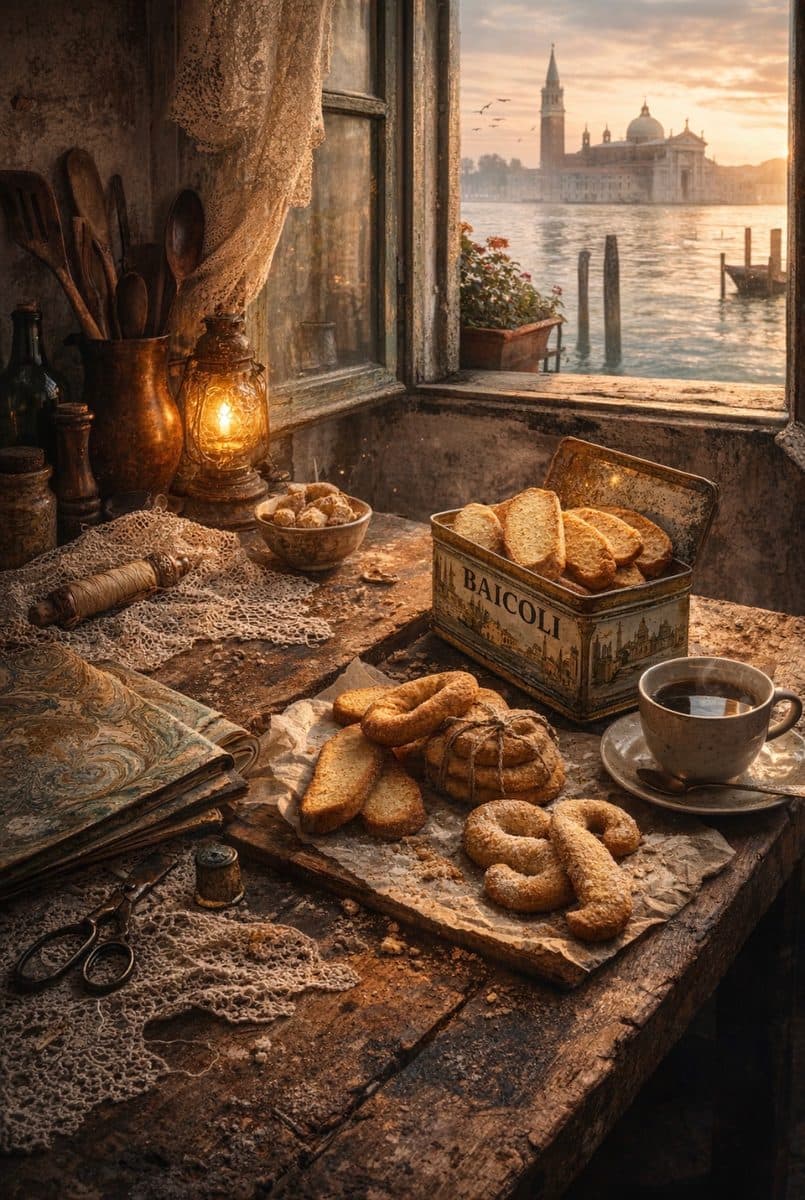
Introduction — The Perspective of the Material Researcher
The material researcher observes a city through what is built, carved, woven, or molded.
They are not simply looking for decorative objects. They want to understand: • which materials are used • which craft techniques have been developed • why certain types of workmanship spread in that particular city
In Venice, these questions lead to the discovery of a network of specialized crafts, born from the city's position between the Mediterranean and Europe.
The journey passes through shipyards, furnaces, paper workshops, and islands of the lagoon to understand how Venetian objects take shape.
Wood of the lagoon: gondolas and forcole
Related souvenirs: • Miniature gondola • Forcola
The gondola is the traditional boat of Venice.
Its shape is not accidental: the boat is asymmetrical, allowing the gondolier to row on one side while keeping the vessel on course. According to historical documentation, its construction uses several types of wood, including oak, linden, and cherry.
Gondolas are built in the squeri, specialized boatyards that have existed in Venice for centuries. One of the best-known examples is the Squero di San Trovaso, which is still active.
The movement of the oar is made possible by the forcola, a hand-carved wooden structure. Its complex shape allows the gondolier to change the position of the oar in order to: • move forward • brake • turn • keep the boat still.
Each forcola is made by artisans known as remeri, who select the wood and carve it by hand.
The fire of the furnaces: Murano glass
Related souvenir: • Murano glass
In 1291 the Republic of Venice ordered that the glass furnaces be moved to the island of Murano.
The decision had two main reasons: 1. to reduce the risk of fires in a city built largely of wood 2. to more easily control a production considered strategic.
In Murano, refined techniques were developed, including: • crystal glass • murrine (glass with patterns obtained by fusing colored rods) • opaque white lattimo glass.
Master glassmakers jealously guarded these techniques, and for centuries the Republic limited their ability to work abroad.
Even today, the island’s furnaces produce decorative and artistic objects that derive from these historic techniques.
Paper and masks: working with water and papier-mâché
Related souvenirs: • Marbled paper • Venetian masks
Marbled paper is made by floating colored pigments on the surface of water. The sheet is then laid over the color, which transfers onto it, creating patterns similar to the veins of marble.
In Venice this technique has been used for centuries in artisanal bookbinding, especially for covers and decorative papers.
Another widespread craft is the making of Venetian masks, produced mainly in papier-mâché.
The technique consists of layering sheets of paper and glue over a mold. After drying, the mask is: • smoothed • painted • decorated with gold leaf or fabrics.
These masks were used during the Venice Carnival, a festival documented as early as the Middle Ages.
Threads and textiles: Burano and Venetian velvets
Related souvenirs: • Burano lace • Historic Venetian textiles
Burano lace is a type of needlework made with needle and thread without a loom.
According to historical sources, this technique developed between the 15th and 16th centuries on the islands of the lagoon. The work was mainly carried out in the homes of the women of the island.
The lace was highly sought after across Europe to decorate: • clothing • collars • linen.
In Venice today there is the Museo del Merletto di Burano, which preserves historical examples of this craft.
At the same time, Venice was for centuries one of Europe’s main centers for the production of velvets and silk brocades.
These textiles were connected to trade with the eastern Mediterranean and were used for: • aristocratic clothing • furnishings • ecclesiastical decorations.
The Museo di Palazzo Mocenigo preserves many testimonies of this textile tradition.
Conclusion — Venice as a city of crafts
Through these objects, a distinct aspect of Venetian history emerges.
The city was not only a commercial or political center. It was also a place where highly specialized crafts developed: • boatyards for gondolas • wood carvers for the forcole • glass furnaces • paper and papier-mâché workshops • textile work and lace-making.
These trades arose in Venice because the city was a crossroads of commerce and techniques coming from different parts of the Mediterranean and Europe.
The souvenirs found in shops today stem from these material traditions. Each object therefore tells not only a story of travel, but also of a system of craftsmanship that contributed to the economic and cultural history of the lagoon.
Contenido editorial elaborado con ayuda de la inteligencia artificial y revisado por Trouvenir. Puede contener imprecisiones.
Descarga gratis
Lleva Trouvenir contigo
iOS y Android. Gratis.
Privacidad primeroSincronización entre dispositivosFunciona sin conexión