Artesanía
Rome Made of Matter
Stone, plaster, and copper: how artisan techniques turn the city into objects
The Material Researcher looks at a city by first asking how objects are made: which materials are used, which tools leave traces on the surface, which hands and which workshops transform a local resource into form. In Rome this perspective is particularly revealing because for centuries the city has been a vast laboratory for the material reproduction of antiquity. Stone quarried nearby, plaster casts taken from classical sculptures, and copper engravings that multiply the image of the ruins have created a true artisanal supply chain. By following these materials – travertine, plaster, and the engraved plate – it becomes clear how Rome has transformed its archaeological heritage into working techniques, specialized crafts, and objects that carry the city out into the world.
Travertine: the stone from the quarries of Tivoli
About thirty kilometers from Rome, in the quarries of Tivoli, travertine has been extracted for centuries in large pale blocks marked by pores and veins. This limestone forms from the mineral deposits of ancient thermal springs: water rich in calcium carbonate slowly solidifies, creating compact layers that can be cut into regular blocks.
The relative proximity of the quarries made travertine an ideal natural resource for building the city. Already in Roman times it was transported along the Aniene valley to urban construction sites. The Colosseum, for example, uses enormous quantities of travertine for the outer ring and for many structural parts, precisely because the stone is resistant to weather and relatively easy to work.
The travertine objects sold in Rome today – small polished blocks, candle holders, decorative elements – contain the same material as the monuments. The porous, slightly irregular surface is not completely concealed: it is part of the material’s identity.
For the Material Researcher, these objects are a miniature version of the city. They tell the story of a concrete supply chain that begins in the quarries of Tivoli, passes through cutting and polishing in stone workshops, and arrives in objects that can be held in the hand.
Chapter sources:
Cutting and finishing stone: from monument to object
After extraction, travertine enters stone workshops where it is transformed. The raw blocks are first cut with diamond circular saws, then polished and finished to obtain regular surfaces or softer textures. It is work that combines modern machinery with the ancient gestures of the stonemason.
In Rome this expertise has never disappeared because the city is a permanent restoration site. Monuments, churches, and historic palaces constantly require work on frames, floors, and stone decorations. Artisans working in stone workshops therefore maintain practical knowledge of materials and finishing techniques.
The same processes are also applied to smaller objects. A paperweight or small decorative element in travertine is made through the same steps: cutting, polishing, and possibly engraving the surface.
In this way the souvenir becomes a compact version of Roman building culture. It is the same stone, worked with the same tools, moving from the monumental construction site to the everyday object.
Chapter sources:
Plaster as a tool for study: the casting technique
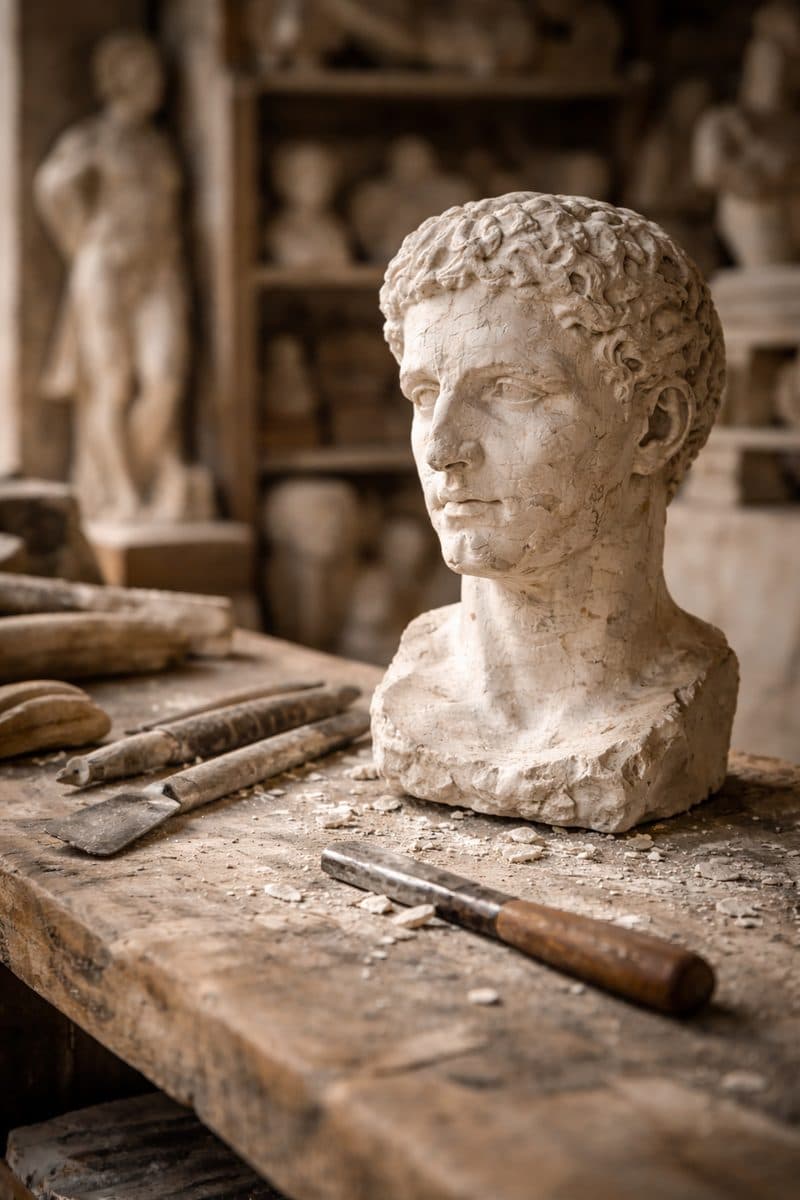
In many Roman workshops plaster is still mixed with water and poured into molds to produce copies of ancient sculptures. The process is simple but precise: first a mold is made that records every detail of the original surface, then liquid plaster is poured inside and left to harden.
The casting technique spread especially from the Renaissance onward, when artists and scholars sought ways to study the sculptures of antiquity up close. Rome, with its enormous number of classical statues preserved in palaces, papal collections, and museums, became one of the main places where this practice developed.
Copies allowed people to observe proportions, muscles, and folds of drapery without moving the marble originals. Over the centuries these replicas became fundamental teaching tools in European art academies.
The small casts sold today in Roman museums – hands, busts, fragments of famous statues – descend directly from this tradition of study. They are objects that transform the surface of antiquity into something tangible and portable.
Chapter sources:
Multiplying antiquity: plaster cast workshops between museums and academies
Between the 17th and 19th centuries Rome became the European center for the production of plaster casts. Art academies, archaeologists, and travelers on the Grand Tour wanted to study and bring home the forms of the classical statues preserved in the city.
Specialized workshops emerged to replicate sculptures. Artisans used plaster or alabaster powder, inexpensive materials capable of capturing every detail of the marble surface: the curls of hair, the folds of fabric, the marks of ancient chisels.
This economy of replication exists precisely in Rome because the originals are here. Historic collections such as those of the Musei Capitolini or the Vatican Museums offer an immense repertoire of models to copy and disseminate.
Contemporary cast souvenirs continue this same logic: multiplying the forms of antiquity and making them accessible. In small format, they carry a material fragment of classical culture beyond the museum walls.
Chapter sources:
Engraving Rome on copper: the technique of vedute
Before the invention of photography, the image of Rome traveled on paper thanks to engraving. The artist worked on a copper plate using tools such as the burin or drypoint, carving fine lines into the metal surface.
When the plate was inked, the pigment remained inside the engraved grooves. Under the pressure of the printing press the paper absorbed the ink, producing an extremely detailed image. This process made it possible to represent complex architecture with great precision.
In the eighteenth century engravers such as Giovanni Battista Piranesi turned this technique into a powerful narrative medium. His views of ruins, arches, and Roman temples spread the monumental image of the city throughout Europe.
The prints that today depict the Colosseum, Pantheon, or Roman Forum descend from this technical tradition. They are images born from the material working of copper, designed to carry Rome beyond its borders.
Chapter sources:
- Giovanni Battista Piranesi - Encyclopaedia Britannica
- Piranesi and the Etching of Rome - The Metropolitan Museum of Art
Printing the city: workshops and the Grand Tour market
Between the 17th and 19th centuries Rome became an essential stop on the Grand Tour, the educational journey many young European aristocrats undertook to experience art and antiquity. This constant presence of visitors created strong demand for images of the city.
Printers and publishers opened workshops specialized in producing engraved views. The process required several stages: engraving the copper plate, manual inking, printing with a press, and often a later coloring done by hand.
Series of prints depicted the most recognizable monuments: the Colosseum, Roman Forum, triumphal arches, squares, and basilicas. These images became a sort of visual atlas of the city that travelers could take home.
The souvenir prints found today in Roman art bookshops follow this same model. They are not only representations of monuments but the result of a typographic tradition born to tell the story of Rome through the precision of the engraved line.
Chapter sources:
Closing
Seen through its materials, Rome appears less like an immobile museum and more like a long chain of processes. Stone quarried near the city becomes architecture and then object; ancient sculptures become molds for casts; ruins turn into lines engraved on copper and printed on paper. Each souvenir therefore tells not only the story of a monument but of a process: quarry, workshop, studio, print. It is in this continuity of techniques and hands that one of the city’s most concrete characteristics can be recognized.
Sources for the itinerary:
Travertine: the stone from the quarries of Tivoli
About thirty kilometers from Rome, in the quarries of Tivoli, travertine has been extracted for centuries in large light-colored blocks crossed by pores and veins. This limestone forms from the mineral deposits of ancient thermal springs: water rich in calcium carbonate slowly solidifies, creating compact layers that can be cut into regular blocks.
The relative proximity of the quarries made travertine an ideal natural resource for building the city. As early as Roman times it was transported along the Aniene valley to urban construction sites. The Colosseum, for example, uses enormous quantities of travertine for the outer ring and many structural parts, precisely because the stone is resistant to weathering and relatively easy to work.
Travertine objects sold in Rome today – small polished blocks, candle holders, decorative elements – preserve the very same material as the monuments. The porous, slightly irregular surface is not completely concealed: it is part of the material’s identity.
For the Material Researcher, these objects are a miniature of the city. They tell the story of a tangible supply chain that begins in the quarries of Tivoli, passes through cutting and polishing in stone workshops, and arrives at the objects you can hold in your hands.
Cutting and Finishing Stone: From Monument to Object
After extraction, travertine enters stone workshops where it is transformed. The raw blocks are first cut with diamond-blade saws, then smoothed and finished until they achieve regular surfaces or softer textures. It is work that combines modern machinery with the ancient gestures of the stonemason.
In Rome this expertise has never disappeared because the city is a permanent restoration site. Monuments, churches, and historic palaces constantly require work on cornices, floors, and stone decorations. The artisans who work in stone workshops thus maintain practical knowledge of materials and finishing techniques.
The same processes are also applied to smaller objects. A paperweight or a small decorative element in travertine is created through the same steps: cutting, smoothing, and possibly engraving the surface.
In this way the souvenir becomes a compact version of Roman building culture. It is the same stone, worked with the same tools, that moves from monumental construction sites to everyday objects.
Plaster as a Tool for Study: The Casting Technique
In many Roman workshops, plaster is still mixed with water and poured into molds to create copies of ancient sculptures. The process is simple but precise: first a mold is made that records every detail of the original surface, then the liquid plaster is poured inside and left to harden.
The casting technique spread especially during the Renaissance, when artists and scholars sought ways to study the sculptures of antiquity up close. Rome, with its vast number of classical statues preserved in palaces, papal collections, and museums, became one of the main places where this practice developed.
These copies made it possible to observe proportions, muscles, and the folds of drapery without having to move the original marble works. Over the centuries, such replicas became essential tools in European art academies.
The small plaster casts sold today in Roman museums—hands, busts, fragments of famous statues—descend directly from this tradition of study. They are objects that transform the surface of the ancient into something tangible and transportable.
Multiplying the Ancient: plaster cast workshops between museums and academies
Between the 17th and 19th centuries, Rome became the European center for the production of plaster casts. Art academies, archaeologists, and travelers on the Grand Tour wanted to study—and take home—the forms of the classical statues preserved in the city.
Specialized workshops devoted to replicating sculptures began to appear. Craftsmen used plaster or alabaster plaster, inexpensive materials capable of capturing every detail of the marble surface with precision: the curls of hair, the folds of fabric, the traces left by ancient chisels.
This economy of replication exists in Rome precisely because the originals are here. Historic collections such as those of the Musei Capitolini and the Musei Vaticani offer an immense repertoire of models to copy and disseminate.
Contemporary souvenir casts continue this same logic: multiplying the forms of the ancient world and making them accessible. In small formats, they carry a tangible piece of classical culture beyond the museum walls.
Engraving Rome on Copper: the Vedute Technique
Before the invention of photography, the image of Rome traveled on paper thanks to engraving. The artist worked on a copper plate using tools such as the burin or the drypoint needle, carving fine lines into the metal surface.
When the plate was inked, the color remained inside the engraved grooves. Under the pressure of the printing press, the paper absorbed the ink, producing an extremely detailed image. This process made it possible to represent complex architecture with great precision.
In the 18th century, engravers such as Giovanni Battista Piranesi transformed this technique into a powerful narrative medium. His views of ruins, arches, and Roman temples spread the monumental image of the city throughout Europe.
The prints that today depict the Colosseum, the Pantheon, or the Roman Forum descend from this technical tradition. They are images born from the physical working of copper, created to carry Rome beyond its borders.
Printing the City: Workshops and the Grand Tour Market
Between the 17th and 19th centuries, Rome became an essential stop on the Grand Tour, the educational journey many young European aristocrats undertook to discover art and antiquity. This constant presence of visitors created strong demand for images of the city.
Printers and publishers opened workshops specializing in the production of engraved views. The process required several steps: engraving the copper plate, applying ink by hand, printing with a press, and often a later stage of hand coloring.
Series of prints depicted the city’s most recognizable monuments: the Colosseum, the Roman Forum, triumphal arches, squares, and basilicas. The images became a kind of visual atlas of the city that travelers could take home.
The souvenir prints found today in Roman art bookshops follow this same model. They are not only representations of monuments, but the result of a printmaking tradition born to tell the story of Rome through the precision of the engraved line.
Contenido editorial elaborado con ayuda de la inteligencia artificial y revisado por Trouvenir. Puede contener imprecisiones.
Descarga gratis
Lleva Trouvenir contigo
iOS y Android. Gratis.
Privacidad primeroSincronización entre dispositivosFunciona sin conexión