Historia♛ Premium
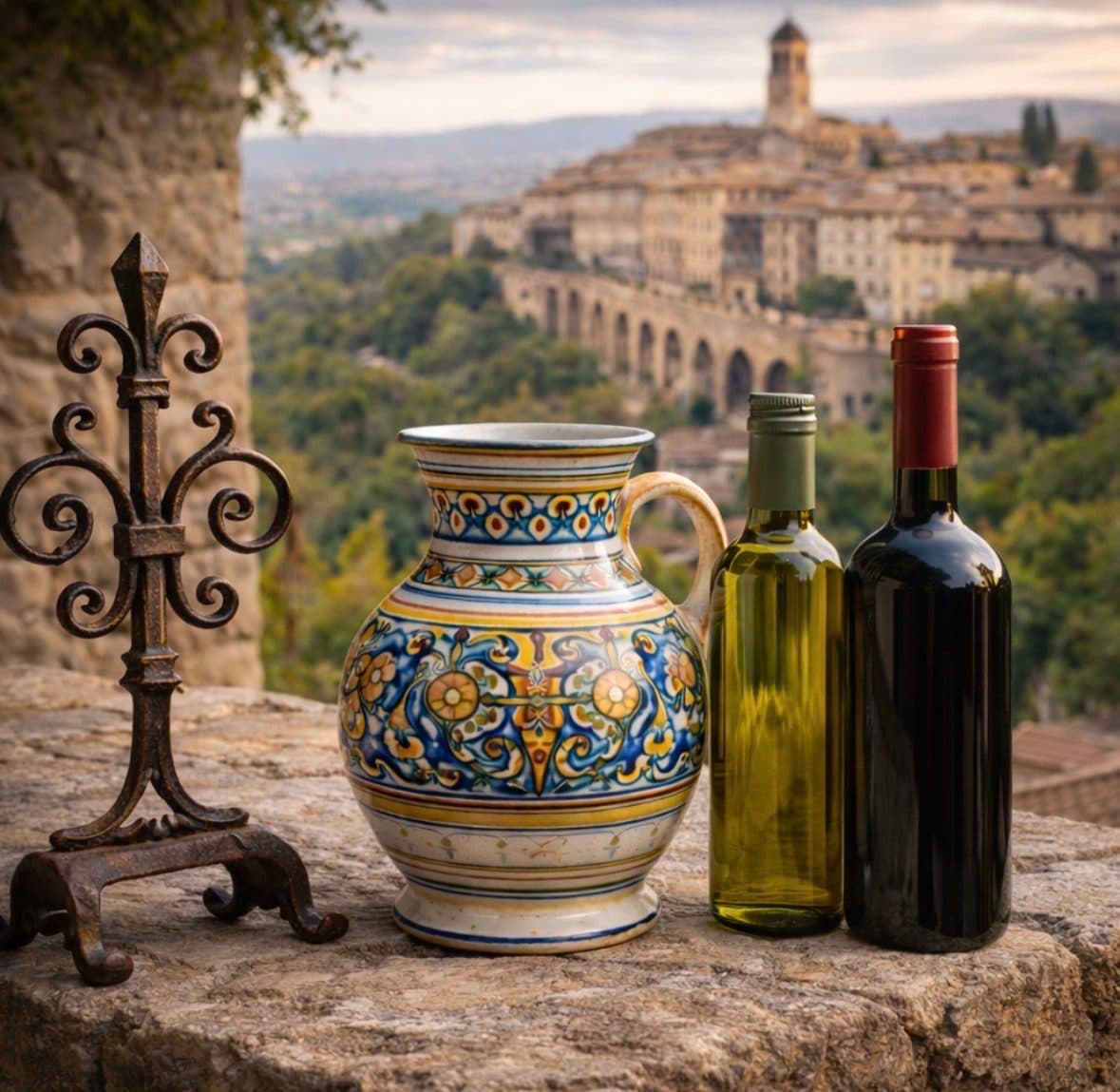
Perugia through materials: iron, clay, olives and vineyards
Material researcher
Introduction — The Material Researcher’s Gaze
The Material Researcher moves through a city searching for the raw materials that compose it.
They do not look first at monuments, but at the objects people produce: worked metal, shaped clay, cultivated fruits, fermented wines.
In Perugia this perspective reveals four fundamental materials of the territory: • iron • clay • olives • grapes
Each tells the story of a tangible relationship between the city and its landscape: the artisan workshops of the historic center, the ceramic studios of the Tiber Valley, the olive groves of the Umbrian hills, and the vineyards around Lake Trasimeno.
Iron in the Medieval City
Related souvenir: traditional wrought-iron object
Walking through the historic center of Perugia, it is easy to notice wrought-iron grilles, street lamps, and signs.
Wrought iron comes from a simple but ancient technique: the metal is heated in the forge and shaped with a hammer on the anvil. This process makes it possible to create elements that are both durable and decorative.
In the Middle Ages, iron was essential for: • doors and gates of houses • defensive structures • agricultural tools • urban elements
The Umbrian hill towns, built with narrow streets and stone buildings, required sturdy grilles and hanging lamps to light the alleyways.
Even today many Umbrian artisan workshops maintain this traditional technique.
The clay and maiolica of Deruta
Related souvenir: Umbrian everyday maiolica
about 20 km from Perugia lies Deruta, one of the most important centers of Italian ceramics.
The production of maiolica is documented as early as the 13th century.
The technique consists of three main steps: 1. shaping the clay 2. first firing 3. coating with a white tin-based glaze 4. painted decoration and second firing
The white glaze allows the colors to stand out and makes the typical Renaissance decoration possible.
Among the most widespread motifs: • Raphael-inspired motifs • Grotesques • Umbrian geometric patterns
Perugia historically used these ceramics for plates, jugs, and household tableware, spreading the production of Deruta throughout the territory.
The olive oil hills of Umbria
Related souvenir: extra virgin olive oil from the Perugian hills
The hills around Perugia are covered with olive groves that have been cultivated for centuries.
The oil produced here falls under the DOP Umbria designation, recognized by the European Union.
The most common olive varieties are: • Moraiolo • Frantoio • Leccino
The Moraiolo variety is particularly well suited to the rocky hillside soils of Umbria and produces oils with an intense, slightly peppery flavor.
The traditional process involves: 1. holive harvesting in autumn 2. pressing within a few hours 3. cold mechanical extraction
The presence of many small farms in the hills around Perugia explains why olive oil is one of the most common gastronomic souvenirs of the area.
The vineyards of Lake Trasimeno
Related souvenir: Trasimeno wine
About 25 km from Perugia lies Lake Trasimeno, the largest lake in central Italy.
The hills surrounding it create a microclimate that is favorable for viticulture.
This is where the Trasimeno DOC designation originates, which includes several wines produced in the province of Perugia.
One of the most characteristic grape varieties is Gamay del Trasimeno, actually genetically close to Grenache, cultivated in the area for centuries.
The geographic conditions explain the spread of viticulture: • well-drained hillside soils • the climatic influence of the lake • an ancient agricultural tradition
For this reason, Trasimeno wine is one of the most representative products of the Perugia area.
Conclusion — The city told through its materials
By following these objects, you discover that Perugia is defined not only by its monuments, but also by the materials the land provides and that its inhabitants work with.
The iron from urban workshops, the clay of Deruta, the olives from the Umbrian hills, and the grapes of Lake Trasimeno all arise from specific geographic conditions: • hills rich in olive groves • soils suited to ceramics • an urban artisan tradition • a climate favorable to viticulture
Souvenirs therefore become a tangible trace for understanding how the Umbrian landscape has shaped the artisanal and agricultural activities around Perugia.
Contenido editorial elaborado con ayuda de la inteligencia artificial y revisado por Trouvenir. Puede contener imprecisiones.
Descarga gratis
Lleva Trouvenir contigo
iOS y Android. Gratis.
Privacidad primeroSincronización entre dispositivosFunciona sin conexión