Historia♛ Premium
Perugia through its signs: images, devotions, and crafts
Symbolic Explorer
Introduction — The Gaze of the Symbolic Explorer
A Symbolic Explorer looks for objects that help reveal how a city tells its own story.
They do not look only at the aesthetic value of souvenirs. Instead, they try to understand: • which images represent the city • which religious traditions have shaped urban life • which materials and crafts have become recognizable over time.
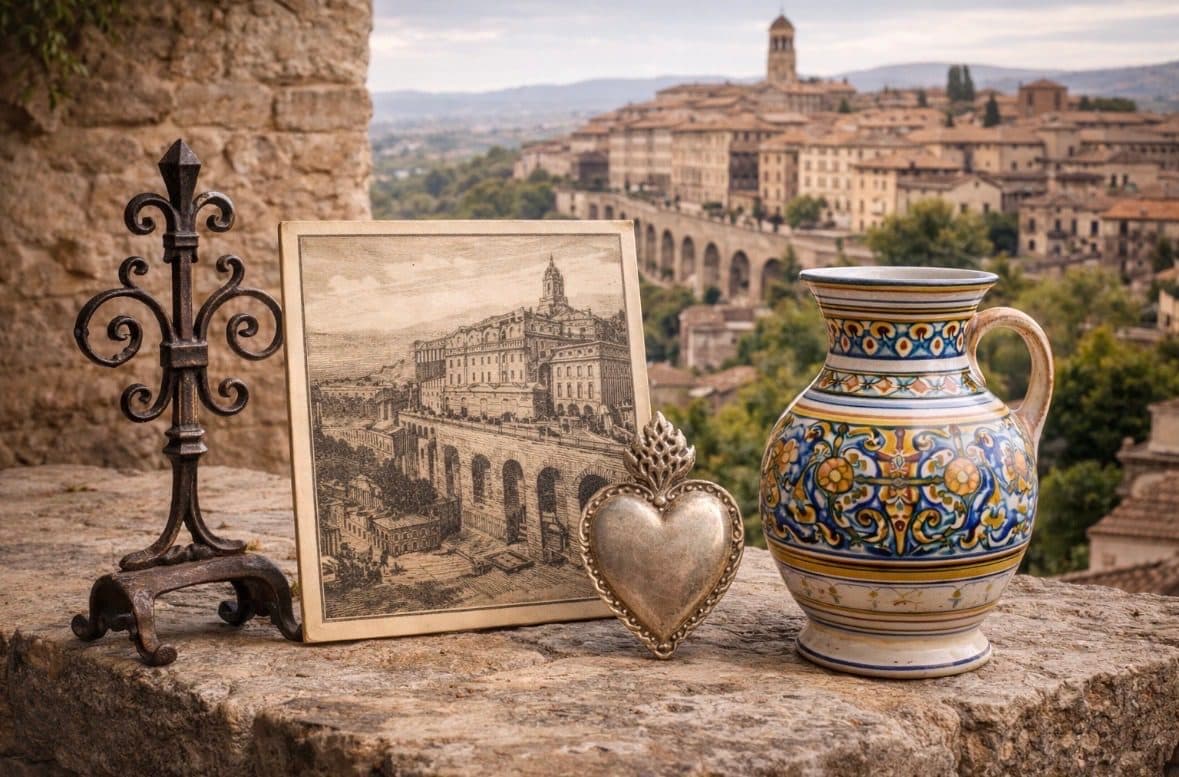
In Perugia, a medieval city built along a ridge of the Umbrian Apennines, these signs appear in four objects: prints, devotional items, maiolica ceramics, and wrought iron. Each one grows out of a real practice of the city: graphic art, religious devotion, Renaissance ceramics, and the work of artisan workshops.
Images of the city — the tradition of prints
Prints and engravings played an important role in spreading images of Perugia between the 16th and 19th centuries.
Many depict: • views of the medieval city • monuments such as Fontana Maggiore • religious scenes connected to local saints.
Intaglio printing involved engraving an image onto a metal plate, usually copper. The plate was inked and then pressed onto paper using a printing press.
This process made it possible to produce multiple copies of the same image.
Why Perugia in particular?
During the Renaissance the city was an active cultural center thanks to the Università degli Studi di Perugia and the presence of artists and printers. Prints therefore became a tool for spreading images of the city and its devotions.
Today these images are preserved in local museums and libraries.
Making protection tangible in objects
Perugia has a long tradition of civic devotion linked to the city’s patron saints.
Among the most venerated are: • Costanzo, first bishop and patron saint • Ercolano, a bishop and martyr killed during the Gothic War of the 6th century.
Their memory is tied to specific places in the city such as: • Cattedrale di San Lorenzo • Chiesa di Sant’Ercolano
Devotional objects such as: • sacred images • religious medals • small crucifixes or rosaries
were sold during religious festivals and pilgrimages.
These objects served a practical purpose: allowing the faithful to take home a sign of the city’s devotion.
For this reason they are also souvenirs today: they tell the story of the religious dimension that shaped urban life for centuries.
The ceramics born from Umbrian clay
A few kilometers from Perugia lies Deruta, one of the best-known centers in Italy for maiolica.
Production has been documented since at least the 14th century.
Maiolica is a ceramic coated with a white tin-based glaze that allows colorful decorations to be painted on the surface.
Common objects include: • plates • pitchers • pharmacy albarelli jars • decorated trays.
Why did this craft develop here?
The Tiber area provides clays suitable for ceramics, and already during the Renaissance Deruta developed specialized workshops that exported maiolica throughout Italy.
Even many everyday objects feature typical decorations: • Renaissance motifs • heraldic animals • geometric ornaments.
For this reason, today a maiolica object represents one of the most recognizable souvenirs from the Perugia area.
The wrought iron of medieval workshops
Walking through the historic center of Perugia you come across many examples of wrought iron: • lamps • railings • signs • gates.
This type of work was carried out by blacksmiths, essential artisans in the medieval city.
The iron was heated in the forge until it became malleable and then shaped with hammer blows.
Common objects produced in the historic workshops: • household tools • locks • architectural elements • decorations for public and religious buildings.
The small wrought‑iron objects sold today as souvenirs draw on these traditional techniques.
For this reason they are not simply decorative objects: they recall the craftsmanship that contributed to the physical construction of the city.
Conclusion — Four objects to understand Perugia
Prints, devotional objects, maiolica, and wrought iron tell four real aspects of Perugia’s history: • the spread of images of the city • the religious devotion that shaped urban life • the ceramic production developed in nearby centers • the artisanal work of medieval workshops.
Seen together, these objects explain why certain souvenirs exist right here.
They are not chosen by chance: they stem from arts, beliefs, and trades that were truly present in the city and its surrounding territory.
Contenido editorial elaborado con ayuda de la inteligencia artificial y revisado por Trouvenir. Puede contener imprecisiones.
Descarga gratis
Lleva Trouvenir contigo
iOS y Android. Gratis.
Privacidad primeroSincronización entre dispositivosFunciona sin conexión