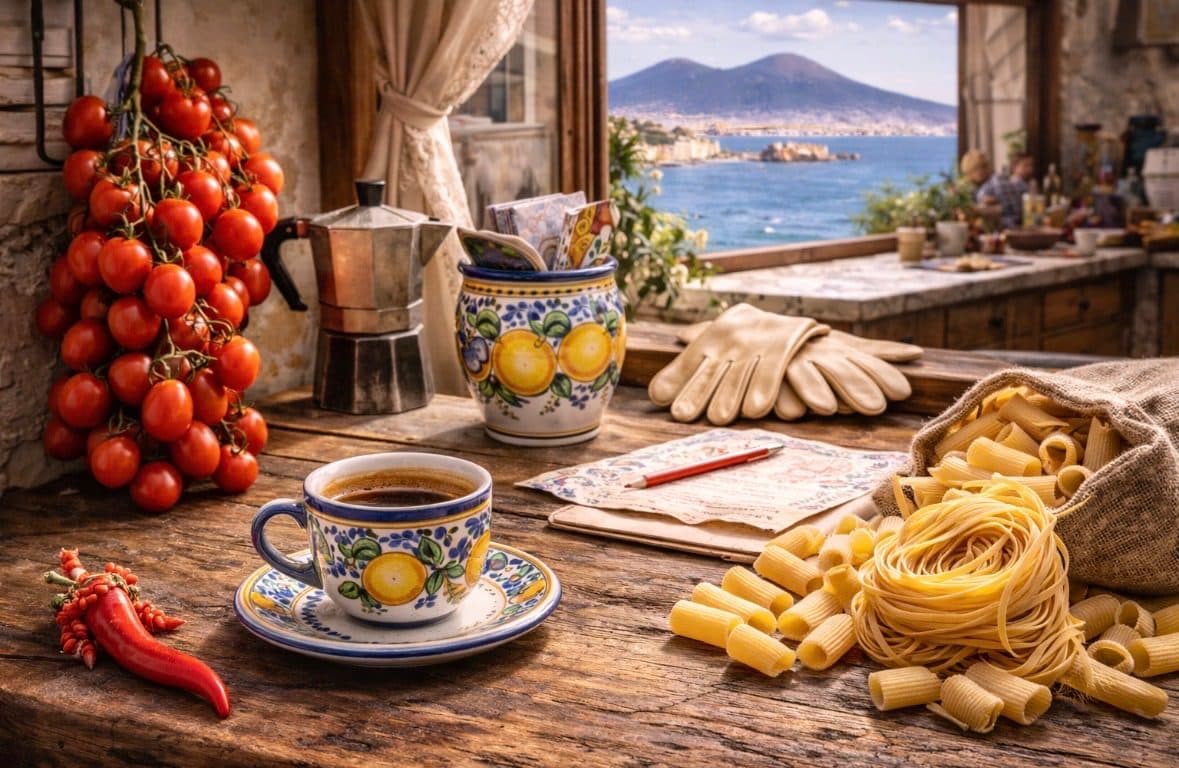
Introduction - The Everyday Observer’s Gaze
An everyday observer does not look for famous monuments or great works of art.
Instead, they look at the objects that are part of the normal lives of residents: what people use in the kitchen, what is bought in the markets, the accessories produced in artisan districts.
In Naples, these objects say a lot about the city. Coffee prepared at home, tomatoes hanging in the kitchen, prints sold in the alleys, or accessories sewn in tailoring workshops show how people have lived and worked here for centuries.
This route follows some of these everyday objects.
The domestic ritual of coffee
Souvenirs: • Neapolitan blend • cuccumella coffee pot • espresso cups
In Naples, coffee is not just a drink but a deeply rooted everyday gesture.
Until the mid‑20th century, many families prepared coffee with the cuccumella, a coffee pot invented in the 19th century that works by filtration. Boiling water passes through the ground coffee and the container is then flipped over to complete the extraction.
This system was common in Neapolitan homes before the arrival of the moka pot.
In cafés, however, a strong culture developed around espresso drunk at the counter, served in small cups and often consumed quickly during the day.
Coffee had already spread in Naples in the 18th century, when the city was one of the largest capitals in Europe and public cafés were places for social gatherings.
Images in the alleys: popular prints
Souvenirs: • Neapolitan decorated paper • popular prints
Between the 18th and 19th centuries, many inexpensive popular prints circulated in Naples.
They were illustrated sheets produced using engraving techniques and sold in markets or small shops. They often depicted: • saints and religious images • scenes of city life • historical events • famous figures.
Many families hung them in their homes or workplaces.
This production was possible because Naples had a strong tradition of typography and engraving, documented in the collections of the Museo di San Martino.
Today this tradition also survives in handcrafted decorated paper, used for notebooks, boxes, and bookbindings.
Cherry tomatoes hanging in the kitchen
Souvenir: • Pomodorino del Piennolo del Vesuvio DOP
Pomodorino del Piennolo del Vesuvio is grown on the slopes of Mount Vesuvius, where the volcanic soil is rich in minerals.
The name “piennolo” comes from the traditional preservation method: the cherry tomatoes are tied with string to form large clusters that are hung in well‑ventilated areas of the house.
This way they can be preserved for many months without refrigeration.
Main characteristics: • thick skin • very concentrated flavor • good keeping qualities.
Since 2009 this product has held the European Union’s DOP certification.
It is widely used in Neapolitan cuisine for: • pasta sauces • pizza • fish dishes.
Tailoring and accessories of the city
Souvenir: • handcrafted gloves • Neapolitan ties
Naples is one of the most important centers of Italian tailoring.
In the twentieth century, what is known as Neapolitan tailoring developed, characterized by: • lightweight jackets • soft shoulders • extensive handwork.
Around the tailoring workshops, artisan accessory ateliers also developed, producing items such as ties and gloves.
The tradition of glove makers is historically documented in the neighborhoods of the historic center, where leather was worked to produce elegant accessories destined both for the local market and for export.
Neapolitan ties are often sewn by hand using fine silks and follow the same tradition of artisanal craftsmanship.
Historic Perfumeries and Pharmacies
Souvenir: • Neapolitan artisanal perfumes
The production of essences and perfumes in Naples is linked to the tradition of ancient apothecaries.
Apothecaries were pharmacies where the following were prepared: • medicines • ointments • scented waters.
An important example is the Antica Farmacia degli Incurabili, part of the Complesso Monumentale degli Incurabili. Founded in the 18th century, it still preserves shelves and tools used for preparing aromatic and medicinal substances.
Some modern artisanal productions of perfumes and fragrances also stem from these traditions.
Conclusion
By observing these everyday objects, many aspects of Neapolitan life become clear.
Coffee tells the story of the social rituals of the day. Popular prints show how images and devotions circulated inside homes. Vesuvio cherry tomatoes explain the relationship between cuisine and the volcanic land. Tailor shops and handcrafted accessories speak of urban trades. Fragrances recall the ancient traditions of apothecaries.
Together, these objects reveal a city shaped not only by monuments but also by domestic habits, skilled trades, and local products that continue to be part of everyday life in Naples.
Contenido editorial elaborado con ayuda de la inteligencia artificial y revisado por Trouvenir. Puede contener imprecisiones.
Descarga gratis
Lleva Trouvenir contigo
iOS y Android. Gratis.
Privacidad primeroSincronización entre dispositivosFunciona sin conexión