Historia♛ Premium
Florence in the Hands of Artisans: Symbols, Workshops and Materials of the City
Symbolic Explorer
The Gaze of the Symbolic Explorer
A symbolic explorer observes a city through the objects that represent it.
They are not simply looking for decorative souvenirs. They look for objects that tell how a city works, produces, and conveys its cultural identity.
In Florence, this means stepping into workshops where metal, paper, leather, and perfumes have been crafted for centuries. Objects born from ancient arts that exist here precisely because the city, since the Middle Ages and the Renaissance, has been a center of artistic and artisanal production.
By following these objects, one discovers a Florence made not only of museums, but of trades passed down through time.
The Metal of Sculptors
Souvenir: • objects in worked bronze or brass
Florence is one of the European cities where bronze sculpture experienced extraordinary development.
During the Renaissance, artists such as Donatello and Benvenuto Cellini created monumental works cast in bronze, a complex technique that requires molds and pours of molten metal.
This tradition has not disappeared. In the twentieth century, workshops specializing in artistic casting emerged, such as the Fonderia Artistica Ferdinando Marinelli, founded in 1905 and still active in producing statues and replicas using the lost-wax casting technique, the same one used during the Renaissance. 
For this reason, many Florentine bronze souvenirs — small statues, decorative plaques, or reproductions of famous works — are not simply decorative objects: they are scaled versions of the sculptural techniques that made Florence a global center of art.
Reproducing Art
Souvenirs: • art prints • engravings • casts of artworks
Florence is home to some of the most important art collections in the world. For centuries, artists and students came to the city to study the masterpieces of the Renaissance directly.
For this reason, between the 18th and 19th centuries the production of plaster casts and art prints reproducing famous statues and paintings became widespread. These reproductions were used in academies and art schools to study proportion, anatomy, and composition.
Even today many Florentine workshops produce reproductions of classical sculptures or art prints, allowing visitors to take home an accessible version of the masterpieces housed in the city’s museums.
These objects exist in Florence because the city has been an international school of art for centuries.
Paper born in the workshops of bookbinders
Souvenir: • Florentine marbled paper
Marbled paper is a decorative technique that creates marble-like patterns by floating pigments on water and transferring them onto paper.
The technique arrived in Florence in the 18th century, initially used by bookbinders to decorate book covers and endpapers. 
Over time this paper also became a material for handcrafted objects: notebooks, boxes, albums, and decorative sheets.
Its connection with Florence comes from the city’s role as a center for publishing, bookbinding, and the artistic production of books. Many workshops in the Oltrarno still continue this manual tradition today.
Leather and the workshops of Santa Croce
Souvenir: • bags • wallets • Florentine leather belts
Leather working has been documented in Florence since at least the Middle Ages.
The workshops of tanners and craftsmen were located near the Arno, where water was needed for tanning hides. 
In the Santa Croce district this tradition is still visible. Here, after the war, the Scuola del Cuoio was founded with the aim of teaching leather craftsmanship to war orphans and preserving the trade. 
Even today, artisans still work leather by hand: cutting the hide, hand stitching, and decoration with gold leaf.
The reason leather is so widespread in Florence is historical: for centuries the city was a commercial and manufacturing center connected to the medieval guilds.
The city of perfumes
Souvenir: • Florentine artisanal perfumes
The Florentine perfume-making tradition was born in medieval convents.
In 1221 the Dominican friars arrived in Florence and began cultivating medicinal herbs in the gardens of the monastery of Santa Maria Novella. With these plants they produced balms, ointments, and scented waters. 
In 1612 these activities were officially organized into the Officina Profumo-Farmaceutica di Santa Maria Novella, one of the oldest pharmacies in the world still in operation. 
One of the perfumes most closely linked to the city is Acqua della Regina, created in the 16th century for Caterina de’ Medici when she left for the court of France. 
For this reason, Florentine artisanal perfumes are not simply fragrances: they represent the long history of monastic pharmacy and Renaissance botany.
Conclusion — Florence through objects
Following these souvenirs reveals a Florence that goes beyond its monuments.
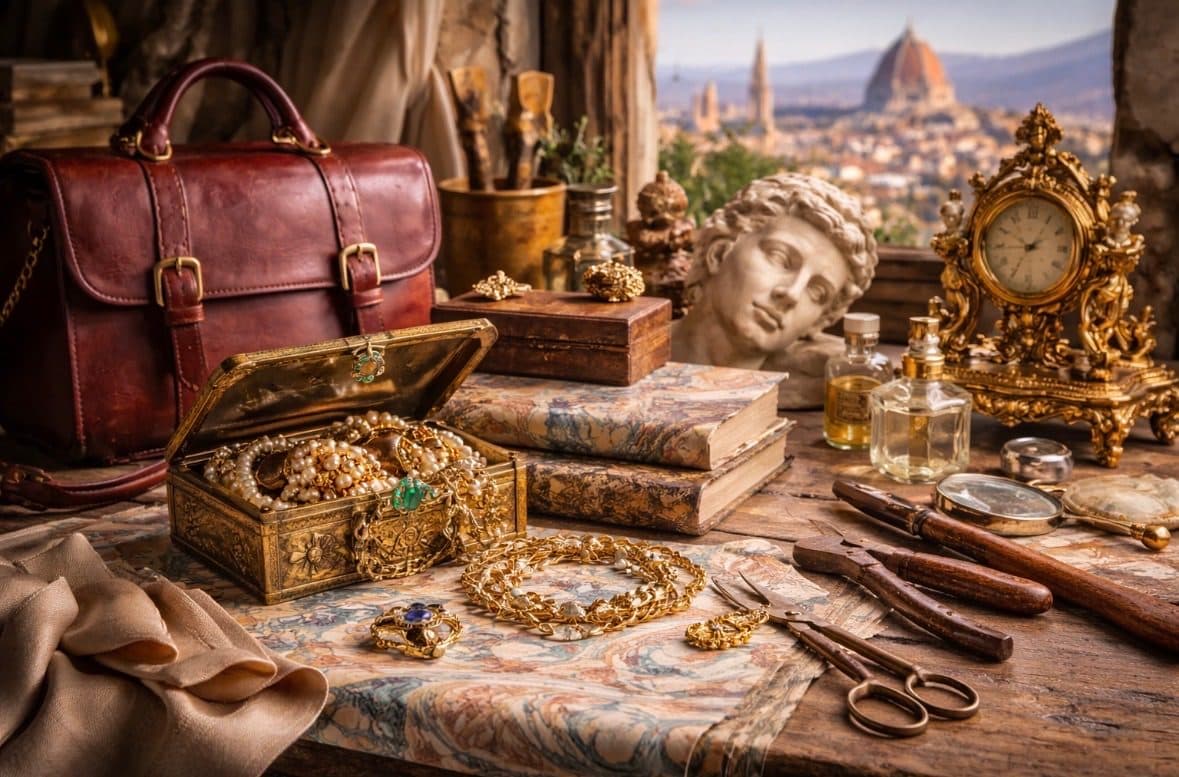
These objects tell the story of a city built on the work of its workshops: • bronze recalls the Renaissance sculptural tradition • artistic reproductions come from the city that has long been a training ground for artists • marbled paper comes from bookbinding workshops • leather from the ancient artisan guilds near the Arno • perfumes from medieval monastic medicine
Each of these objects exists in Florence because the city was for centuries a European center of arts, crafts, and cultural production.
Bringing one of these objects home means carrying with you a small part of that history.
Contenido editorial elaborado con ayuda de la inteligencia artificial y revisado por Trouvenir. Puede contener imprecisiones.
Descarga gratis
Lleva Trouvenir contigo
iOS y Android. Gratis.
Privacidad primeroSincronización entre dispositivosFunciona sin conexión