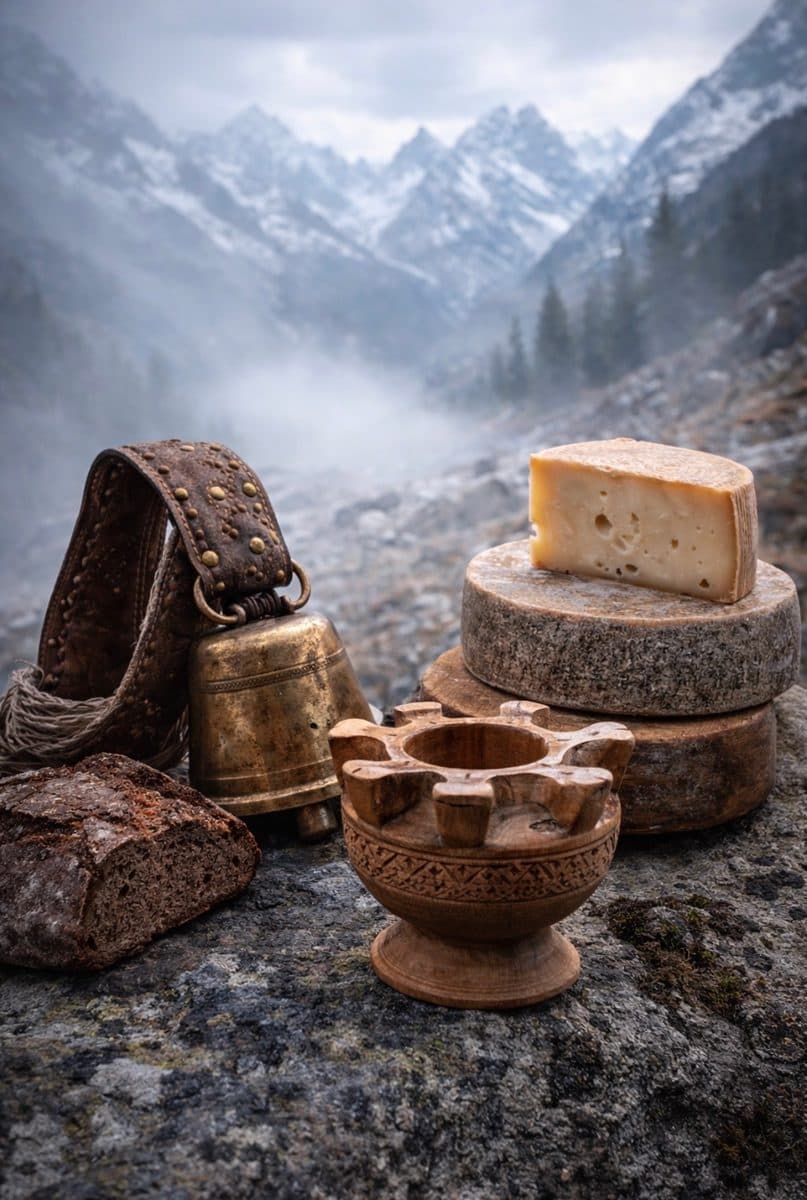
The gaze of the symbolic explorer
The symbolic explorer observes a city through objects that tell the story of its cultural identity.
They are not simply looking for decorative souvenirs. They look for objects that exist because history, landscape, and people’s daily activities made them necessary.
In Aosta and the Aosta Valley, many traditional objects arise from life in the mountains: livestock grazing in alpine pastures, the cultivation of cold‑resistant grains, and the convivial spirit of small alpine communities.
Cowbells, rye bread, Fontina cheese, and friendship cups tell exactly this story: how people built a culture by adapting to the mountains.
The sound of the alpine pastures
The pastoral cowbell
The cowbell is one of the most recognizable objects of Alpine culture.
It is used to keep track of animals out to pasture: its sound allows the shepherd to locate the herd even when the animals scatter across the mountain pastures.
In the Aosta Valley the cowbell is especially visible during the Désarpa, the festival that celebrates the descent of the herds from the alpine pastures at the end of summer. On this occasion the cows are decorated and led through the villages with large bells.
The cowbell, therefore, is not just an agricultural tool. It tells the story of the alpine pasture system, which for centuries has organized the region’s economic life.
The bread born from the Alpine climate
Rye black bread
Rye black bread exists in the Aosta Valley for a very specific reason: the mountain climate.
Rye is a cereal that is highly resistant to cold and grows well even in poor soils and at high altitudes. For this reason, for centuries it was one of the few grains reliably cultivated in the Alpine valleys.
Traditionally, bread was baked in the villages’ communal ovens only a few times a year. Families prepared large quantities of dried bread that could keep for a long time during the winter.
This tradition is now celebrated in the festival Lo Pan Ner, during which many old village ovens are lit again.
Rye bread therefore tells the story of how Alpine food culture adapted to the mountain’s climatic and agricultural conditions.
The Cheese of the Alpine Pastures
Fontina from the Alpine Pastures
Fontina DOP is one of the most representative products of the Aosta Valley.
It is produced exclusively with raw milk from Valdostana-breed cows, raised on high summer alpine pastures. After production, the wheels are aged in traditional natural caves called “crottes”, where temperature and humidity encourage the cheese’s maturation.
Medieval documents attest to the production of Fontina as early as the 13th century.
Fontina exists precisely here because the territory of the Aosta Valley developed over centuries an agricultural system based on alpine pasturing: in summer the livestock move up to high-altitude meadows, producing rich, aromatic milk.
This cheese is therefore the gastronomic expression of the region’s alpine landscape.
Sharing Coffee
The grolla or friendship cup
The friendship cup is a wooden cup with several spouts used to drink Valdostan-style coffee.
This drink is prepared with coffee, sugar, grappa, and spices such as cinnamon or lemon zest. After being warmed in the cup, it is drunk by passing the vessel from one person to another.
The traditional rule says that the cup should never be placed on the table: the act of passing it directly creates a moment of sharing.
The grolla is made by local artisans from turned and decorated wood, a technique typical of Aosta Valley craftsmanship.
This object therefore tells an important story about life in Alpine communities: conviviality and the value of coming together.
Conclusion – Four objects to understand the Aosta Valley
Seen together, these objects tell a coherent story.
The cowbell speaks of pastoralism and alpine pastures. Rye bread shows how Alpine communities adapted to the mountain climate. Fontina represents the agricultural system that connects pastures, animals, and food production. The friendship cup tells of the way people share time and food.
Through these objects, it becomes clear that the culture of Aosta and the Aosta Valley is born from three concrete elements: the mountains, work in the alpine pastures, and the communal life of the villages.
Contenido editorial elaborado con ayuda de la inteligencia artificial y revisado por Trouvenir. Puede contener imprecisiones.
Descarga gratis
Lleva Trouvenir contigo
iOS y Android. Gratis.
Privacidad primeroSincronización entre dispositivosFunciona sin conexión