Historia♛ Premium
Amalfi among lemons and paper: objects that tell the story of a seaside town
Symbolic explorer
The symbolic explorer’s gaze
A symbolic explorer observes a city through objects that tell its real story.
They don’t look for random souvenirs. They look for objects that explain: • which landscape shaped the city • which economic activities sustained it • how inhabitants transformed local resources.
In Amalfi, two elements explain almost everything:
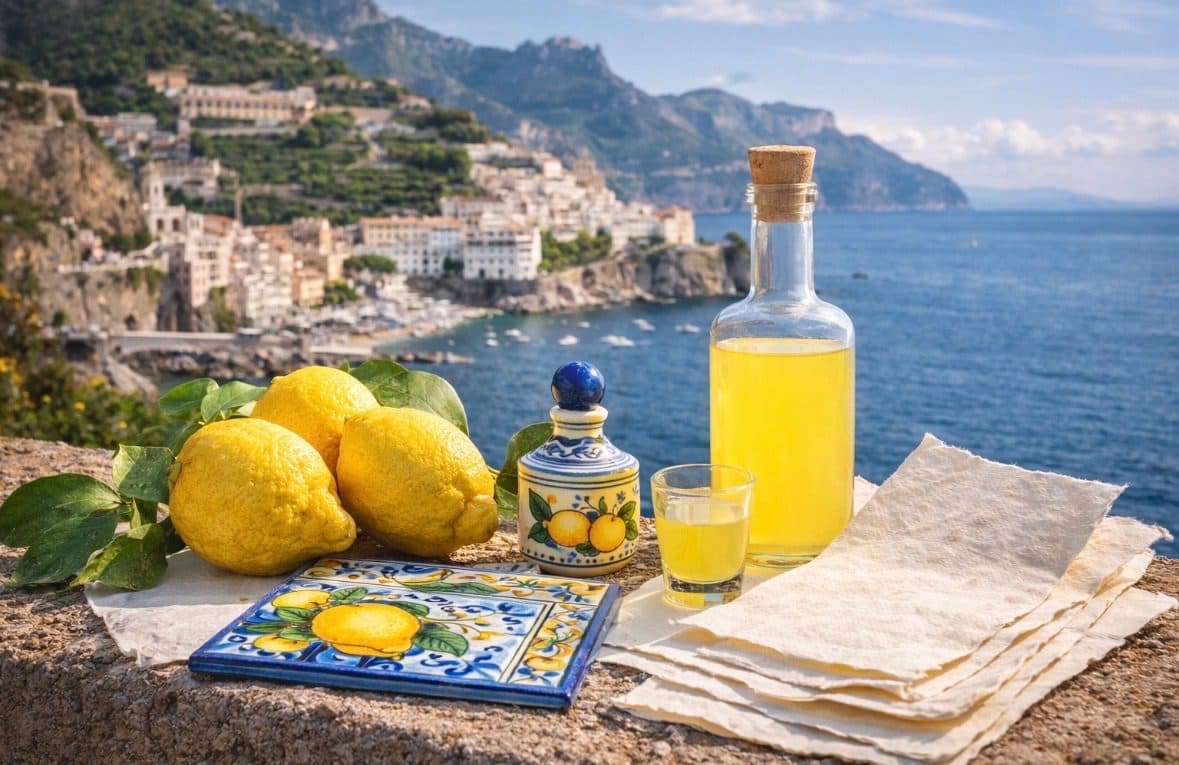
the cultivation of lemons and the production of paper.
Lemons explain the relationship between agriculture and the landscape of the Amalfi Coast. Paper tells the commercial story of the Maritime Republic.
By following these objects, you can understand why Amalfi became a famous city in the Mediterranean.
The lemons that shape the landscape
Related souvenirs • Limone Costa d’Amalfi IGP • Lemon marmalade • Candied lemon peel
The Limone Costa d’Amalfi IGP, known as Sfusato Amalfitano, is grown only in a few municipalities along the Amalfi Coast. 
The name “sfusato” comes from the elongated shape of the fruit.
Cultivation takes place on terraces carved into the slopes of the Monti Lattari, supported by stone walls. This agricultural system makes it possible to farm even on very steep hillsides.
The local climate is ideal because: • the mountains protect the area from cold winds • the sea breeze keeps temperatures mild • sun exposure helps the citrus fruit ripen. 
For this reason, lemons have become the dominant crop along the coast.
This fruit is also used to make many preserved products, such as marmalades and candied peels, which allow the intense aroma of the peel—rich in essential oils—to be fully used. 
The lemon, therefore, is not just an ingredient: it is what has shaped the agricultural landscape of the Coast.
The lemon that traveled by sea
Related souvenirs • Amalfi sfusato lemon • Limoncello
Lemons have been present on the Amalfi Coast since at least the Middle Ages. Some sources indicate that their cultivation spread thanks to contacts with the Arab world. 
During the era of the Maritime Republic of Amalfi, ships carried citrus fruits on long voyages.
The reason was practical: lemons are rich in vitamin C and helped prevent scurvy, a disease that was common among sailors. 
Over time production increased, and the lemons of the Coast were also exported to Europe and the Americas. 
This citrus fruit is also the origin of limoncello, a liqueur obtained by macerating lemon peels in alcohol, with the addition of water and sugar.
The peel of the Sfusato Amalfitano contains many aromatic essential oils, a characteristic that makes it particularly suitable for preparing the liqueur. 
In this way, the lemon becomes a product that tells both the maritime history and the gastronomic culture of the city.
The scent of lemon: the Amalfi Coast’s raw ingredient
Related souvenirs • Artisanal lemon perfumes
The peel of Amalfi Coast lemons contains a high concentration of aromatic essential oils, responsible for the fruit’s intense fragrance. 
These oils are extracted and used not only in cooking but also in the production of: • perfumes • cosmetics • fragrant artisanal products.
These items show how an agricultural raw material can be used in different ways.
In Amalfi, lemon is not just a food: it is an aromatic resource used in many local products.
Amalfi paper: the other great tradition
Related souvenir • Amalfi paper
Beyond its lemons, Amalfi is famous for the production of handmade paper, called bambagina.
This activity has been documented since at least the 13th century and was one of the main industries of the medieval city. 
The production technique probably arrived through commercial contacts with the Arab world, which had learned papermaking from China. 
Paper was produced in the Valley of the Mills, where the waters of the Canneto stream powered the hydraulic machinery of the paper mills.
The traditional process uses: • rags of linen, cotton, or hemp • soaked and transformed into pulp • sheets formed manually with metal frames. 
Even today, some artisan workshops continue to produce this paper, used for: • letters • handcrafted books • invitations and fine documents.
Amalfi paper tells the story of the period when Amalfi was a trading city connected to the ports of the Mediterranean.
Conclusion — Two materials that explain Amalfi
Looking at these souvenirs, a very clear structure of the city emerges.
Lemons tell the story of the relationship between agriculture and landscape: terraced hillsides, a Mediterranean climate, and specialized agricultural production.
Amalfi paper, on the other hand, tells the story of the city’s medieval urban and commercial history.
These two objects explain why Amalfi is not just a tourist destination.
It is a city that built its identity through: • trade in the Mediterranean • artisanal craftsmanship • the cultivation of a fruit that has shaped the entire territory.
Following these souvenirs, one discovers that the city’s history is written among lemon pergolas and sheets of handmade paper.
Contenido editorial elaborado con ayuda de la inteligencia artificial y revisado por Trouvenir. Puede contener imprecisiones.
Descarga gratis
Lleva Trouvenir contigo
iOS y Android. Gratis.
Privacidad primeroSincronización entre dispositivosFunciona sin conexión