Historia♛ Premium
Alghero Through Its Materials: Sea, Thread, and Cuisine
Materials researcher
Introduction — The Material Researcher’s Gaze
The Material Researcher visits a city trying to understand which materials are used by its inhabitants and how they are transformed.
In a place like Alghero, this means observing: • what comes from the sea • what emerges from artisanal work • what derives from preservation and cooking techniques.
The path follows four objects commonly found in the city’s shops — coral, embroidery, bottarga, and traditional sweets — to understand which natural resources and which local know-how have shaped the material culture of Alghero.
Red Coral and the Craftsmanship of the Sea
Souvenir: • Red coral from Alghero • Handcrafted coral jewelry
The sea around Alghero is home to populations of Mediterranean red coral (Corallium rubrum), a species that grows on rocky seabeds between 20 and 200 meters deep.
Coral harvesting has been documented along the Sardinian coasts since at least the Middle Ages, but it became particularly important between the 18th and 19th centuries, when Alghero became one of the main centers in the Mediterranean for coral fishing and processing.
After harvesting, the material is: 1. cleaned 2. cut 3. polished 4. set into jewelry.
Even today there are artisanal workshops and specialized boutiques, and the city is home to the Museo del Corallo, dedicated to the history of coral fishing and craftsmanship.
Coral is therefore a common souvenir because the raw material comes directly from the local sea and for centuries supported the city’s artisanal economy.
Filet: a domestic textile technique
Souvenir: • Traditional embroidered filet from Alghero
Filet is an embroidery technique created on a net made by hand with needle and thread.
The process takes place in two stages: 1. creating the square net with a netting needle 2. decorative embroidery on the net using cotton thread.
In Sardinia this technique spread especially between the 19th and 20th centuries as a domestic activity. Women produced: • doilies • curtains • bedspreads • home decorations.
In Alghero, filet stands out for decorative motifs that include: • floral elements • animals • scenes of everyday life.
Today these embroideries are sold as souvenirs because they represent a form of traditional textile craftsmanship linked to local domestic production.
Bottarga: preserving fish from the Mediterranean
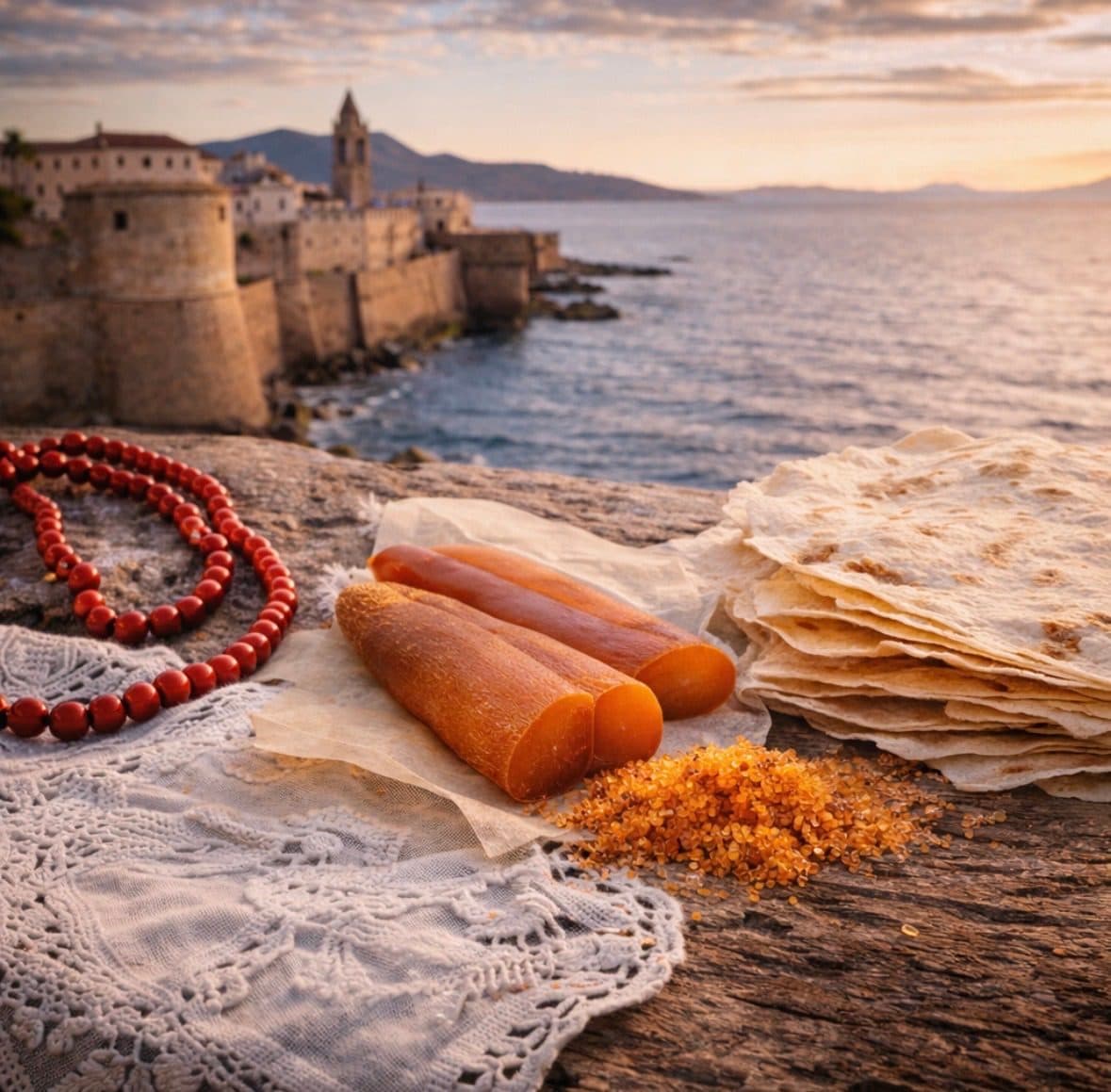
Souvenir: • Bottarga from northern Sardinia
Bottarga is obtained from the roe of grey mullet (Mugil cephalus).
The traditional process involves: 1. extraction of the roe sacs 2. salting 3. pressing 4. drying.
This technique allows the product to be preserved for long periods.
In Sardinia, production is documented especially in lagoon areas, where grey mullet is abundant. Bottarga is particularly linked to the ponds along the island’s western coast.
It is consumed: • grated over pasta • cut into thin slices • with olive oil.
It is popular as a souvenir because it comes directly from coastal fishing and local fish-preservation techniques.
Menjar blanc: the dessert of Catalan history
Souvenir: • Menjar blanc
Menjar blanc is a dessert found in Alghero that comes from the Catalan tradition.
The city was under the control of the Crown of Aragon from the 14th century, and many Catalan linguistic and gastronomic traditions have remained in the local culture.
The dessert is made with: • milk • sugar • starch • lemon zest.
The preparation consists of cooking the mixture until it becomes a thick cream, which is then left to cool.
Similar recipes also exist in Catalonia with the same name (menjar blanc), reflecting the historical connection between Alghero and the Catalan world.
The dessert is commonly found in local shops and pastry stores because it represents a culinary continuity with the city’s Aragonese history.
Conclusion - What These Objects Reveal About Alghero
Looking at these four souvenirs through the lens of a material researcher, three fundamental elements of the city emerge: • the sea, which provides raw materials such as coral and fish • home-based craftsmanship, visible in embroidered filet lace • Mediterranean history, present in the cuisine and sweets of Catalan origin.
The objects sold in the city’s artisan shops are therefore not simply tourist mementos. They are material traces of the natural resources and craft techniques that have supported Alghero’s economic and cultural life for centuries.
Contenido editorial elaborado con ayuda de la inteligencia artificial y revisado por Trouvenir. Puede contener imprecisiones.
Descarga gratis
Lleva Trouvenir contigo
iOS y Android. Gratis.
Privacidad primeroSincronización entre dispositivosFunciona sin conexión