Historia♛ Premium
Agrigento: a journey through raw ingredients, fields, and artisan hands
Material researcher
The Materials Researcher’s Gaze
The materials researcher observes a city starting from a simple question: which raw materials are available here and how are they transformed?
In Agrigento this question leads to cultivated fields, bakeries, and artisan workshops.
The Agrigento area is characterized by: • limestone soils and a Mediterranean climate • historic cultivation of almond trees and durum wheat • agricultural and domestic traditions that have produced objects useful for everyday life
The selected souvenirs — almonds, bread, baskets, and embroidery — therefore tell the story of the concrete relationship between territory, work, and materials.
The Landscape of Almond Trees
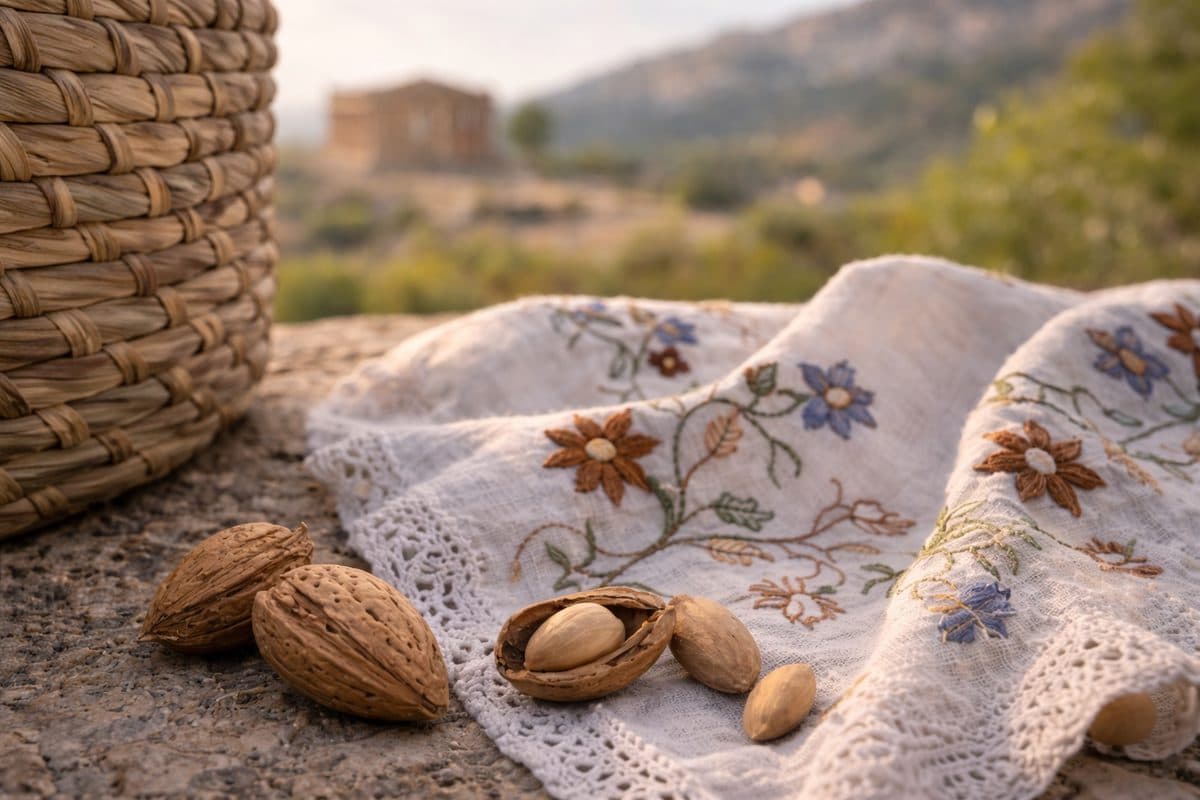
Souvenir: Almonds of Agrigento
Agrigento is one of the places historically most closely linked to almond cultivation in Sicily.
Until the mid‑twentieth century the province was among the island’s main production areas, thanks to favorable environmental conditions: • mild winters • hot summers • well‑drained limestone soils. 
In the Valley of the Temples, numerous local almond varieties have been documented, and the area’s agricultural landscape is still characterized by these orchards today. 
The widespread presence of almond trees has also influenced local culture. Every year Agrigento celebrates the Almond Blossom Festival, an event created to mark the early blooming of the trees and the arrival of spring. 
For this reason, the almond is one of the city’s most representative souvenirs: it comes directly from a crop that has shaped the local agricultural landscape for centuries.
The Bread of the Countryside and the Mines
Souvenir: Pane di Favara (Chichireddu)
The traditional bread of Favara is born from a fundamental ingredient of Sicily: durum wheat.
Since ancient times the island has been a major grain‑growing area; during the Roman era it was considered one of the main granaries of the Mediterranean. 
Chichireddu, the typical bread of Favara, is prepared with: • durum wheat semolina • dough made with little water • long manual kneading • baking in the oven. 
The hard‑dough technique produces a compact, crunchy bread that can keep for many days. This characteristic made it suitable for workers in the countryside and in the mines, who needed a durable food during long workdays. 
The spread of this bread therefore depends on two very concrete material factors: • the local cultivation of Sicilian durum wheat varieties, such as Russello  • the need for long‑lasting bread for agricultural and mining work.
Giummarre: weaving the resources of the land
Souvenir: Giummarre (woven baskets)
Giummarre are traditional baskets found in the countryside around Agrigento.
They are made from local plant fibers, especially: • reed • rush • other wild plants from river areas.
The weaving of these fibers produces sturdy, lightweight containers used for harvesting and transporting agricultural products.
The existence of these baskets depends on two material elements: 1. the availability of flexible plants suitable for weaving 2. the agricultural need for containers for almonds, olives, and vegetables.
Basket-weaving is an ancient practice widespread across many rural areas of the Mediterranean, but in the Agrigento area it developed in connection with local agricultural activities.
Domestic Embroidery and Textile Craftsmanship
Souvenir: Handcrafted embroidery from the Agrigento area
Another type of traditional manual work widespread in the area is domestic embroidery, often connected to the production of: • tablecloths • bedsheets • bridal trousseaus.
These activities were mainly carried out in the home and were part of the artisanal skills passed down through generations.
Embroidery does not originate from a specific agricultural resource like wheat or almonds, but from the availability of textile threads and from the tradition of women’s handcraft work common in many Sicilian communities.
For this reason, embroidery pieces today are souvenirs that bear witness to the technical and decorative skills of local craftsmanship.
Conclusion – Agrigento Seen Through Its Materials
Looking at these objects together reveals a very tangible story of the city.
Agrigento is not told only through its Greek temples, but also through: • almond trees cultivated in the fields • wheat transformed into long‑lasting bread • wild plants woven into baskets • threads worked with needle and patience
Each souvenir is born from raw materials specific to the territory and from the techniques developed to use them.
Through these objects, it becomes clear that the material culture of the Agrigento area is built on three fundamental elements: • Mediterranean agriculture • artisan craftsmanship • the everyday practices of rural communities.
And it is precisely from this relationship between land, materials, and human work that the city’s most authentic souvenirs are born.
Contenido editorial elaborado con ayuda de la inteligencia artificial y revisado por Trouvenir. Puede contener imprecisiones.
Descarga gratis
Lleva Trouvenir contigo
iOS y Android. Gratis.
Privacidad primeroSincronización entre dispositivosFunciona sin conexión