
Napoli is one of Italy's destinations with the deepest artisanal and gastronomic traditions. Every product here reflects the area's history, craftsmanship, and culture — something you won't find elsewhere with the same character.
This guide collects distinctive souvenirs selected by the Trouvenir app for Napoli: distinctive objects and specialties that truly capture the soul of the city, far from tourist stalls and mass-produced items. For each souvenir you'll find cultural context, price ranges, and where to buy with confidence.
1. Neapolitan cameo (Torre del Greco)
🏺 Craftsmanship
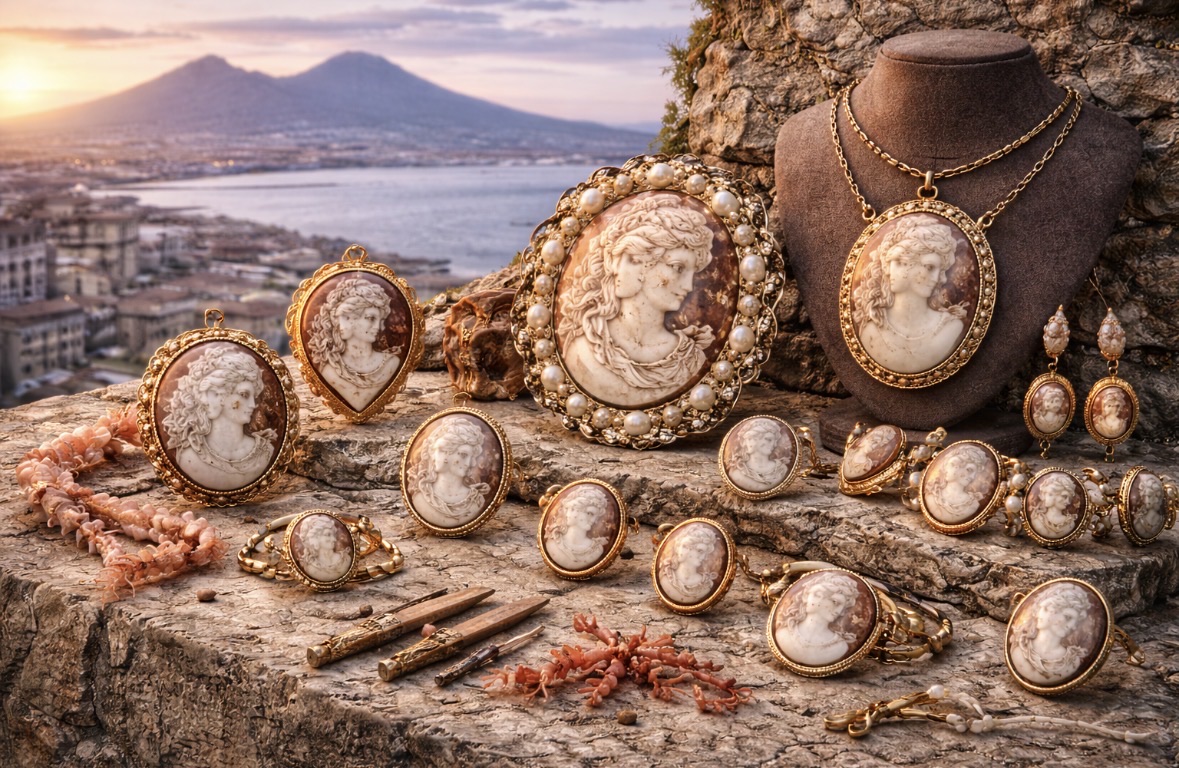
It is a small relief carving made from layered shell or, more rarely, from hard stone. The design emerges through subtraction, using the natural color differences of the layers. The most common subjects are classical profiles, female faces, mythological scenes, flowers, and allegorical figures. The cameo can be set into a brooch, pendant, or ring, or kept as a loose plaque. Each piece is entirely hand-engraved with extremely fine burins.
It is an object that tells the story of Napoli through carving and patience. Travelers choose it when they recognize, in the smallest details, the value of time and the human hand. It is ideal for those seeking a souvenir that does not simply represent a place, but a tradition born from the sea and transformed into art.
Why it's special
The cameo tells the story of the cultured Napoli of the Grand Tour, of foreign travelers and the refined arts that flourished around the Vesuvio. It is the symbol of a city that transformed marine materials into lasting memory. It speaks of a culture where luxury is not ostentation, but precision, silence, and patience. In this object lives the Neapolitan idea that even a shell, if listened to long enough, can become a portrait.
History
The tradition of cameo carving in Torre del Greco began between the late eighteenth and early nineteenth centuries, when this Vesuvian town became the main European center for working coral and shells. Under the Bourbon monarchy, and especially with Ferdinando I, schools and workshops specialized in engraving profiles, mythological scenes, and female figures on sardonyx shell. From here Neapolitan cameos reached the courts of Europe, becoming collectible objects and symbols of the Grand Tour. Even today Torre del Greco is recognized as the historic capital of cameo engraving and coral craftsmanship.
Price
€60-€300
Where to find it
Historic engravers’ workshops Artisanal coral and cameo shops Museum spaces and workshops connected to the Vesuvian tradition
Discover Neapolitan cameo (Torre del Greco) on Trouvenir →
2. Neapolitan decorated paper / folk prints
🏺 Craftsmanship
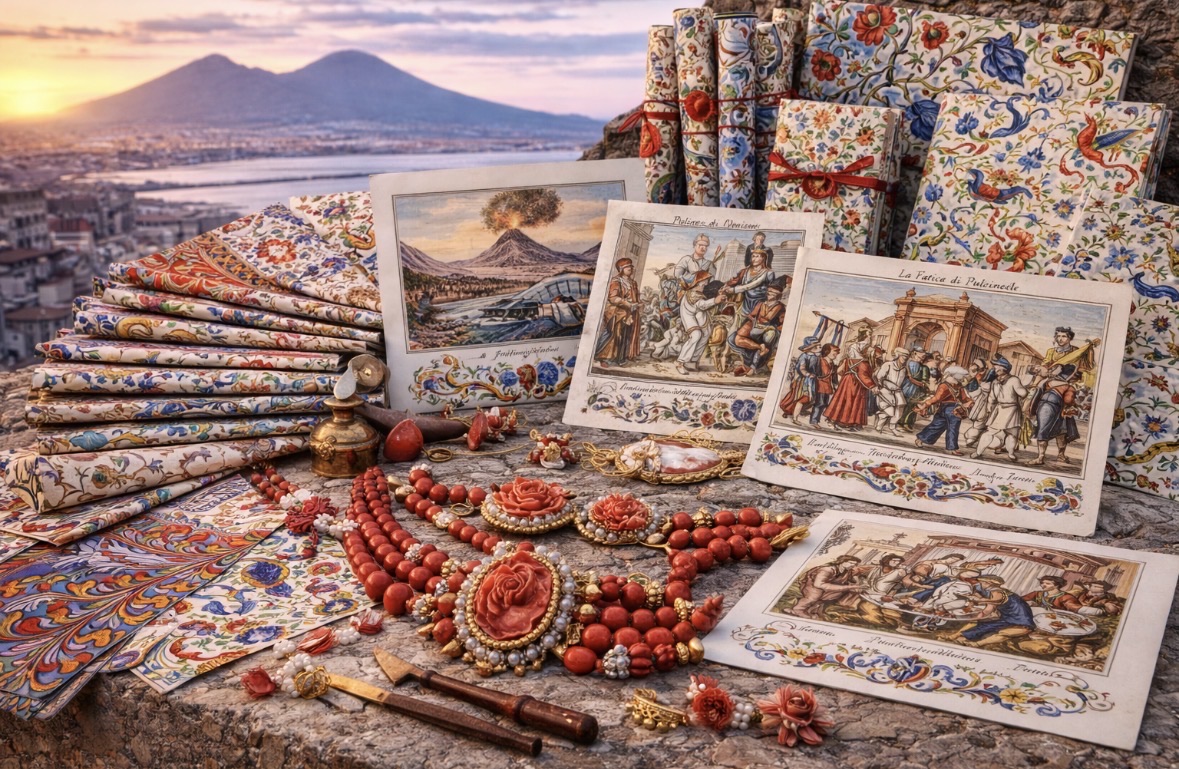
These are sheets of paper decorated by hand using marbling, block printing, or engraving techniques. The most common motifs include flowing veins, arabesques, stylized flowers, and light geometric patterns. Colors remain understated: blue, ochre, green, brick red, ivory. The paper is used to cover notebooks, boxes, book covers, folders, or as a single sheet for writing and drawing. Each sheet is different, marked by water, pigment, and the artisan’s gesture.
It is an object that tells the story of Napoli through the slow gesture of decoration. Chosen by travelers who recognize in humble materials a form of everyday elegance. It is ideal for those seeking a discreet keepsake, able to turn a sheet of paper into a memory without ever becoming a useless ornament.
Why it's special
Decorated paper reflects the Napoli of studies, printing houses, and quiet libraries. It symbolizes a city that has united knowledge and beauty, the written word and ornament. It speaks of a culture in which even what serves to protect a book or a letter becomes an opportunity for art. Within this sheet lives the Neapolitan idea that memory is preserved not only in archives, but also in the materials that protect it.
History
The tradition of decorated paper in Napoli developed between the 17th and 18th centuries, when the city was one of the main typographic and paper-making centers of the Kingdom. Alongside the production of books and documents, the use of marbled and hand-printed papers spread for bindings, covers, drawer linings, and letter papers. These techniques derive from ancient Eastern and European marbling practices, which reached Napoli through editorial and university networks. Over time, decorated paper entered domestic life as a quiet element of functional beauty, connected to writing, study, and preservation.
Price
€10-€50
Where to find it
Artisanal bookbinding and paper decoration workshops Historic stationery shops Shops connected to book restoration and traditional printing
Discover Neapolitan decorated paper / folk prints on Trouvenir →
3. Neapolitan / Vesuvian ceramics
🏺 Craftsmanship
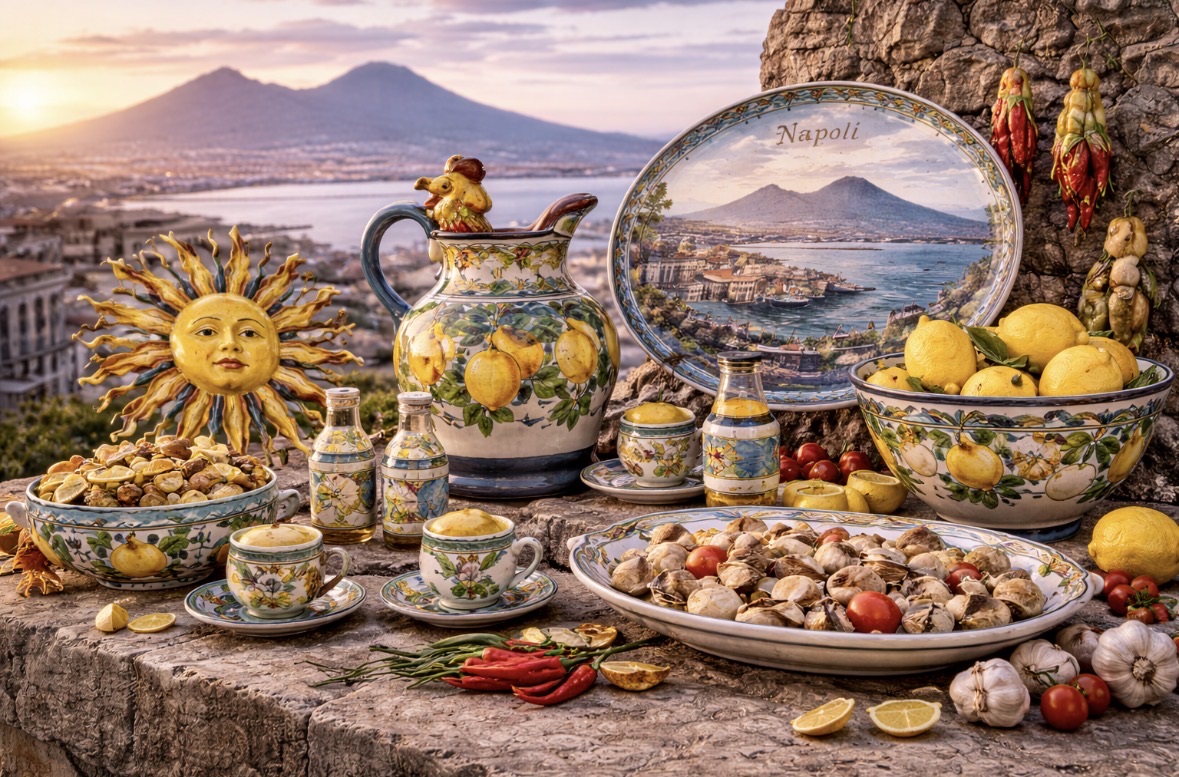
They include plates, vases, cups, decorative riggiole tiles, small panels, and tableware. Traditional ceramics use glazed terracotta and maiolica, with warm colors: yellow, copper green, blue, and ochre. The most typical motifs depict flowers, grapes, lemons, seaside scenes, Vesuvian landscapes, and geometric patterns. Porcelain in the Capodimonte tradition is lighter and more refined, with floral decorations, mythological scenes, and sculpted reliefs. Each piece is hand-painted, with slight variations that make it one of a kind.
It is an object that tells the story of Napoli through its earth and its fire. Travelers choose it to recognize, in the materials themselves, the deep bond between the city, the volcano, and the domestic arts. It is ideal for those seeking a keepsake that combines everyday use with cultivated memory, without ever becoming mere decoration.
Why it's special
These ceramics tell the story of a Napoli built from its raw materials. They speak of a city that transformed the clay of Vesuvio into everyday beauty, blending refined art with popular craftsmanship. They symbolize a culture that does not separate palace from kitchen, museum from home. In every plate or tile lives the Neapolitan idea that even the most practical object can become a story, when it is shaped by the right hands.
History
The ceramic tradition in the Neapolitan area developed in different forms between the 17th and 19th centuries, intertwining popular production with refined manufacture. In the 18th century the Real Fabbrica di Capodimonte was founded, commissioned by Carlo di Borbone, making Napoli one of Europe’s great centers of artistic porcelain. At the same time, in the Vesuvian area, workshops producing maiolica and terracotta spread, closely tied to building and household use: plates, jars, riggiole, and painted tiles for floors and kitchens. These ceramics accompanied everyday life in the city and in the Vesuvian towns, transforming volcanic material into objects of art and home.
Price
€40-€200
Where to find it
Artisan ceramic workshops Historic shops in the Vesuvian area Museum spaces and workshops linked to the Capodimonte tradition
Discover Neapolitan / Vesuvian ceramics on Trouvenir →
4. Corallo del Golfo di Napoli
🏺 Craftsmanship
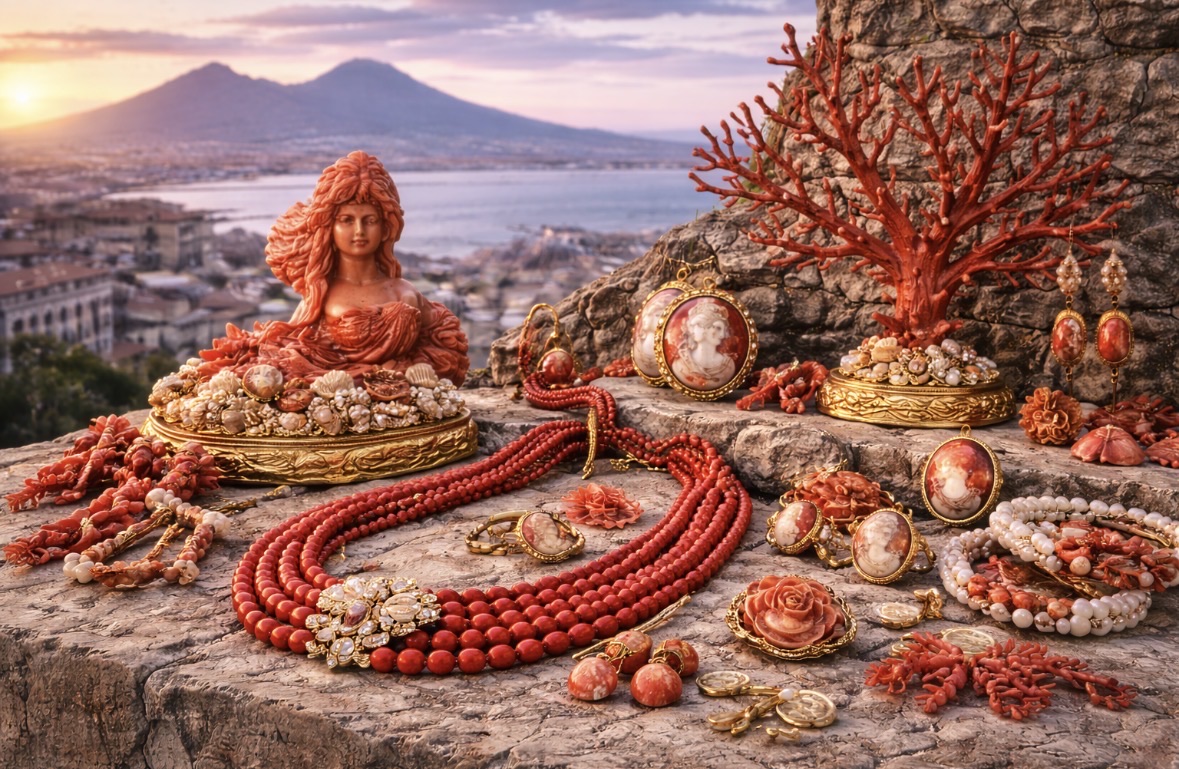
It is Mediterranean red coral, gathered in branches and worked by hand after a long curing process. It is engraved, polished, or carved into beads, cameos, pendants, rosaries, small amulets, or understated jewelry. The color ranges from bright red to deep orange-red. The surface is compact, slightly porous, and warm to the touch. Each piece is unique in its veins, color intensity, and natural shape.
An object born from the sea that becomes a memory. Chosen by travelers who recognize, in materials, the deep history of a place. It is ideal for those seeking a quiet souvenir, capable of telling the story of Napoli through time, fishing, and the patience of its engravers.
Why it's special
Coral tells the ancient story of the relationship between Napoli and its sea. It is both ornament and protection, luxury and superstition, art and talisman. It speaks of fishermen, of dangerous dives, of silent workshops where the sea is slowly carved. In this material lives the Neapolitan idea that beauty is born from risk, and that what rises from the depths can become light to wear.
History
Coral craftsmanship in the Golfo di Napoli is documented as far back as the Roman age, but it reached its greatest development between the 18th and 19th centuries in the Vesuvian area, particularly in Torre del Greco. Here one of Europe’s most important coral districts was established, favored by Mediterranean coral banks and Bourbon protection. In 1789 Ferdinando IV founded a royal school for coral engravers, transforming a seafaring activity into a refined art. Since then, coral from the gulf has become jewelry, an amulet, a Grand Tour gift, and a recognized symbol of Neapolitan craftsmanship.
Price
€50-€300
Where to find it
Historic coral craftsmen’s workshops Artisan shops in the Vesuvian area Museum spaces and shops connected to maritime tradition
Discover Corallo del Golfo di Napoli on Trouvenir →
5. Corno Napoletano
🏺 Craftsmanship
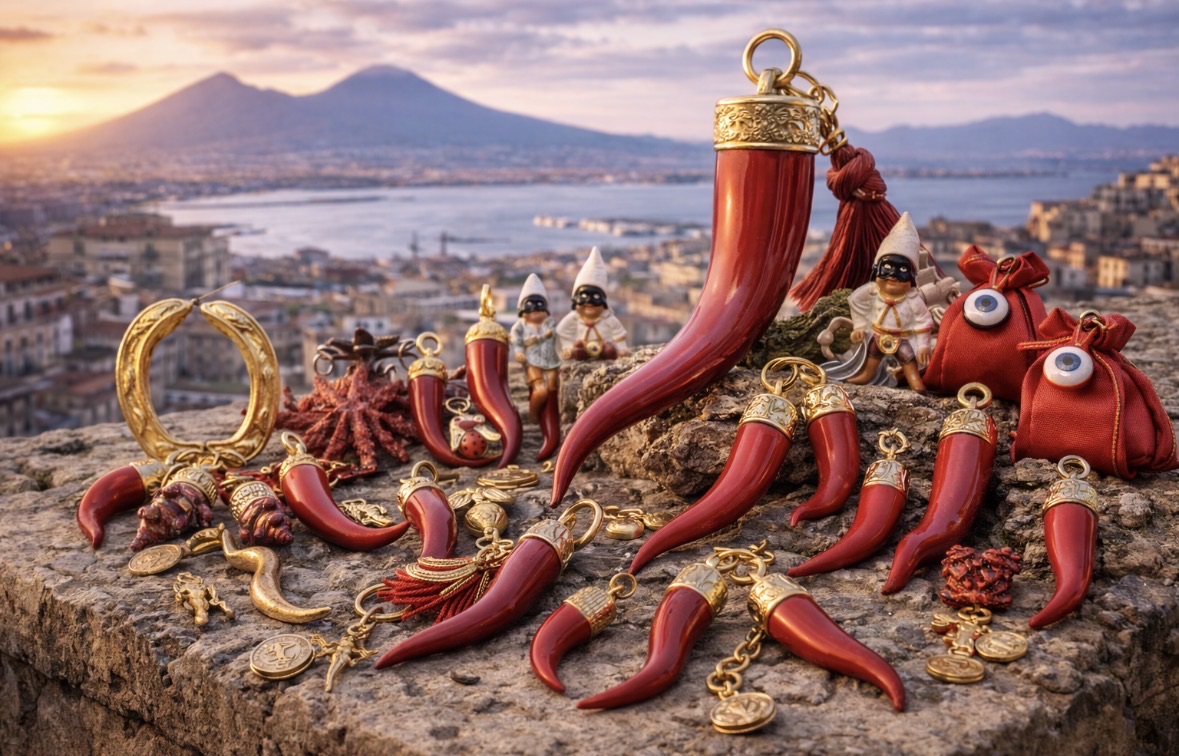
It is a small elongated, curved amulet, pointed at the tip. Traditionally it is red, smooth or lightly grooved. The most common materials are coral, glazed terracotta, metal, or resin. It is worn as a pendant or hung in the home, in a car, or near the entrance as a protective sign. The shape should be unique and irregular: a horn that is too perfect loses its symbolic value.
It is an object that tells the story of Napoli through its oldest idea of protection. Travelers choose it to understand the hidden symbols of the city — the ones you cannot see, but carry with you. It is ideal for those looking for a discreet keepsake, able to hold superstition, irony, and popular memory in a single gesture.
Why it's special
The corno napoletano tells the story of a city that lives comfortably with mystery. It symbolizes a culture that does not separate rationality and superstition, but lets them coexist every day. It speaks of a Napoli that is ironic and serious at the same time, able to defend itself from misfortune with a smile and an ancient gesture. Within this object lives the Neapolitan idea that luck is not something to wait for, but something to carry quietly with you.
History
The horn as an amulet against the evil eye has very ancient origins, dating back to the Greek and Roman worlds, where its curved, phallic shape symbolized vital force and fertility. In Napoli this tradition became deeply rooted between the Middle Ages and the early modern era, intertwining with the popular cult of luck and the fear of envy. Over time the horn became red — the color of blood and life — and began to be made in coral, terracotta, or metal, depending on regional resources. It is not simply an ornamental object, but a true domestic and personal talisman, passed down or given as a gift, never bought for oneself.
Price
€5-€40
Where to find it
Artisan shops specializing in amulets and coral Folk ceramic workshops Historic markets and shops selling symbolic objects
Discover Corno Napoletano on Trouvenir →
6. Handcrafted ex voto
🏺 Craftsmanship
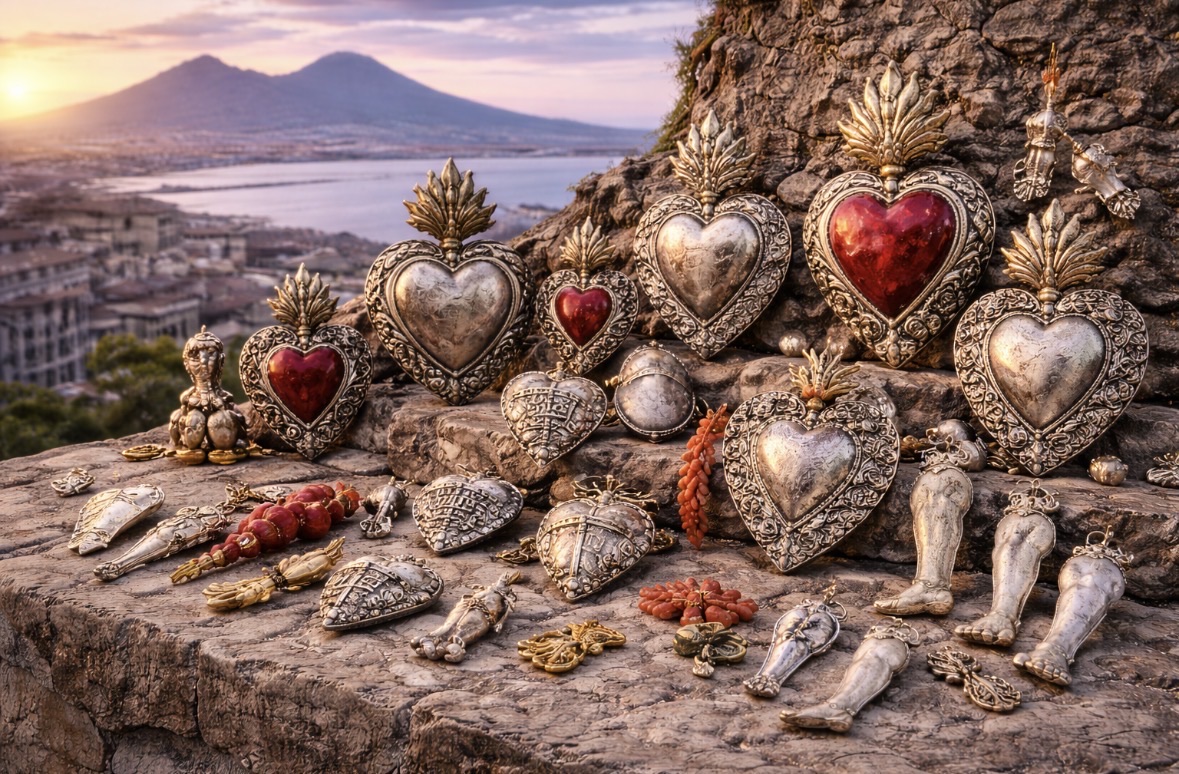
They are small objects made from simple materials: painted wooden panels, silver sheets, metal hearts, wax figures, small tablets with narrative scenes. The images depict accidents, illnesses, childbirths, storms, miraculous interventions, with the sacred figure invoked shown above. Colors are direct, perspectives naive, inscriptions brief: names, dates, words of thanks. Each piece is unique, marked by the artisan’s hand and by the personal story it represents.
It is an object born from a promise fulfilled. Travelers choose it to understand the fears, hopes, and everyday devotion of a city. It is ideal for those seeking a quiet keepsake capable of telling the story of Napoli through gratitude, faith, and popular memory.
Why it's special
Ex voto tell the story of Napoli through fragility and hope. They are the sign of a practical, lived religiosity born from real danger and everyday gratitude. They speak of a city that has always lived between risk and protection: volcano, sea, illness, poverty. In these objects lives the Neapolitan idea that faith is not theory, but the story of what turned out well when it might have been lost.
History
The practice of ex voto has been widespread in Napoli since the Middle Ages, connected to the city’s great sanctuaries and devotion to the Madonna, patron saints, and San Gennaro. Over the centuries, sailors, artisans, mothers, and soldiers offered small painted or molded objects in thanks after a healed illness, a shipwreck avoided, or a danger overcome. Between the 17th and 19th centuries, a true artisanal production developed of painted tablets, silver hearts, wax figures, and small narrative panels, now preserved in churches such as Gesù Nuovo, Santa Maria del Carmine, and the Duomo. Ex voto thus became a popular chronicle of the city, made not of kings and battles, but of ordinary lives saved.
Price
€10-€50
Where to find it
Artisan workshops specializing in devotional objects Shops connected to historic sanctuaries Traditional markets and folk art shops
Discover Handcrafted ex voto on Trouvenir →
7. Handcrafted Neapolitan Nativity figures (San Gregorio Armeno)
🏺 Craftsmanship
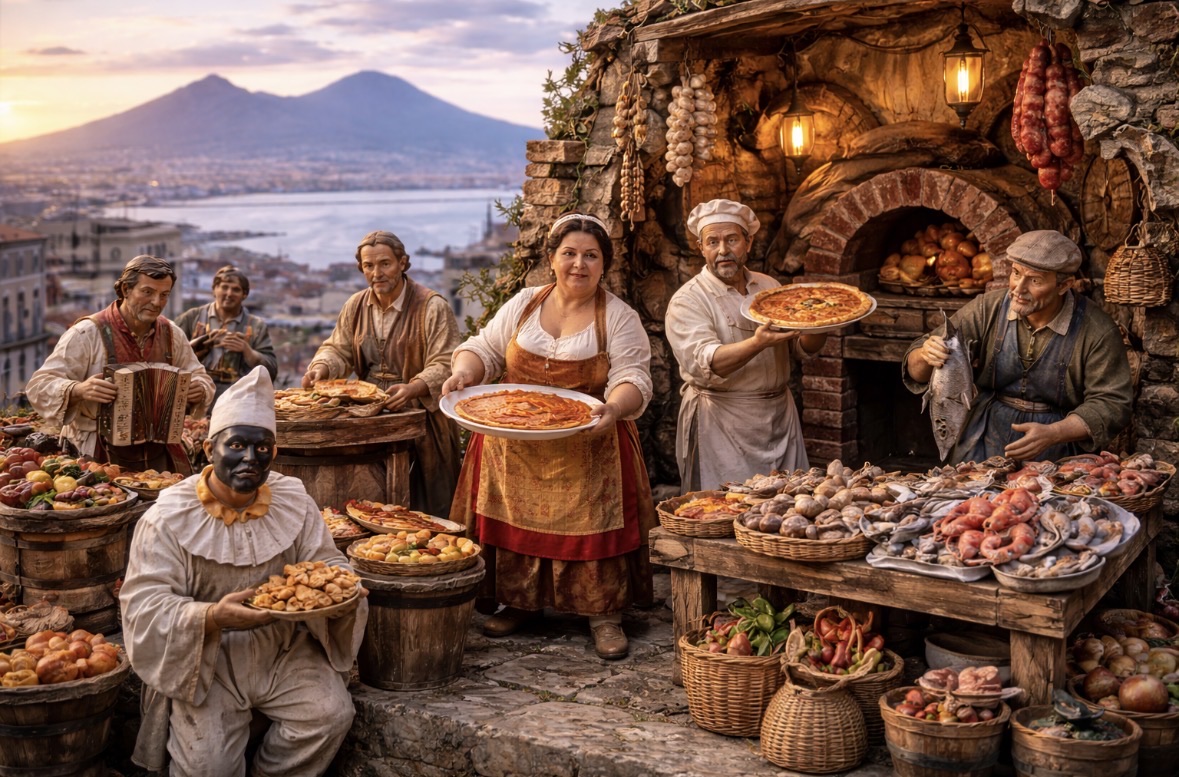
These figures stand between 15 and 30 centimeters tall, with hand-painted terracotta heads, glass or enamel eyes, and flexible bodies made from wire and tow. Their clothing is crafted from real fabrics, sewn and aged by hand to recreate the look of everyday wear. Alongside the sacred characters appear popular figures: fishermen, fruit sellers, tavern keepers, musicians, shepherds, and sometimes contemporary personalities reimagined with an ironic twist. Each figure is unique, differing in expression, posture, and costume.
It is an object that tells the story of Napoli through its characters. Travelers choose it to understand how a city transforms devotion into everyday theater. It is ideal for those who want to take home not just a figurine, but a living fragment of the Neapolitan imagination.
Why it's special
Nativity figures tell the story of Napoli as a grand theater of the world. They do not represent only the birth of Christ, but the entire human comedy: sacred and profane, hardship and celebration, devotion and irony. They symbolize a city that observes itself with affection and clarity, turning reality into a permanent stage. In every shepherd lives the Neapolitan idea that the Nativity scene is not a decoration, but a way of telling life itself.
History
The tradition of the Neapolitan Nativity scene emerged between the 17th and 18th centuries, during the Baroque period, when Napoli was one of Europe’s cultural capitals. Alongside the religious Nativity, a scene populated with secular figures developed: vendors, musicians, innkeepers, nobles, and common people, transforming the Nativity into a full representation of society. Via San Gregorio Armeno became the heart of this craft, the historic home of the workshops of figurinai, artisans specialized in modeling terracotta heads, hands, feet, and fabric garments. Even today, this street remains one of the few places in Europe where a theatrical and artisanal tradition has continued uninterrupted for more than three centuries.
Price
€30-€200
Where to find it
Historic workshops on Via San Gregorio Armeno Artisan workshops of figurinai Museum spaces and exhibitions dedicated to the Nativity scene
Discover Handcrafted Neapolitan Nativity figures (San Gregorio Armeno) on Trouvenir →
8. Neapolitan handcrafted jewelry
🏺 Craftsmanship
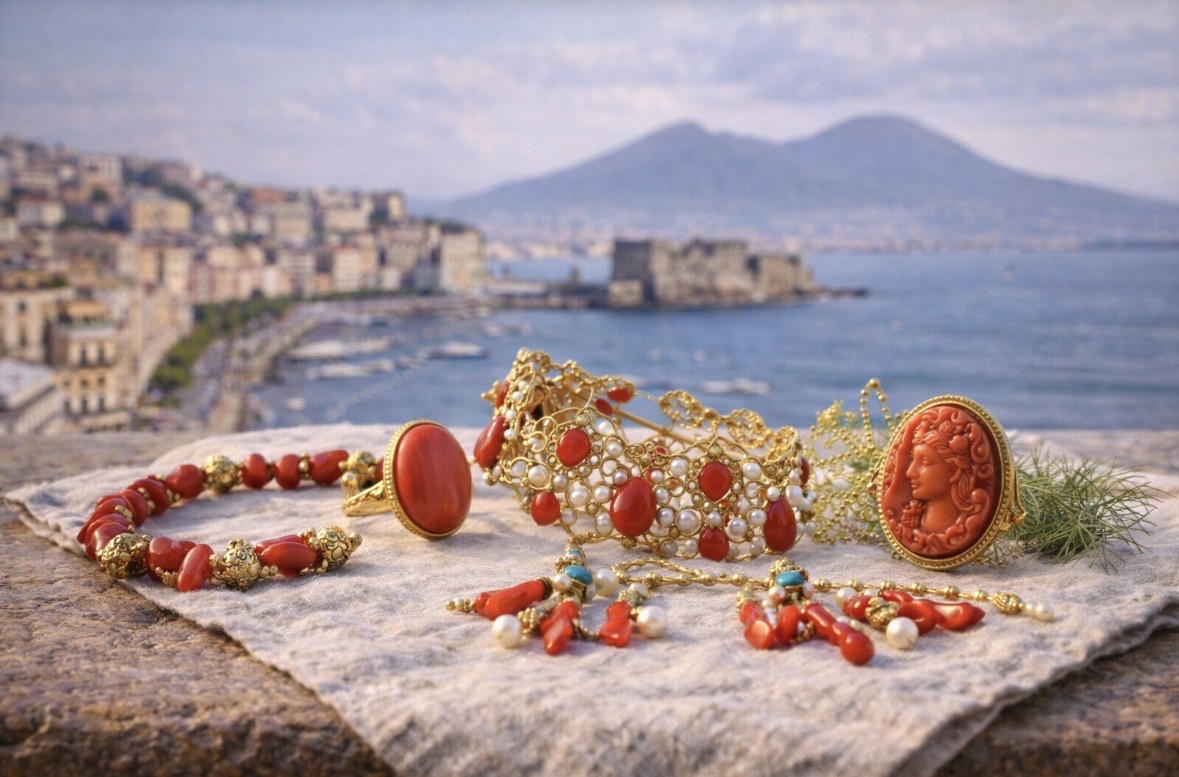
These are handmade jewels, often crafted in gold or silver, sometimes featuring hard stones, coral, or cameos. The range includes rings, pendants, bracelets, and earrings, characterized by signs and motifs that echo regional identity: marine symbols, stylized floral patterns, sacred figures, or emblems typical of the Neapolitan tradition. The craftsmanship is entirely manual, using techniques such as casting, engraving, chasing, and enameling. Each piece retains traces of the hand that made it: slight irregularities, markings, and fleeting gestures that make it one of a kind.
It is an object that carries a cultural idea as well as an aesthetic one. It is chosen by travelers who wish to understand how craftsmanship and material can be transformed into a personal symbol. It is ideal for those looking for a memory that is not just aesthetic, but a story of a craft and of regional sensibility.
Why it's special
Neapolitan handcrafted jewelry is not merely ornament: it is a mark of belonging, measure, and memory. It tells of a city that has turned identity and symbols into objects meant to be worn—expressions of personality and relationships. They speak of a relationship between the wearer and the maker: not merchandise and consumption, but an exchange of meaning. Within these jewels lives the Neapolitan idea that what is precious is not only what is rare, but what is capable of telling a story.
History
Handcrafted jewelry in Napoli has deep roots intertwined with the history of the Mediterranean. Over the centuries the city has been a crossroads of peoples and cultures, and its goldsmithing reflects this blend: Greek, Roman, Byzantine, and Islamic techniques merge in the regional craft. Beginning with the Neapolitan Renaissance, specialized workshops emerged in the historic center, working gold, silver, and precious stones to create unique pieces. This tradition evolved over the centuries into more recent eras, preserving a heritage of manual techniques and symbolic meaning, often passed down from one generation to the next.
Price
€60-€300
Where to find it
Artisanal goldsmith workshops Historic artisan shops in the city center Regional artistic craft and design spaces
Discover Neapolitan handcrafted jewelry on Trouvenir →
9. Neapolitan handmade gloves and ties
🏺 Craftsmanship
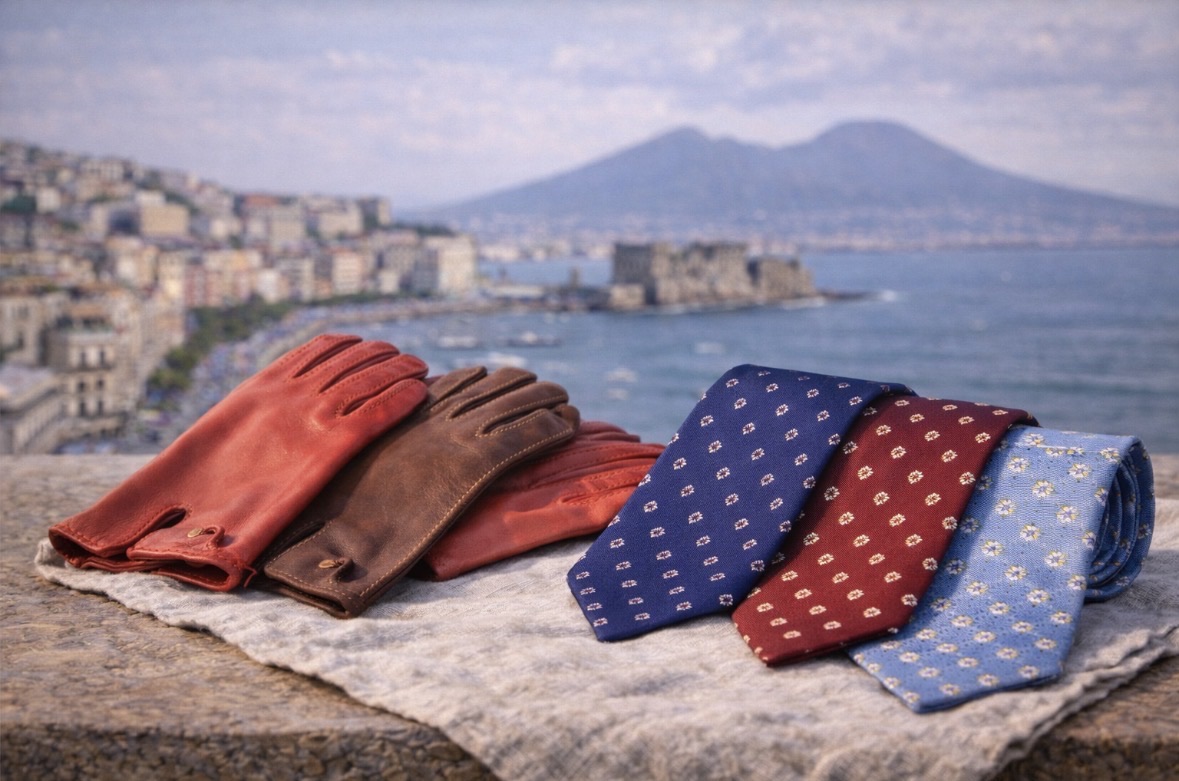
The gloves are made from extremely soft lamb or kid leather, hand-cut and stitched with invisible seams, lined in silk or cotton. The ties are crafted from natural silk, cut on the bias and sewn by hand, often with light interlinings that allow for a soft knot. Colors remain understated: navy, burgundy, grey, brown, sometimes with discreet polka dots or thin stripes. Each piece carries small imperfections that testify to the manual work and the difference between series and individual.
It is an object that tells the story of Napoli through the quiet elegance of a daily gesture. Chosen by travelers who want to understand how a city transforms the art of tailoring into identity. It is ideal for those seeking a discreet keepsake, able to carry style, craftsmanship, and memory without ever becoming ostentatious.
Why it's special
Gloves and ties tell the story of Napoli’s understated elegance. They are the symbol of a culture that considers style a form of respect, not display. They speak of quiet workshops, skilled hands, and a way of dressing that favors comfort without giving up form. In these objects lives the Neapolitan idea that true elegance is never shown—it is recognized in the details.
History
The tradition of handmade gloves and ties in Napoli developed between the nineteenth and early twentieth centuries, when the city became one of the most important centers of European menswear tailoring. Alongside the renowned school of the Neapolitan jacket, workshops specialized in working soft leather for gloves and in the handcrafting of silk ties. These activities first served the taste of the Bourbon aristocracy and later that of the cultivated bourgeoisie, shaping a recognizable style: informal yet refined, precise but never rigid. Over time, gloves and ties became symbols of the so-called “Neapolitan elegance,” now studied and appreciated internationally.
Price
€40-€200
Where to find it
Artisanal tailoring workshops Historic glove and tie boutiques Spaces connected to the tradition of Neapolitan tailoring
Discover Neapolitan handmade gloves and ties on Trouvenir →
10. Pulcinella Mask
🏺 Craftsmanship
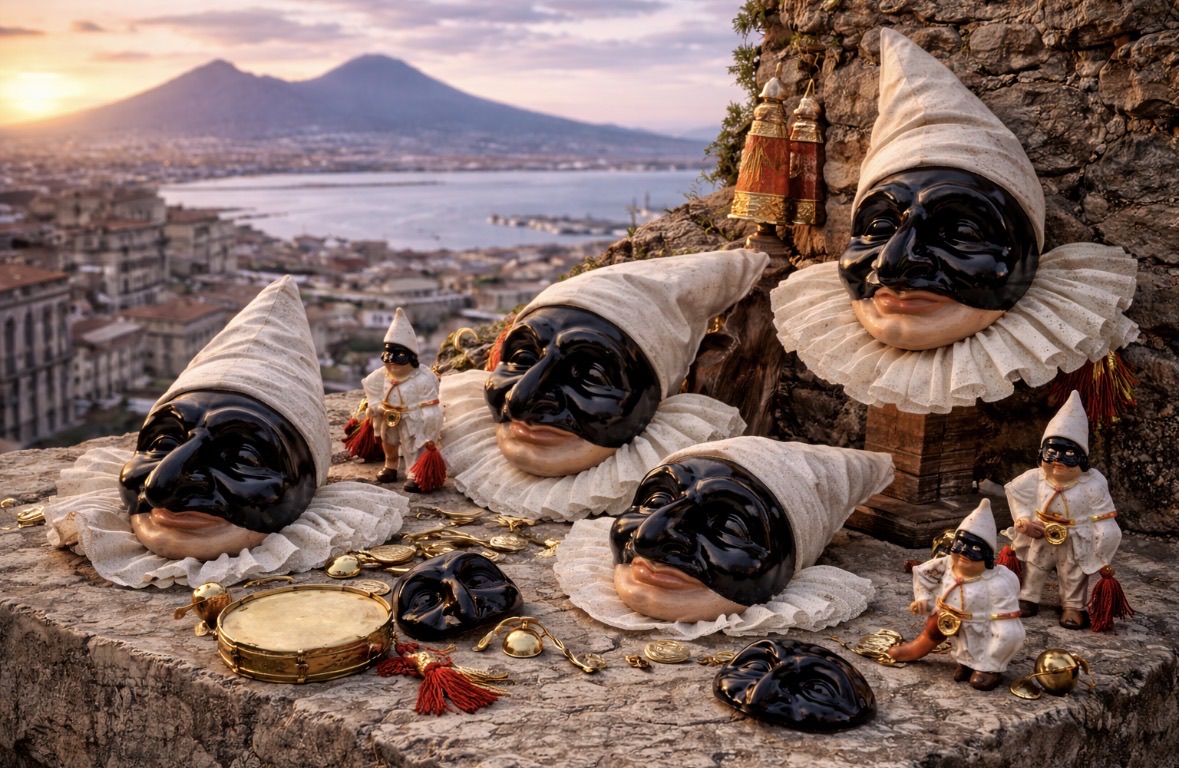
It is a mask made of leather, papier-mâché, or ceramic, traditionally black in color. The face features a high forehead, hollow cheeks, and a long, curved nose. It is sometimes accompanied by the white conical hat and the collar of the traditional costume. Artisanal versions are shaped and hand-painted, with slight variations that make each face unique.
It is a face that tells the story of Napoli better than any panorama. Chosen by those who travel to understand the city’s ironic and profound spirit. It is ideal for those seeking a keepsake that does not represent a character, but a way of looking at the world.
Why it's special
The Pulcinella mask is the deepest portrait of Neapolitan identity. It represents the ability to survive with intelligence, to laugh at hardships, and to express uncomfortable truths through play. He is both servant and master, victim and victor, child and old man. In this face lives the Neapolitan idea that irony is not escape—it is a form of popular wisdom.
History
Pulcinella was born in the 17th century within the Commedia dell’Arte, evolving from older popular masks from Campania linked to rural life and to the farcical characters of ancient Atella in Roman times. The mask, with its black face and hooked nose, took on its current form between the 17th and 18th centuries, becoming a theatrical symbol of the city of Napoli. Pulcinella is servant and philosopher, naïve and cunning, hungry and ironic: a figure able to cross the centuries by adapting to social change. From the theater he moved into music, literature, and the visual arts, eventually becoming one of the most recognizable cultural icons of Neapolitan tradition.
Price
€30-€80
Where to find it
Theatrical artisan workshops Traditional mask shops Spaces connected to popular theater and the Commedia dell’Arte
Discover Pulcinella Mask on Trouvenir →
11. Neapolitan artisanal perfumes
🏺 Craftsmanship
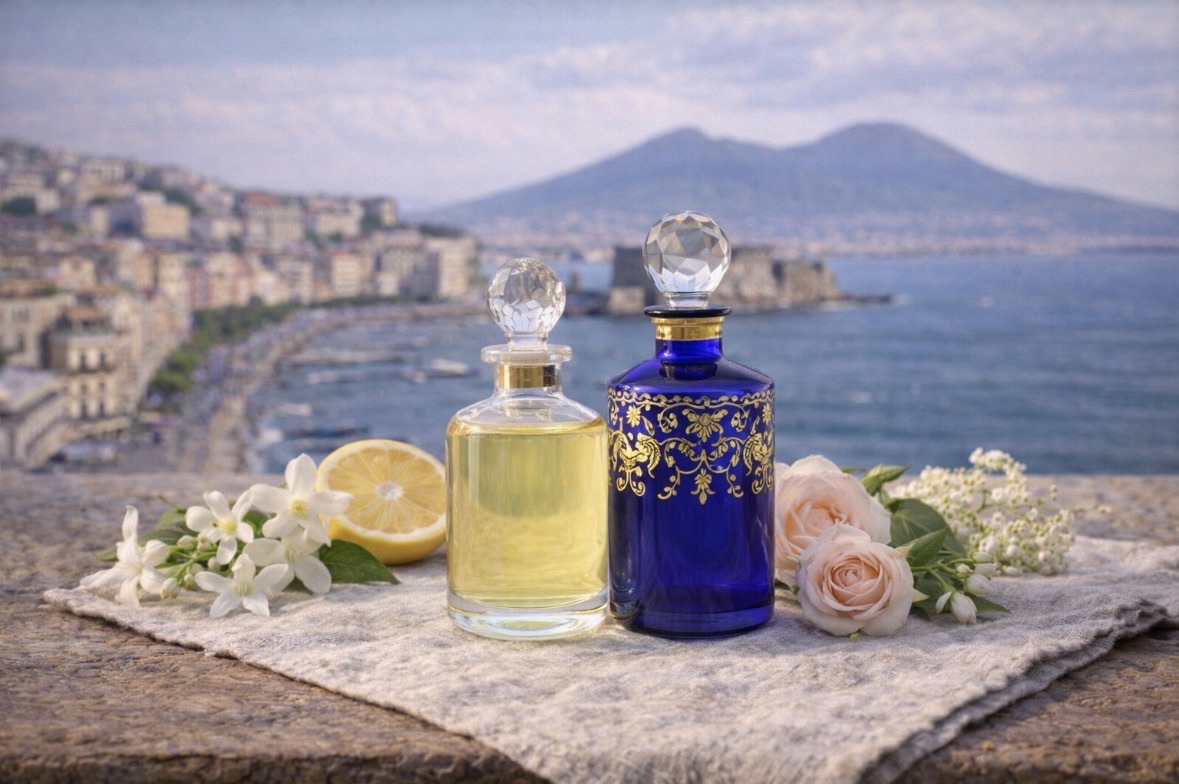
They are essences composed by hand, often on an alcohol or natural olfactory base, with top, heart, and base notes designed to evoke places and memories. The raw materials include citrus fruits of the gulf, zagara blossoms, bergamotto, Mediterranean woods, ancient spices, and aromas of the market. The result is a complex and refined perfume, able to evolve over time on the skin, revealing each fragrance as it gradually opens. The bottle is often simple, elegant, and free of ornament, because the value lies in what it contains, not in the wrapping.
It is an invisible object that speaks of sensory memory. Chosen by those who travel to understand not only places, but the atmospheres that move through them. It is ideal for anyone who wants to carry with them a memory made of scents — not images — that can return with the very first breath.
Why it's special
Neapolitan artisanal perfumes tell the story of a city of crossings: between West and East, sea and mountains, citrus groves and spice shops. They speak of an olfactory heritage made of markets, spices, and gardens, gathered and transformed into fragrances. They represent the idea that a place is not told only through sight, but above all through smell — and that a perfume can hold entire seasons and memories.
History
Artisanal perfumery in Napoli has its roots in the Middle Ages, when apothecaries and pharmacists began distilling scented waters and herbal extracts for healing, devotion, and everyday use. With the modern age, this practice evolved into the art of perfume: essences of citrus, flowers, Mediterranean spices, and resins were harmonized into unique formulas, often preserved for generations within the same artisan families. In the historic workshops of Napoli and its province, perfume becomes a narration of the landscape, gathering and reinterpreting the olfactory memory of lemons, zagare, bergamotto, mirto, and resins from the East.
Price
€40-€200
Where to find it
Artisanal perfume shops Essence laboratories and historic spice workshops Artisanal craft spaces connected to the olfactory tradition
Discover Neapolitan artisanal perfumes on Trouvenir →
12. Alici di Cetara / Colatura
🍽️ Food Specialties
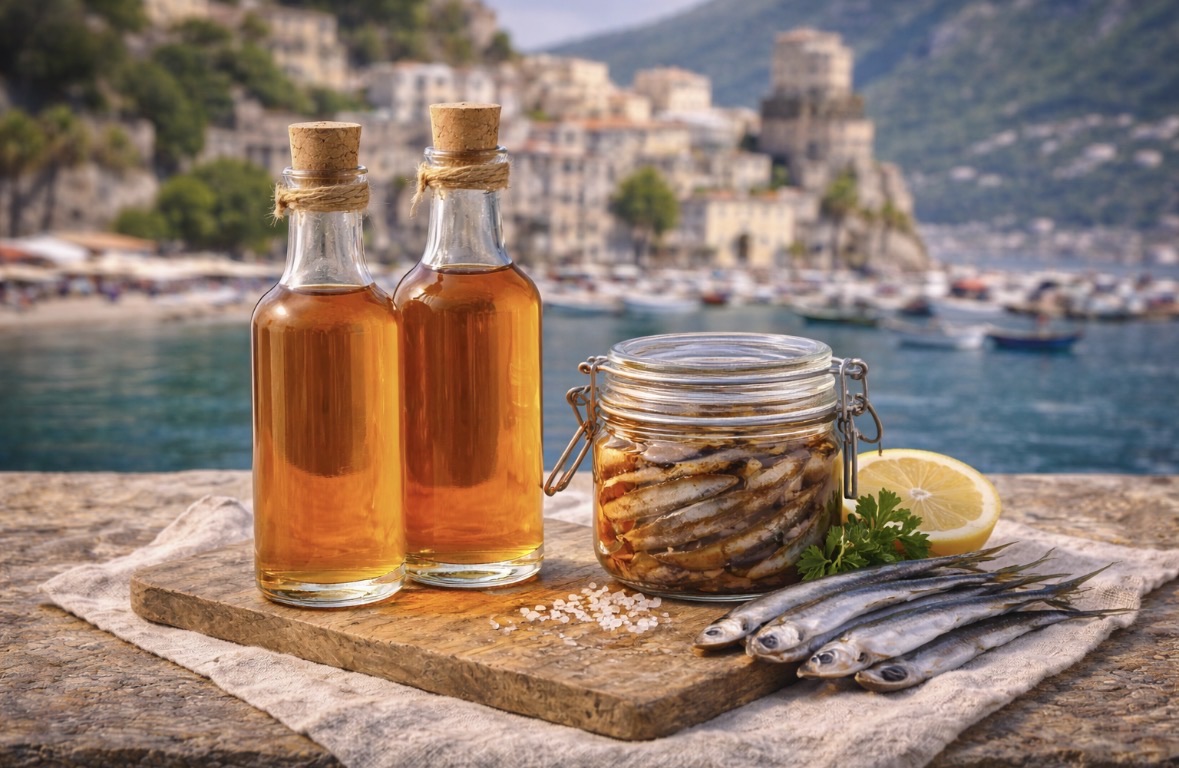
The anchovies are caught in the Gulf of Salerno, cleaned by hand and layered with sea salt in small wooden containers. The maturation lasts several months. The salt-cured anchovies become firm, rosy, and intensely savory. The colatura is a clear amber-colored liquid, extremely fragrant, slowly filtered and bottled in small glass vials. Just a few drops are used to season pasta, vegetables, fish, and bread.
Why it's special
Anchovies and colatura tell the story of the maritime culture of the Costiera. They symbolize a cuisine created to last, to provide nourishment during the winter months, and to waste none of the catch. They evoke nights at sea, nets pulled in by hand, and barrels guarded like household treasures. In these products lives the Neapolitan and Amalfitan idea that time is not the enemy of food: it is its most precious ingredient.
History
The processing of anchovies in Cetara has been documented since the Middle Ages and is tied to the fishing vocation of the village, one of the oldest maritime centers of the Costiera Amalfitana. The technique derives directly from the Roman garum, the fermented fish sauce used in antiquity. Over time, from the maturation of salt-cured anchovies comes colatura, the amber liquid that slowly filters from the barrels during the aging months. This family knowledge, passed down through generations, is recognized as a unique gastronomic heritage, and today colatura di alici di Cetara is protected as a Slow Food Presidio.
Price
€8-€40
Where to find it
Artisanal fish-preserve workshops Gastronomic shops in seaside villages Traditional markets of the Costiera
Discover Alici di Cetara / Colatura on Trouvenir →
More souvenirs not to miss
Napoli has much more to offer. Here are the other distinctive souvenirs catalogued by Trouvenir:
- Babà — 🍽️ Food Specialties · €5-€30
- Neapolitan coffee (blend, cuccumella, cups) — 🍽️ Food Specialties · €10-€60
- Limoncello del Golfo — 🍽️ Food Specialties · €10-€40
- Artisanal pasta from Gragnano — 🍽️ Food Specialties · €5-€25
- Pastiera napoletana — 🍽️ Food Specialties · €15-€507
- Pomodorini del Vesuvio (Piennolo, preserves) — 🍽️ Food Specialties · €8-€30
- Sfogliatella — 🍽️ Food Specialties · €5-€20
- Vino del Vesuvio (Lacrima Christi, etc.) — 🍽️ Food Specialties · €15-€40
How to recognise a typical souvenir in Napoli
Typical products from Napoli are found in artisan workshops, neighbourhood markets, and directly from producers — not in tourist shops in the city centre.
Practical rule
if a product has no indication of origin, producer, or production method, it's probably not what it seems.
Use Trouvenir to find certified workshops near you, with details on products, prices, and provenance.