Florence is one of Italy's destinations with the deepest artisanal and gastronomic traditions. Every product here reflects the area's history, craftsmanship, and culture — something you won't find elsewhere with the same character.
This guide collects distinctive souvenirs selected by the Trouvenir app for Florence: distinctive objects and specialties that truly capture the soul of the city, far from tourist stalls and mass-produced items. For each souvenir you'll find cultural context, price ranges, and where to buy with confidence.
1. Florentine Leather Craftsmanship
🏺 Craftsmanship
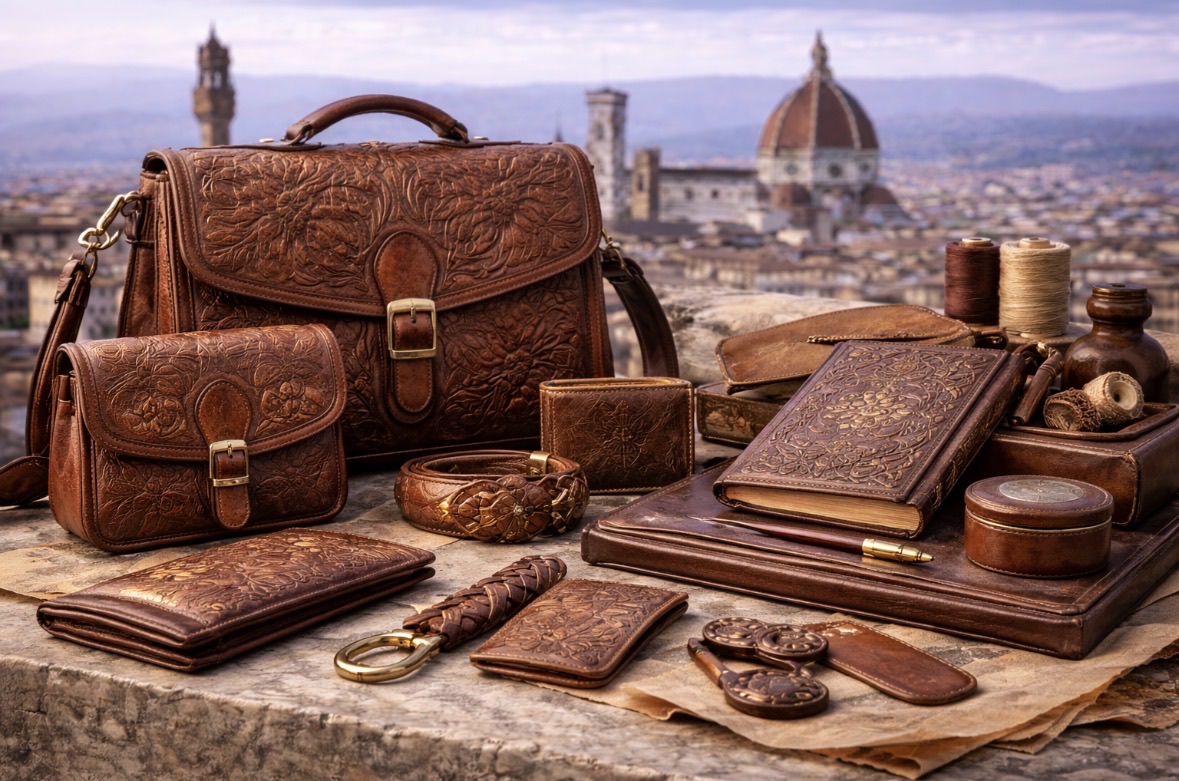
Leather work in Firenze is not simply leather goods: it is a centuries-old tradition of craft and design, where leather becomes form, function, and understated elegance. The objects are not only beautiful, but perfectly useful: bags, wallets, belts, document holders, notebooks bound in leather.
The crucial distinction from other Italian productions is this: here leather does not seek display, but structural integrity and aesthetic restraint. The Florentine style is clear, clean, without embellishment.
Typical objects:
- Classic leather work bags
- Two‑fold wallets
- Tailored belts
- Cases for pens or notebooks
- Document briefcases
Why it's special
In Firenze, leather is not fashion. It is applied gesture, continuity, craft.
This city—whose identity is shaped by balance and cultural discipline—reflects this vision even in leather: every cut, every stitch is intended to last, not to astonish. Here leather does not sing. It speaks quietly. It says: “I simply do my job well.”
In a culture that values measured form, leather becomes an expression of:
- Responsibility
- Durability
- Function before form
- Understated elegance
History
Leather working in Firenze is documented as early as the Middle Ages, with strong ties to the guilds (Arti) that regulated quality and technique. The Florentine tanning tradition is among the oldest in Europe and played a key role in shaping the relationship between workshop, raw material, and client.
Firenze was a center for:
- Small-scale urban tanneries
- Production workshops
- Apprenticeship schools connected to the Arti Minori
Florentine leather has evolved over time, yet it still retains features such as:
- respect for classical forms
- traditional tanning techniques
- high-quality raw materials
- attention to everyday function
It is the embodiment of a culture of skilled gesture.
Price
20–400 € a seconda dell’oggetto
Where to find it
📍 Ideal areas:
- Historic workshops in the center of Firenze: Via Tornabuoni, Via de’ Tornabuoni, and the small streets between Oltrarno and the historic center.
- Artisan studios frequented by locals and design students.
- Small workshops in neighborhoods such as Santo Spirito, Santa Croce, and San Frediano.
Often the workshop and the shop are the same place — meaning you can see hands at work, not only finished products.
Discover Florentine Leather Craftsmanship on Trouvenir →
2. Artigianato in pelle del quartiere Santa Croce
🏺 Craftsmanship
Nel quartiere di Santa Croce a Firenze si trovano botteghe e laboratori specializzati nella lavorazione artigianale della pelle. Qui si producono borse, portafogli, cinture, taccuini e piccoli accessori realizzati in cuoio conciato e lavorato a mano. Gli oggetti sono spesso caratterizzati da cuciture robuste, colori caldi e uno stile sobrio che richiama la tradizione artigiana toscana. Molti pezzi vengono rifiniti manualmente e possono includere iniziali impresse o piccoli dettagli personalizzati.
Why it's special
La lavorazione della pelle è una delle tradizioni manifatturiere più radicate di Firenze e della Toscana. Nei secoli la città è stata un importante centro di concia e commercio del cuoio, favorito dalla presenza dell’Arno e dalle corporazioni medievali degli artigiani. Ancora oggi il settore rappresenta un simbolo della continuità tra sapere manuale e produzione contemporanea. Le botteghe di Santa Croce incarnano questa eredità artigiana, dove tecniche tradizionali convivono con design moderni e produzioni di piccola scala.
History
La tradizione della lavorazione della pelle a Firenze risale almeno al Medioevo, quando le corporazioni artigiane regolavano il mestiere di conciatori e pelletteri. Le attività legate alla concia si svilupparono lungo il fiume Arno, dove l’acqua era essenziale per il processo produttivo. Dopo la Seconda guerra mondiale la Scuola del Cuoio di Santa Croce contribuì a rilanciare e tramandare il mestiere formando nuovi artigiani. Da allora il quartiere è diventato uno dei luoghi più riconoscibili della pelletteria fiorentina.
Price
€25–€400+ a seconda dell’oggetto
Where to find it
Le botteghe storiche e i negozi di pelle si concentrano intorno alla Basilica di Santa Croce e nelle strade circostanti, come via dei Benci e via San Giuseppe. In questa zona si trova anche la Scuola del Cuoio, fondata nel dopoguerra all’interno del complesso di Santa Croce, dove è possibile vedere gli artigiani al lavoro e acquistare direttamente in laboratorio. Altri negozi e piccoli atelier della zona vendono prodotti realizzati localmente o da laboratori toscani.
Discover Artigianato in pelle del quartiere Santa Croce on Trouvenir →
3. Cappello di paglia di Firenze
🏺 Craftsmanship
Il cappello di paglia di Firenze è un cappello intrecciato con sottili fili di paglia toscana, noto storicamente a livello internazionale come "Leghorn hat". Si distingue per la trama molto fine e compatta, ottenuta da varietà locali di grano coltivate appositamente per l’intreccio. La forma classica è ampia e leggera, pensata per proteggere dal sole durante l’estate. Ancora oggi alcuni artigiani e piccole botteghe mantengono viva questa tradizione manifatturiera legata alla campagna fiorentina.
Why it's special
Il cappello di paglia rappresenta una delle più importanti industrie artigianali che hanno collegato Firenze e il suo territorio rurale all’economia internazionale tra Settecento e Ottocento. Migliaia di persone, soprattutto donne delle campagne, lavoravano all’intreccio della paglia, creando una filiera diffusa tra campi e case. Questo oggetto racconta quindi non solo uno stile elegante associato alla moda europea, ma anche una storia di lavoro domestico e manifattura diffusa. Oggi è considerato un simbolo della tradizione artigiana toscana e della relazione storica tra città e campagna.
History
La produzione del cappello di paglia fiorentino si sviluppò in modo significativo tra XVIII e XIX secolo nelle campagne intorno a Firenze, in particolare nell’area di Signa. La paglia proveniva da una varietà di grano coltivata per ottenere fili lunghi, chiari e resistenti, ideali per l’intreccio. I cappelli venivano esportati attraverso il porto di Livorno, da cui deriva il nome internazionale "Leghorn hat" (Leghorn è il nome inglese di Livorno). Nel corso dell’Ottocento divennero un accessorio di moda molto richiesto in Europa e negli Stati Uniti.
Price
20–80 € circa, a seconda della qualità e della lavorazione
Where to find it
A Firenze si possono trovare cappelli di paglia in alcune botteghe artigiane del centro storico e nei negozi specializzati in prodotti toscani. Un luogo particolarmente legato alla tradizione è Signa, poco fuori città, dove ha sede il Museo del Cappello di Paglia e dove storicamente si concentrava la produzione. Durante l’estate è facile trovarli anche nei mercati e in negozi di accessori vicino alle principali aree turistiche.
Discover Cappello di paglia di Firenze on Trouvenir →
4. Florentine Marbled Paper
🏺 Craftsmanship
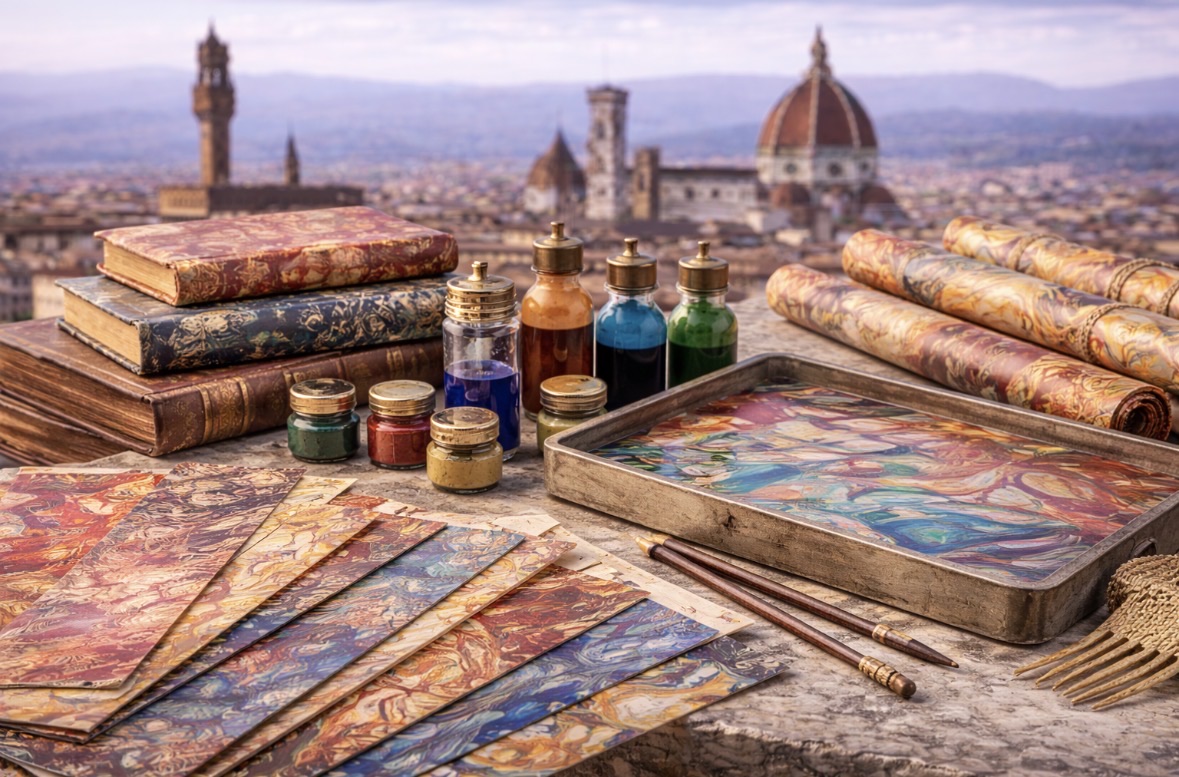
In Firenze, marbled paper is not decoration: it is visual order. It is an ancient technique that creates controlled movement, variation within structure, disciplined irregularity.
Unlike Venetian marbled paper (more fluid, aquatic, instinctive), the Florentine version is:
- more geometric
- more measured
- more restrained
The colors do not explode; they combine. The veins do not invade; they converse.
It is used for:
- bookbindings
- covers
- endpapers
- handcrafted notebooks
- frames
- small desk objects
Here, paper is not a background. It is visual structure.
Why it's special
In Firenze, marbled paper was not created to amaze. It was created to organize beauty.
It is a technique that perfectly reflects the Florentine mindset:
- movement exists, but within a rule
- variety exists, but within a structure
- creativity exists, but it is controlled
It is never chaotic. Never excessive. Never instinctive.
It is the visual translation of a culture of measure.
This is why it is so widely used in books: because in Firenze, a book is not just content. It is a mental form.
History
Paper marbling arrived in Europe from the East (the Turkish and Persian world) between the 16th and 17th centuries. In Firenze it found perfect ground because:
- there was already a strong tradition of:
- bookbinding
- scribes
- printers
- libraries
- the city was a center of:
- humanism
- scholarship
- archiving
Over time the technique was:
- refined
- made more geometric
- adapted to Florentine taste
It never became purely spectacular. It became functional to the structure of the book.
For centuries, Firenze was one of Europe’s major centers for the production and preservation of books, so marbled paper was never a hobby. It was a technical necessity.
Price
€5-€20
Where to find it
📍 Key areas in Firenze:
- Oltrarno (San Frediano, Santo Spirito) – paper and bookbinding workshops
- Santa Croce – historic area of the city’s paper crafts
- Centro storico – hidden artisan studios
Typical places:
- bookbinding workshops
- art paper studios
- book restoration laboratories
- artisans who work with libraries
These spaces are often very quiet, almost invisible to tourist flows.
Discover Florentine Marbled Paper on Trouvenir →
5. Commisso o 'pietre dure' fiorentine
🏺 Craftsmanship
Il commesso fiorentino è una raffinata tecnica di intarsio che utilizza sottili tessere di pietre semipreziose tagliate e accostate per formare immagini decorative. Diaspro, lapislazzuli, malachite, madreperla e molte altre pietre vengono sagomate con precisione per creare paesaggi, fiori, animali o motivi geometrici. A differenza del mosaico tradizionale, le tessere vengono tagliate seguendo esattamente i contorni del disegno, ottenendo superfici perfettamente lisce. Il risultato è un oggetto lucido e duraturo, spesso trasformato in gioielli, piccoli quadri, scatole o elementi decorativi.
Why it's special
Il commesso in pietre dure è uno dei simboli più raffinati dell’artigianato artistico fiorentino. La tecnica incarna l’incontro tra arte, scienza dei materiali e gusto rinascimentale per la perfezione tecnica e la bellezza naturale delle pietre. Per secoli è stato associato al prestigio delle corti europee e alla diplomazia culturale dei Medici, che regalavano questi manufatti come oggetti di lusso. Ancora oggi rappresenta una tradizione di altissima specializzazione artigianale e conservazione del sapere manuale.
History
La tecnica si sviluppò a Firenze nel XVI secolo sotto il patronato della famiglia Medici. Nel 1588 Ferdinando I de’ Medici fondò l’Opificio delle Pietre Dure per produrre arredi, tavoli e pannelli decorativi destinati ai palazzi granducali e alle corti europee. Gli artigiani selezionavano pietre provenienti da diverse parti del mondo e le tagliavano con seghe sottilissime per comporre immagini di straordinaria precisione. Nel tempo la produzione si estese anche a oggetti più piccoli e collezionabili, contribuendo alla diffusione della tecnica oltre i contesti aristocratici.
Price
€30–€1000+ a seconda delle dimensioni e delle pietre utilizzate
Where to find it
A Firenze si trovano esempi tipici nelle botteghe artigiane del centro storico e soprattutto nell’area dell’Oltrarno, dove sopravvive parte della tradizione manifatturiera cittadina. L’Opificio delle Pietre Dure, istituzione storica fondata dai Medici, ha un museo e talvolta una selezione di oggetti legati a questa tecnica. Alcuni negozi specializzati vicino a Ponte Vecchio e nelle vie attorno a Santa Croce vendono piccoli oggetti in pietre dure realizzati da artigiani locali.
Discover Commisso o 'pietre dure' fiorentine on Trouvenir →
6. Gioielli artigianali del Ponte Vecchio
🏺 Craftsmanship
I gioielli artigianali del Ponte Vecchio sono anelli, pendenti, bracciali e piccoli oggetti preziosi realizzati nelle storiche botteghe orafe che si affacciano sul celebre ponte di Firenze. Le vetrine mostrano lavorazioni in oro giallo, bianco e rosa, spesso accompagnate da pietre preziose o incisioni raffinate. Molti pezzi sono creati a mano secondo tecniche tradizionali tramandate da generazioni di orafi fiorentini. Anche quando il design è contemporaneo, la lavorazione mantiene un forte legame con la tradizione artigianale locale.
Why it's special
La lavorazione dell’oro è una delle arti storiche di Firenze e ha contribuito alla fama della città già nel Medioevo e nel Rinascimento. Il Ponte Vecchio è diventato nel tempo il luogo simbolico di questa tradizione, ospitando botteghe di orafi almeno dal XVI secolo. L’arte orafa fiorentina si distingue per la precisione tecnica, l’equilibrio delle forme e l’attenzione ai dettagli. Ancora oggi rappresenta un settore artigianale che unisce patrimonio artistico, economia locale e identità culturale della città.
History
In origine il Ponte Vecchio ospitava macellai e conciatori, attività comuni nei ponti medievali perché potevano scaricare i rifiuti direttamente nel fiume. Nel 1593 il granduca Ferdinando I de’ Medici ordinò che queste botteghe fossero sostituite da orafi e gioiellieri, considerati più decorosi per un luogo attraversato dal Corridoio Vasariano, utilizzato dalla famiglia Medici. Da quel momento il ponte si trasformò progressivamente in un centro della gioielleria fiorentina. Nei secoli successivi la presenza di botteghe orafe è rimasta una costante, consolidando la reputazione del luogo come cuore simbolico dell’arte orafa cittadina.
Price
€80 – €2000+ a seconda di materiale, pietre e lavorazione
Where to find it
Le botteghe orafe si trovano direttamente sul Ponte Vecchio, uno dei luoghi più iconici di Firenze, dove le vetrine si affacciano sull'Arno. Qui operano gioiellieri indipendenti e storiche famiglie di artigiani. Altri laboratori e negozi collegati alla stessa tradizione si trovano nelle vie circostanti, in particolare nel quartiere dell’Oltrarno e nelle strade attorno a via Por Santa Maria. Passeggiare tra queste botteghe permette spesso di osservare oggetti unici o piccole produzioni realizzate in laboratorio.
Discover Gioielli artigianali del Ponte Vecchio on Trouvenir →
7. Iris simbolo di Firenze (oggetti con giglio fiorentino)
🏺 Craftsmanship
Il giglio fiorentino è il celebre emblema rosso della città di Firenze, in realtà una stilizzazione dell’iris fiorentino. Compare su una grande varietà di oggetti: spille, gioielli, ceramiche, taccuini, tessuti stampati, calamite e piccoli oggetti decorativi. Il motivo è riconoscibile per i tre petali principali con stami stilizzati e una forma elegante e araldica. Anche nelle versioni più semplici, questo simbolo mantiene un forte legame visivo con la storia civica della città.
Why it's special
Il giglio è il simbolo civico di Firenze fin dal Medioevo ed è stato usato nello stemma della città e nelle insegne della Repubblica Fiorentina. Nel corso dei secoli è diventato un segno identitario fortissimo, associato alla vita politica, alle corporazioni e alle celebrazioni cittadine. Il simbolo compare ancora oggi sugli edifici pubblici, sulle fontane storiche e nelle decorazioni urbane. Anche la squadra di calcio cittadina, la Fiorentina, utilizza una versione del giglio nel proprio stemma, segno della continuità simbolica nella cultura locale.
History
Il simbolo deriva probabilmente dall’iris che cresce spontaneamente nelle campagne intorno a Firenze, in particolare sulle colline circostanti. Già nel XIII secolo il giglio era presente nello stemma della città, inizialmente con colori invertiti rispetto a quelli attuali. Dopo il conflitto tra guelfi e ghibellini nel 1251, il giglio rosso su fondo bianco divenne l’emblema ufficiale della Firenze guelfa. Nel tempo l’immagine si è stilizzata fino alla forma araldica oggi riconosciuta, diffondendosi su bandiere, monete, architetture e manufatti.
Price
5-80 € a seconda dell’oggetto (souvenir semplici, gioielli, ceramiche o articoli artigianali)
Where to find it
Oggetti con il giglio fiorentino si trovano facilmente nelle botteghe del centro storico, soprattutto nelle zone intorno al Duomo, Piazza della Signoria e Ponte Vecchio. Molti negozi di artigianato locale lo utilizzano come motivo decorativo su ceramiche, pelletteria e carta decorata. Versioni più curate compaiono anche nelle botteghe artigiane dell’Oltrarno, dove il simbolo viene reinterpretato su oggetti fatti a mano.
Discover Iris simbolo di Firenze (oggetti con giglio fiorentino) on Trouvenir →
8. Worked brass or bronze objects
🏺 Craftsmanship
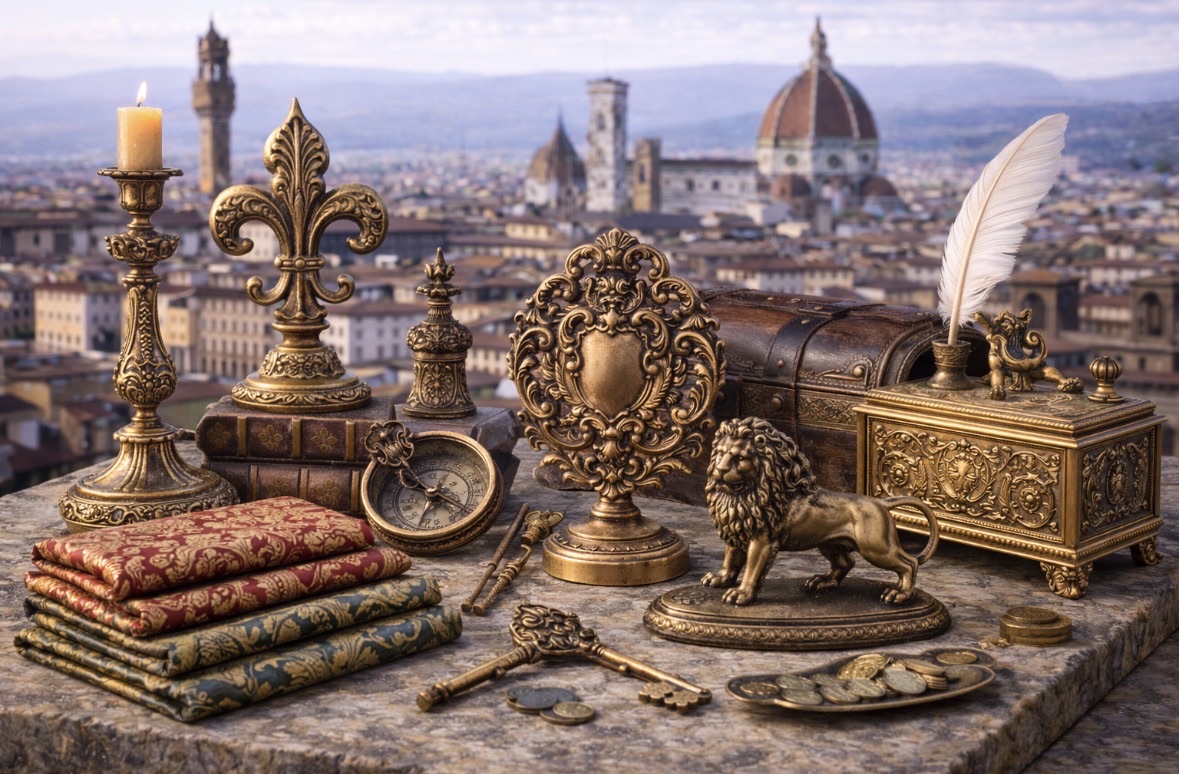
In Firenze, brass and bronze objects are not decoration. They are weight.
They are matter that stays. That supports. That stabilizes. Paperweights, handles, small desk pieces, furnishing details: nothing is light, nothing is fragile, nothing is superfluous.
Here, metal is not polished to shine. It is worked to last.
The surfaces are solid, compact, often matte. The volumes are simple, clean, functional. There is no search for virtuosity, no playfulness. There is measure and function.
These are objects that do not ask for attention. They ask to be used.
Why it's special
In Firenze, metal is not ornament. It is structure.
Brass and bronze are used to:
- hold
- support
- delimit
- define
In a city that built its identity on form, order, and discipline, metal becomes a physical boundary. It is what gives things weight, anchors them, and makes them stable.
A bronze paperweight is not just an object. It is an idea of the world: 👉 things should not fly away. 👉 things should stay.
This is deeply Florentine.
History
Firenze has always had a serious relationship with material. Not playful. Not decorative. Serious.
Bronze and brass entered Florentine life as materials of responsibility. They were used for doors, grilles, balustrades, structural elements, and objects in constant use. They had to resist. They had to hold. They had to last.
Here, metal has never been treated like jewelry. It has always been treated as a foundation.
The workshops of blacksmiths, founders, and metal beaters built a culture of the precise gesture, the measured strike, the controlled form. You cannot improvise with metal. You simply can’t. Metal does not forgive.
This trained generations of artisans to:
- think before striking
- measure before bending
- design before casting
In a city that already believed in form and discipline, metal found its home.
It never became excess. It remained function.
Even today, in small objects for desks and homes, this legacy can be felt: they are not light, not frivolous, not ironic. They are serious.
Like the city.
Price
€20-€300
Where to find it
📍 Key areas in Firenze:
- Oltrarno – metal workshops and artisan studios
- Santa Croce – historic crafts district
- Centro storico – small hidden workshops, often shared with carpenters or restorers
Typical places:
- artistic blacksmith workshops
- restoration studios
- artisans working for architecture, interiors, churches, and palazzi
These are not polished showrooms. They are working spaces.
Discover Worked brass or bronze objects on Trouvenir →
9. Objects Inspired by the Renaissance
🏺 Craftsmanship
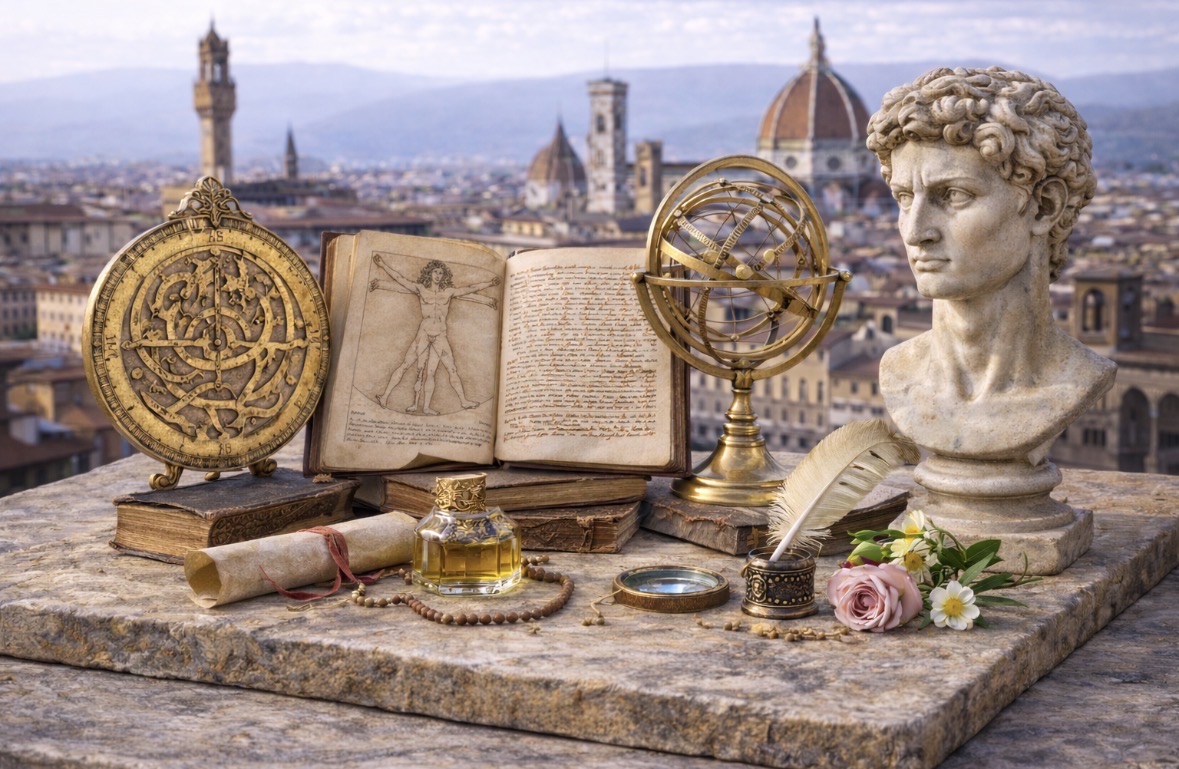
In Firenze, the Renaissance is not a style. It is a method.
Objects inspired by the Renaissance are not quotations, not reenactments, not nostalgia. They are applications of a grammar.
Clean lines. Symmetry. Proportion. Balance.
Whether it is a frame, a small relief, a desk element, or a decorative object, what matters is not the subject. It is the structure.
Here, the Renaissance is not imitated. It is continued.
Why it's special
In Firenze, the Renaissance is not a past era. It is a mental posture.
It is the idea that:
- the world can be measured
- form can be governed
- beauty can be constructed
Renaissance objects, even small ones, carry this logic within them: they do not seek emotion, they seek order.
They are objects that:
- do not disturb
- do not invade
- do not impose themselves
They simply remain. Like form.
History
The Renaissance in Firenze did not begin as a style. It began as a need for order.
In a city emerging from the Middle Ages—reorganizing thought, space, the body, and art—there was a need for a new grammar. No longer symbolic, no longer vertical, no longer mystical. Human.
Proportion. Measure. Relation.
This created a way of thinking that never truly stopped. Even as centuries changed, even as tastes evolved, Firenze continued to reason through structure.
That is why Renaissance-inspired objects here are not quotations. They are working inheritances.
A relief, a frame, a small decorative element does not repeat the past. It carries forward a method.
It is a city that has never stopped thinking in terms of form.
Price
€50-€400
Where to find it
📍 Key areas in Firenze:
- San Lorenzo / San Marco – historic area of artistic workshops
- Oltrarno – sculpture, plaster, and wood studios
- Centro storico – artisan ateliers
Typical places:
- sculptors’ workshops
- architectural decoration studios
- artisans who work on restoration, interiors, and installations
They are not souvenir shops. They are workshops of form.
Discover Objects Inspired by the Renaissance on Trouvenir →
10. Florentine Goldsmithing
🏺 Craftsmanship
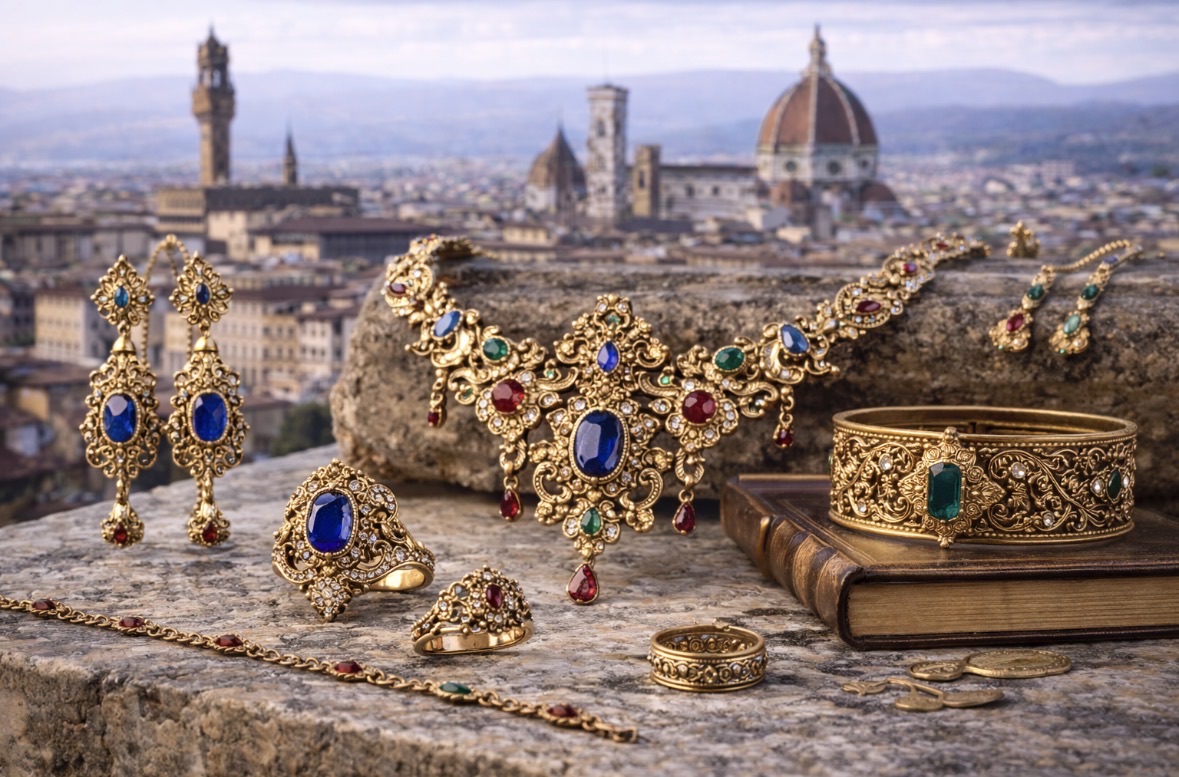
Goldsmithing in Firenze was not born to shine. It was born to measure.
Florentine jewelry is controlled, precise, structured. It does not chase effect, it dislikes excess, it does not play with theatricality. It is designed, drawn, constructed.
Here, gold is not display. It is disciplined material.
Rings, bracelets, necklaces, brooches, cameos, small objects in precious metal follow a clear logic: balance between form and function, between decoration and structure.
The Florentine signature is:
- clean
- measured
- proportioned
- never baroque
- never loud
Even when it is rich, it remains composed.
Why it's special
In Firenze, gold is not status. It is measure applied.
In a city that built its identity on form, proportion, and the discipline of gesture, goldsmithing becomes:
- an exercise in precision
- a training of the eye
- an education of the hand
The jewel is never “free.” It is always controlled.
It follows the same logic as the Rinascimento:
- the body is proportion
- architecture is balance
- the object is structure
Here even the precious obeys the rule.
History
Goldsmithing in Firenze did not arise from a desire for luxury. It arose from a need for measure.
In a city that long believed the world could be regulated, designed, controlled, even precious metal was treated as a material to be educated, not displayed.
As early as the Middle Ages, Firenze organized the work of gold within strict rules, guilds, and apprenticeships. One did not become a goldsmith through spontaneous talent, but through formation. One learned to inhabit the gesture before the material itself.
The hand was trained. The eye educated. Taste supervised.
When the Medici moved the goldsmiths’ workshops onto Ponte Vecchio, it was not an aesthetic gesture. It was political and cultural. They wanted order, decorum, control. They wanted commerce itself to be composed, production visible but not chaotic.
Gold, in Firenze, has always lived within a frame.
It has never exploded. It has never overflowed. It has never become excess.
This created a very precise style: elegant without being showy, rich without being loud, refined without being fragile.
Across the centuries, Florentine goldsmithing has never lost this line. Even as the world changed, as fashion shifted, as taste elsewhere became more theatrical, Firenze remained faithful to its sense of measure.
It did not invent. It refined.
It did not break. It continued.
That is why even today, stepping into a Florentine goldsmith’s workshop does not feel like entering a shop. It feels like entering a continuity.
A gesture that has never been interrupted. A hand that has not stopped. A form that has not been betrayed.
Price
€150-€2000
Where to find it
📍 Key area: Ponte Vecchio
Ponte Vecchio is historically the center of Florentine goldsmithing. It is not coincidence, not marketing: it is a medieval continuity.
Beyond the bridge:
- goldsmith workshops in Oltrarno
- ateliers in Santa Croce
- small artisans in the historic center
The real workshops:
- still work at the bench
- do repairs
- create custom pieces
- don’t rely only on window displays
Often the workshop is behind the counter.
Discover Florentine Goldsmithing on Trouvenir →
11. Porcellane Ginori (Doccia)
🏺 Craftsmanship
Le porcellane Ginori nascono nella storica manifattura di Doccia, vicino a Firenze, una delle più antiche fabbriche europee ancora legate alla tradizione della porcellana artistica. I pezzi spaziano da piatti e tazze da tè a piccole scatole, vassoi e oggetti decorativi, spesso caratterizzati da decorazioni eleganti, motivi floreali o geometrie classiche. La qualità della porcellana è molto fine e luminosa, frutto di tecniche produttive perfezionate nel corso dei secoli. Anche i pezzi contemporanei mantengono un equilibrio tra artigianato, design italiano e cultura della tavola.
Why it's special
La manifattura Ginori rappresenta uno dei capitoli più importanti della storia della porcellana europea e del gusto italiano per l’arte della tavola. Fin dal XVIII secolo le sue creazioni hanno unito influenze artistiche, scultura e decorazione, dialogando con la tradizione artistica fiorentina. Nel tempo il marchio ha collaborato con artisti e designer, contribuendo a definire un’estetica domestica elegante ma riconoscibilmente italiana. Le porcellane Ginori non sono solo oggetti funzionali, ma testimonianze di un sapere manifatturiero che lega arte, industria e cultura del vivere quotidiano.
History
La manifattura fu fondata nel 1737 dal marchese Carlo Ginori nella località di Doccia, oggi parte di Sesto Fiorentino. Ginori era affascinato dalle porcellane orientali e dalle nuove manifatture europee e volle creare una produzione italiana capace di competere con quelle di Meissen e Sèvres. Fin dall’inizio la fabbrica combinò sperimentazione tecnica e ispirazione artistica, realizzando sia servizi da tavola sia figure e sculture in porcellana. Nel XIX secolo l’azienda si unì alla famiglia Richard, dando origine alla storica denominazione Richard‑Ginori che ha reso il marchio famoso nel mondo.
Price
30–300+ € a seconda del pezzo
Where to find it
A Firenze è possibile trovare porcellane Ginori nelle boutique ufficiali del marchio, in negozi specializzati in articoli per la tavola e in alcune gioiellerie o concept store di fascia medio‑alta. Un luogo particolarmente significativo è il Museo Ginori a Sesto Fiorentino, poco fuori città, dove la manifattura storicamente ha sede e dove si comprende meglio la tradizione che sta dietro agli oggetti. Alcuni grandi magazzini e negozi di design fiorentini vendono anche collezioni contemporanee. Nei negozi del centro si trovano spesso pezzi singoli perfetti come souvenir.
Discover Porcellane Ginori (Doccia) on Trouvenir →
12. Herbal and officinal products
🏺 Craftsmanship

Florentine herbal and officinal products are not “items for the shelf.” They are traces of natural experience: a balance between plant matter, human knowledge, and daily care.
They are not generic cosmetics. They are not “fashion perfumes.” They are not fleeting souvenirs.
They are reflections of a body of knowledge that flows through folk medicine, herbalism, pharmaceutical craft, and the botanical traditions of Tuscany.
They appear as:
- handcrafted soaps
- lavender or Tuscan herb ointments
- hand and body balms
- essential oils
- regionally harvested dried herbal teas
- traditional herbal blends
They are products that gently touch the skin, rather than covering it.
Why it's special
In Firenze, the body, the mind, and plants are not separate. The herbalist’s shop is not a cosmetics store: it is a space of connection between living and feeling.
These products are not about aesthetics. They are about attention.
Care for the hands after work, deep breaths during the cold seasons, herbal infusions to slow down, ointments for tension. These are not superficial products—they are everyday gestures weaving together bodily experience and material wisdom.
They are the result of a culture that:
- does not separate nature and human practice
- does not divide body and environment
- does not place fashion above function
They are companions in life, not gadgets.
History
The herbal tradition of Firenze was not born from abstract alchemy, nor from a desire for spectacle. It emerged from the necessity of living within the sensory world.
Over the centuries, Firenze has been a crossroads of exchange:
- spices
- officinal plants
- extraction techniques
- botanical compounds
Florentine spezierie, which began as pharmacy workshops before becoming shops, were spaces of:
- practical research
- herb observation
- ingredient blending
- continuous experimentation
And this tradition moved through:
- monks who safeguarded medicinal plants
- merchants who brought spices from the East
- herbalists who combined folk knowledge with scientific techniques
There is no precise date, but there is a cultural logic: 👉 the human body is part of nature 👉 nature offers tools 👉 experience teaches how to use them 👉 tradition shapes the technique
It is a slow process, not an instant one. It is a process of care, not of effect.
Even today, in the workshops of Firenze, this line can still be felt: products are not made for immediacy. They are made to endure sensorially.
They do not create fleeting perfumes. They create bodily memories.
Price
€15-€90
Where to find it
📍 Key areas in Firenze:
- Centro storico, in multisensory shops and historic spezierie
- Oltrarno, in herbal workshops and small artisanal ateliers
- side streets of Santa Croce and San Frediano, shops dedicated to herbs and soaps
Typical places:
- renovated historic spezierie
- historic herbalist shops
- labs that produce on site
- artisanal natural cosmetics workshops
They are not supermarkets. They are spaces of care.
Discover Herbal and officinal products on Trouvenir →
More souvenirs not to miss
Florence has much more to offer. Here are the other distinctive souvenirs catalogued by Trouvenir:
- Florentine artisanal perfumes — 🏺 Craftsmanship · €60-€180
- Profumi di Officina Profumo-Farmaceutica di Santa Maria Novella — 🏺 Craftsmanship · €60-€150 circa a seconda della fragranza e del formato
- Florentine embroidery — 🏺 Craftsmanship · €40-€600
- Florentine artisanal bookbinding — 🏺 Craftsmanship · €30-€300+
- Artistic reproductions (prints, engravings, casts) — 🏺 Craftsmanship · €10-€150+ a seconda della tecnica e della dimensione
- Florentine silk — 🏺 Craftsmanship · €120-€1000 al metro
- Berlingozzo — 🍽️ Food Specialties · €6-€15
- Buristo fiorentino — 🍽️ Food Specialties · €10-€22
- Caciotta Toscana — 🍽️ Food Specialties · €10-€20
- Mugello cow's milk caciotte — 🍽️ Food Specialties · €12-€20
- Cantucci — 🍽️ Food Specialties · €6–€18 a confezione (300–500 g)
- Tuscan capocollo — 🍽️ Food Specialties · 20–35 € al kg
- Finocchiona IGP — 🍽️ Food Specialties · €12-€25
- Mugello Goat Cheeses — 🍽️ Food Specialties · €18-€32
- Frittelle di riso di San Giuseppe — 🍽️ Food Specialties · €1,50-€3,50
- Lardo — 🍽️ Food Specialties · €15-€30
- Marzolino Toscano — 🍽️ Food Specialties · €14-€26
- Tuscan extra virgin olive oil — 🍽️ Food Specialties · €12-€40
- Pane toscano (pane sciocco) — 🍽️ Food Specialties · €3-€8
- Pecorino delle Colline Fiorentine — 🍽️ Food Specialties · €14-€26
- Pecorino aged in walnut leaves / grape pomace / hay — 🍽️ Food Specialties · €20-€3
- Pecorino Toscano DOP — 🍽️ Food Specialties · €12-€35
- Prosciutto Toscano DOP — 🍽️ Food Specialties · €22-€28
- Raviggiolo dell’Appennino Tosco-Romagnolo — 🍽️ Food Specialties · €12-€22
- Ricotta (sheep’s and cow’s milk) — 🍽️ Food Specialties · €6-€12
- Rigatino — 🍽️ Food Specialties · €14-€22/kg
- Salame Toscano — 🍽️ Food Specialties · €12-€25
- Sbriciolona — 🍽️ Food Specialties · €10-€18
- Schiacciata all’olio — 🍽️ Food Specialties · €2–€5 al pezzo
- Schiacciata alla fiorentina — 🍽️ Food Specialties · €8-€15
- Schiacciata alla fiorentina (dolce) — 🍽️ Food Specialties · €8-€20
- Soprassata Toscana — 🍽️ Food Specialties · €12-€22
- Vin Santo — 🍽️ Food Specialties · €15-€60
- Chianti Wine — 🍽️ Food Specialties · €10-€50
- Zuccotto — 🍽️ Food Specialties · €5–8 a fetta; €20–35 per uno zuccotto intero artigianale
How to recognise a typical souvenir in Florence
Typical products from Florence are found in artisan workshops, neighbourhood markets, and directly from producers — not in tourist shops in the city centre.
Practical rule
if a product has no indication of origin, producer, or production method, it's probably not what it seems.
Use Trouvenir to find certified workshops near you, with details on products, prices, and provenance.